
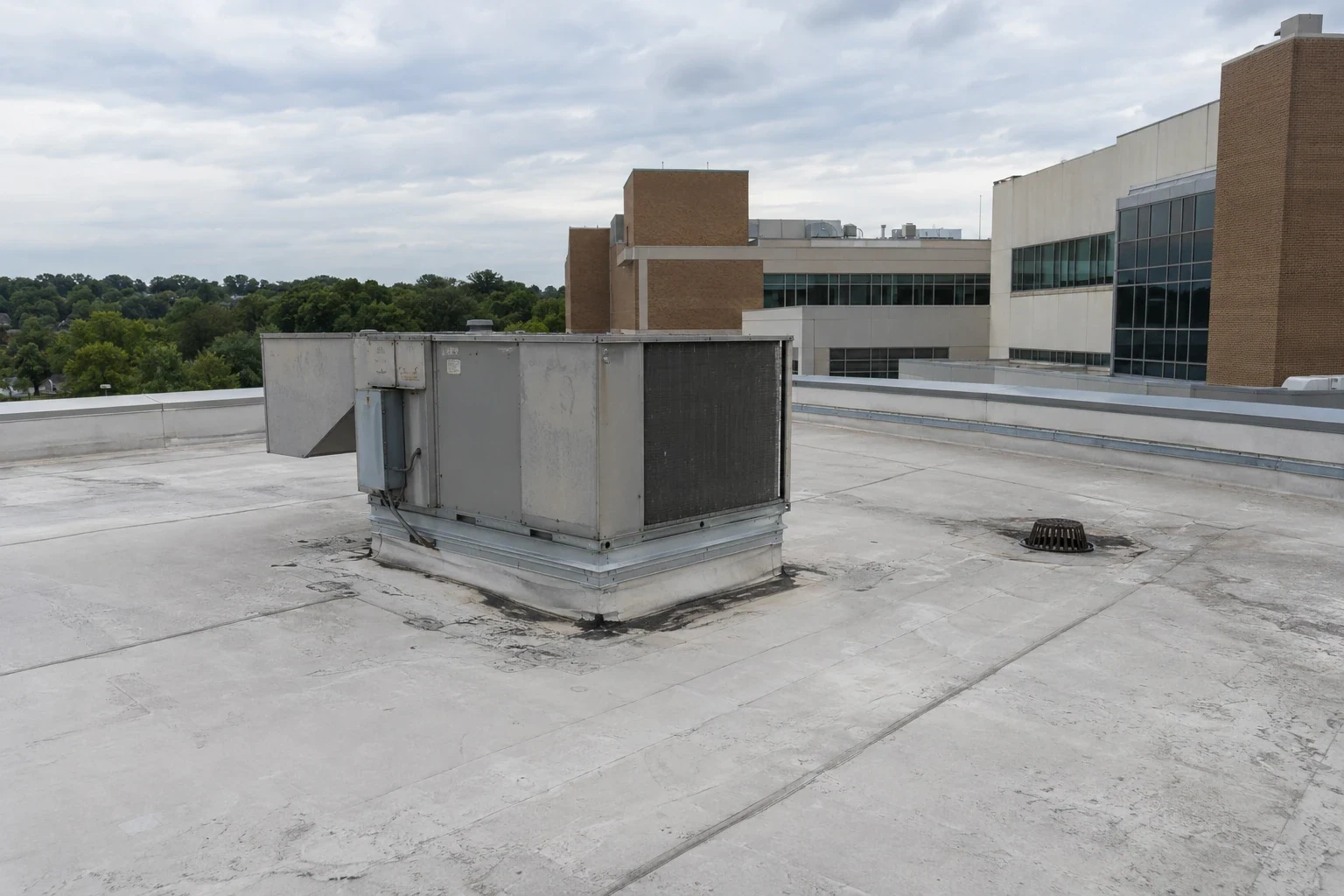
Hospital Roofing in Sherman, TX
Hospital and healthcare campus roofing in Sherman, TX: infection-control planning, layered moisture scans and phased repairs that keep patient areas dry.
A hospital roof is rarely one roof. It is a quilt of levels, wings and additions, each with its own deck, its own insulation and its own membrane. Each section expands and shrinks at its own rate. Where two sections meet, a joint takes the stress. In Sherman, TX that stress spans 113 F to -3 F, both on record.
Water that enters a hospital roof has a long way to go before anyone sees it. It soaks insulation, follows the deck and appears above a ceiling tile. By then the wet area can be much larger than the stain. We start by finding the true edge of the damage.
Map Every Wing and Roof Level
We begin with a drawing. Each roof level gets a number. Each section gets a note on membrane type, apparent age and drainage path. Joints between levels get a mark of their own, since they move the most.
Healthcare campuses add buildings over time. Additions often tie into the older roof with a flashing that nobody has looked at since the day it was installed. That tie-in is where we look first. A wall flashing that has lost its sealant lets water ride down the wall into the older ceiling.
The map also records what sits where. Air handlers, exhaust stacks, medical gas vents and generators each shape the repair. We plan around them, not through them.
Control Air, Dust and Noise First
Hospitals have rules for air. Roof work stirs dust and releases fumes, and both must stay away from patient areas. Before a crew mobilizes, we meet with the facility team to review infection control requirements for the project.
We locate every fresh-air intake and set staging far from them. Cold-applied and welded methods avoid open flame near oxygen systems and suppression lines. Where an intake must close for a short period, the facility team handles the shutdown and tells us the time.
Noise gets its own plan. Surgery suites, imaging rooms and nurseries need quiet. Tear-off and deck fastening wait until the rooms below allow it. A reroof on an occupied building depends on this kind of sequencing.
Mechanical-heavy buildings share these constraints. A data center roof faces the same questions about intakes and hot work, and the same answers apply.
Find Water in Layers
Water hides in the roof assembly. It may sit in a top layer of insulation and never reach the deck. It may travel under a coating without breaking it. A visual check sees none of this.
So we scan. An infrared moisture survey maps warm and cool patches at the right time of day. A capacitance meter confirms. Then we take core samples at the edges of each wet zone and at one sound area for comparison.
The cores tell us what lies under the surface. They show the number of layers, the type of insulation and how wet each layer is. A hospital that has been re-covered more than once may carry two or three old membranes. Each one traps water in its own way.
Sherman's roughly 79 days of rain, sleet and snow a year give a small flaw many chances to leak.
Plan Around Sherman's Storm Season
Tornadoes cluster in April and May across North Texas. Sherman's tornado of May 15, 1896 killed 73 people and ranks second on the regional list of deadliest storms. More recently, the June 8, 2025 storm spawned an EF1 southwest of Sherman and brought half-dollar hail reports from northwest of Denison.
Hospital roofs need a storm plan. Loose rooftop covers, torn flashing and displaced pavers can become projectiles. We recommend a spring walk-through to secure covers and clear drains. After a storm, we check edge metal, seams and curbs, then scan for hail bruises. The record supports a storm damage repair and any insurance claim.
Winter also loads these roofs. Ice in December 2013 accumulated 4 to 5 inches thick across Sherman and Denison. Frozen drains hold water against the membrane and add weight to the deck.
Pick Repairs That Limit Disruption
Not every leak needs a new roof. A seam welded or re-taped fixes a seam. A wet section of insulation cut out and replaced fixes a wet section. A failed flashing rebuilt fixes the flashing. We choose the smallest repair that addresses the cause.
When the system is near its end, a recover over dry insulation avoids tear-off. It cuts noise and dust. When insulation is wet, it must be removed. Wet board does not dry in place. We stage replacement in sections so the rest of the roof stays covered.
Welded sheets such as PVC resist many chemicals from exhaust, which suits hospital rooftops. TPO offers a reflective surface at a different price point. Each has tradeoffs, and we state them before the owner chooses.
Reach the Hospitals Around Sherman and Denison
Carrus Hospital employs 650 people, and Sherman Medical Center and Heritage Park Surgical Hospital are the other two. Denison adds Texoma Medical Center. A hospital campus, wherever it sits, has its own mix of wings, additions and mechanical yards, so each needs its own map.
Healthcare owners with several sites can combine them in one program. A Sherman hospital, a clinic in Denison and a medical office in a smaller town can share one record and one ranking.
Access shapes the schedule. US 75 and US 82 cross in Sherman, and Denison lies about 11 miles north on US 75. Material trucks, cranes and hoists need a staging route that leaves ambulance and visitor lanes clear. We agree on that route with campus security before delivery day, and we keep it open through every phase.
Hand Over Records Facilities Can Use
The facilities team needs a file it can use, not a brochure. We deliver the roof map, scan images, core results, repair photos and a list of open items. Each finding ties to a spot on the plan. The next survey can then be set beside this one.
Permit rules matter too. We confirm what the permit office requires before pricing a replacement, and the permit and inspection records join the file. Photographs of concealed layers are taken before they are covered, so the file shows what sits under the finished surface, wing by wing, for the next team that has to open the roof.
Commercial Roofing Questions
How is dust kept out of patient areas during roof work?
Through planning before the first day. We map the intakes, set staging away from them and use welded or cold-applied methods. The facility team decides when an intake closes.
Can a hospital roof be repaired without a full replacement?
Often, yes, when the insulation is dry and the membrane is sound. A scan and cores show the answer. We repair the failed part and leave the rest.
What makes a campus roof harder to read than a single building?
Additions. Each wing may have a different membrane, insulation and drain path. Their joints move more than the field. We map each section before we judge any of them.
Do we need a storm checklist for the roof?
Yes. Secure covers, clear drains and walk the edges before spring. Tornado and hail season runs April and May in North Texas, and a short walk-through costs far less than a flooded corridor.
What records should facilities keep after a repair?
The roof map, scan images, core results, dated photographs and a list of open items. Together they let the next survey compare like with like.
Send the Campus Plan and Leak History
Send the building address, a plan of the wings and any past leak history. We will walk the roof with your facility team and explain what the readings show.
Related Roofing Work
Occupied Building Reroofing
Reroofing Sherman, TX hospitals, schools, plants and offices while they stay open, with sectioned tear-off, dust and noise control and daily closure.
Data Center Roofing
Data center roofing in Sherman, TX: moisture scans, welded seams and flame-free repairs for roofs crowded with cooling plant, planned around change windows.
Infrared Moisture Survey
Infrared and core-cut moisture surveys for commercial roofs in Sherman, TX, mapping wet insulation so repair and replacement dollars go where water sits.
Storm Damage Roof Repair
Commercial storm damage assessment and repair in Sherman, TX: wind uplift, hail bruises and debris impact found, documented, dried out and rebuilt in order.