
Commercial Roof Inspection in Sherman, TX
Hands-on commercial roof inspections in Sherman, TX, with photographed findings, moisture checks and a ranked list of repairs and budget timing for owners.
An inspection turns a roof from a guess into a set of readings. We walk the surface, probe the seams, check every flashing and measure how water leaves the building. In Sherman, TX that work has a seasonal rhythm. Spring brings hail and wind, summer brings heat that has reached 113 F, and winter brings freezes that have gone as low as -3 F. Each season loads the assembly in a different way, so each leaves a different set of marks. A careful inspection reads those marks, ties them to a cause and puts a price and a time on every item the roof needs.
The result is a document an owner can plan a budget around, hand to a lender or give to an insurer.
Walking the Roof Surface Seam by Seam
The walk starts at the access point and covers the whole roof in a pattern, not by wandering. We look at the field membrane for blisters, splits, ridging and chalking. We probe seams with a blunt tool and note any weld that lifts. We check the surface for ponded water and for debris near drains. At each penetration we look at the flashing, the sealant and the fasteners. Edge metal is checked for loose cleats and open joints. We photograph every finding with a marker showing its place on a roof plan, so the report can be read by someone who was never on the roof.
The walk includes the roof edge and the parapets, where many failures begin. We check coping joints, sealant lines and the height of base flashings against the roof surface. We also look at what is on the roof that does not belong: abandoned equipment, old cables running across the membrane and traffic paths that show wear where service crews walk to rooftop units. Wear at those paths often calls for walkway pads, which cost little compared with the membrane they protect.
Checking for Water You Cannot See
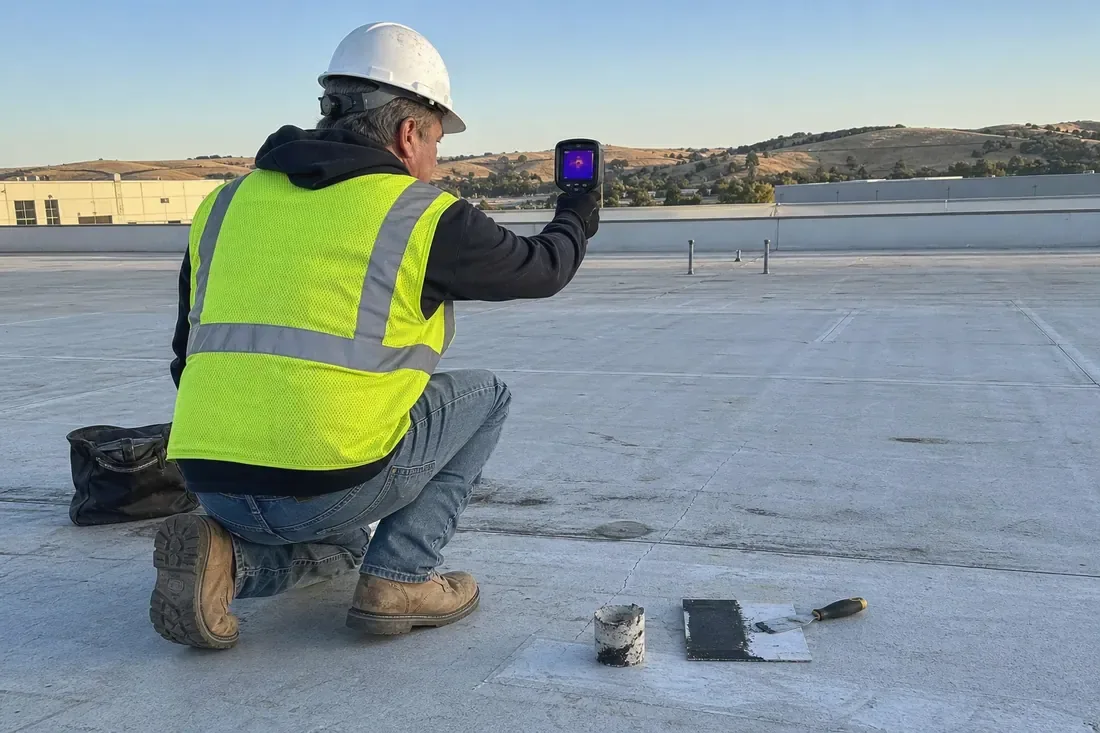
The surface can look fine while the insulation below is wet. A handheld meter finds moisture at suspect spots, and an infrared scan shows broader patterns after sunset. When the readings raise a concern, a core cut confirms what is inside the assembly. For a full building survey, a dedicated infrared moisture survey maps the whole roof. For a drone flyover of a large or steep roof, we can add drone imaging to cover areas that are unsafe to walk. Wet insulation is the finding that most often changes a repair plan into a replacement plan, so we take care to document its extent and its likely source.
Interior signs add to the picture. Stained ceiling tiles, damp insulation at the deck and rust at fastener heads all tell us where water has been, and they guide where we place cores.
Reading the Marks Hail and Wind Leave
A roof that has been through the spring storm season carries evidence. Half-dollar-size hail was reported northwest of Denison on June 8, 2025, and an EF1 tornado touched down southwest of Sherman the same day. In April 2014, dime-size hail was reported north of Sadler. On a membrane, hail leaves dents, bruises and cracked scrim. On metal, it leaves dimples and dented ribs. Wind leaves lifted edges, torn flashings and displaced gravel. We map these marks, note their density and say whether the damage looks new or old. If the roof has a possible hail claim, the inspection record supports the adjuster's review.
We also check the underside when it is reachable. From inside, a view of the deck shows rust at fasteners, stained insulation edges and daylight at penetrations that should be sealed. That view fills in what the roof surface cannot tell us.
Following Water Off the Roof
Drainage decides how long a membrane lasts. We look at slope, drain locations, strainers, scuppers and overflow openings. We measure ponding depth after a rain when we can, and we check whether standing water is on the roof because of a sagging deck, a blocked drain or a design that never sloped well. In winter, drains that freeze or clog turn a flat roof into a basin. Nine to eleven inches of snow fell on some Grayson County locations in January 2025, and a roof that cannot shed meltwater faces that load and the freeze afterward. Our report ranks drainage items by urgency, since a clogged drain is cheap to clear and expensive to ignore.
Checking Rooftop Units, Curbs and Supports
Rooftop equipment concentrates risk. Every unit sits on a curb or a rail, and every connecting line crosses the membrane. We check curb flashing height, sealant condition at corners and the way condensate drains away from the unit. Refrigerant lines and conduit that rest on the membrane without supports wear a path through it over time. Where the equipment is heavy, we look for ponding around curbs and for signs the deck has deflected under the load. These findings feed directly into the repair list and, where curbs need rebuilding, into the planning for curbs and supports.
Reading the Written Report
The report puts findings in order. It starts with a summary: the roof system, its approximate age, its condition and the main concerns. Then each finding appears with a photo, a location, a cause and a recommended action. Actions are ranked as urgent, planned for this year or watch for next year. Costs are given as ranges where a decision is needed, and as firm line items for priority repairs. Owners can use the report to plan capital spending, to request bids or to negotiate during a sale. When the findings call for a longer program, we outline a maintenance schedule with seasonal visits.
Putting Inspections to Work Across Property Types
Different buildings call for different inspections. A school or college campus needs a roof-by-roof ranking so the budget goes to the worst first. A manufacturing plant or distribution building in Progress Park may want an inspection timed to a planned shutdown. A medical or hospital owner cares most about the roofs over sensitive spaces. A buyer in Sherman or Denison may need a pre-purchase survey before closing. We adjust the report to the question the owner is trying to answer, so the findings fit the decision.
Commercial Roofing Questions
What should I get from an inspection besides a list of problems?
Photos tied to a roof plan, a condition rating for the system, a cause for each finding and a ranked list of actions with timing. A report without cause and ranking leaves the owner to guess which item matters first.
Do you need roof access ahead of time?
We need to know how to reach the roof, whether by hatch, ladder or lift. Send the location of access and any safety rules for the property. If the roof has tie-off points or restricted hours, include that too so the visit goes smoothly.
Can an inspection support a lender or buyer?
Yes. A condition report with photos and a cost range gives a lender or buyer facts to price the roof into the deal.
When is the best time of year to inspect?
After spring storms and before winter. The first shows what hail and wind did, and the second gives time to fix drains and seams before the freeze.
Will the inspection find hidden wet insulation?
Meter checks and an infrared scan find it in most cases. Core cuts confirm the result before a plan depends on it. The method is chosen to fit the roof type, since some insulations and membranes read differently under a scan.
Schedule a Walk of Your Roof
Send the building address and the access details. We will inspect the roof, photograph what we find and give you a ranked list of what to fix and when.
Related Roofing Work
Infrared Moisture Survey
Infrared and core-cut moisture surveys for commercial roofs in Sherman, TX, mapping wet insulation so repair and replacement dollars go where water sits.
Drone Roof Inspection
Drone roof inspections for large and hard-to-reach commercial buildings in Sherman, TX, with high-resolution imagery, thermal capture and a mapped report.
Hail Damage Roof Repair
Hail damage roof repair in Sherman, TX: find bruises, fractured membranes and dented metal with moisture scans and core samples, then repair and document.
Rooftop Equipment Curbs and Supports
Rooftop unit curbs, equipment rails and pipe supports for Sherman, TX commercial roofs: load paths, curb flashing, vibration, walkway wear and timing.