
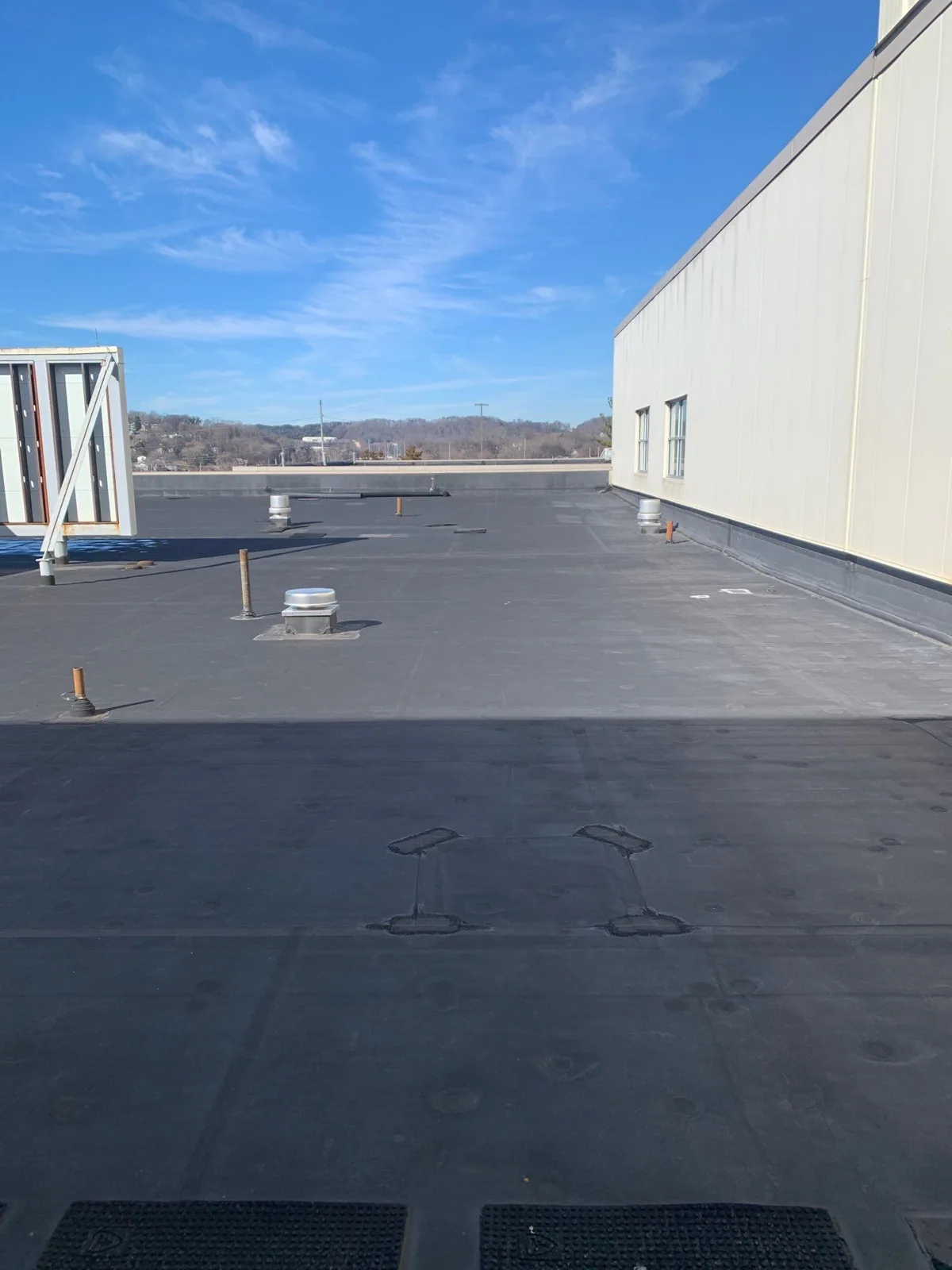
Commercial Roof Leak Repair in Sherman, TX
Tracing and stopping active commercial roof leaks in Sherman, TX with moisture mapping, water testing and repairs matched to the real entry point.
Water on a ceiling tile has already traveled. It entered somewhere upslope, ran along a deck flute or a layer of insulation, and dropped at the first gap it found. Our job is to follow that path backward until we reach the opening. In Sherman, TX the paths change with the season. Summer heat opens laps and shrinks flashings. A freeze closes them and then forces water into the smallest crack. A leak call here is a mechanism problem, and we treat it like one: gather evidence, name the cause, then build the repair to match.
Following the Water Back to Its Source
We begin inside. The stain pattern, the location of lights and ducts and the date of the first drip all narrow the search. Then we go up and walk the roof against that map. Penetrations come first: pipe boots, vent stacks, curb corners and drain bodies cause more leaks than open field membrane. Next come seams, wall terminations and the edge metal. A blunt probe along each seam finds welds that have let go. Where two causes look possible, a controlled water test settles it. One person runs a hose on a small area while another watches the interior, and we move upslope a few feet at a time until the drip shows.
The scan is not a guess at a leak. It is a drawing of where water sits, and it lets us price the repair by area. We mark the boundary on the roof with paint, photograph it and carry the same drawing into the proposal.
Mapping Wet Insulation With a Scan
A leak that has run for months leaves a wet area bigger than the visible stain. Moisture in insulation holds heat differently from dry material, and an infrared scan after sunset shows the boundary. We then confirm the boundary with a core cut or a meter reading. The map tells us how much roof to open. A small wet patch around a boot calls for a section cut and a new flashing. A large area calls for a wider repair, or for a talk about a full moisture survey before further money goes into patches. Wet insulation left in place corrodes deck fasteners and keeps feeding water back into the room below.
Before any cutting, we set the roof up for the repair. Walkway pads protect the finished membrane, debris is bagged, and tools stay off the open surface. Small details like these keep a leak repair from creating a second leak.
Matching the Fix to the Cause
Each cause has its own repair. A split seam gets cleaned, welded or taped and then probed. A failed pipe boot gets replaced with a new one set in sealant and clamped. A cracked curb flashing is cut back to sound material and rebuilt to full height. A drain with a poor seal at the clamping ring is reset with new gaskets. Ponding that feeds a leak calls for correction of the low area, not only a patch. For puncture damage, the membrane puncture repair path covers cut-out and patch methods. We do not use roof cement as a cure-all, since it cracks in the first hot season and hides the real opening for the next crew.
Reading Seams, Curbs and Drains for Repeat Leaks
Buildings with many penetrations leak more often, because each penetration is a joint between two materials that move at different rates. A curb for a rooftop unit expands with the unit and the sun. A pipe through the deck sees pipe movement, and a drain body settles with the deck. When the same building leaks twice at similar spots, the detail itself is the problem. We note the pattern and propose a rebuilt detail instead of another patch. On a school, a medical office or a plant with a full line of rooftop equipment, that approach turns a string of service calls into one planned repair and reduces calls through the year.
Leaks That Follow Storms and Freezes
Some leaks appear within a week of a storm. On June 8, 2025 half-dollar-size hail fell northwest of Denison, and in 2014 dime-size hail was reported north of Sadler. Hail bruises the membrane and cracks the reinforcement, and the water arrives later. Other leaks arrive with the cold. In December 2013 a sleet storm froze about four to five inches of ice onto the Sherman and Denison area, and ice in a clogged drain pushes water back across the roof. After a storm or a freeze, we inspect drains, edges and flashings first, then scan the field for impact marks. A leak from hail damage may belong in an insurance file, so we keep photos and notes.
Protecting What Sits Under the Leak
Until the roof is fixed, the building needs protection. We can help the facility team route water into buckets, cover shelving, move inventory and keep power off wet light fixtures. In a hospital, a school or a plant, the priorities differ. A leak above a surgical or clean-room area needs immediate containment and a quick temporary dry-in. A leak over a warehouse aisle can wait for the correct repair if the area is protected. We also note which ceilings, walls and insulation have been wetted, since interior moisture left alone can lead to mold. Where a leak is active during a storm, emergency roof repair brings a crew and tarps to close the opening the same day.
Checking That the Repair Held
A repair is not finished when the crew leaves. We return after the next significant rain, or we water test the repaired area before we pack up. We compare the interior to the stain map and confirm that no new drip has appeared. If the building has other aged details, such as the same style of pipe boots across the roof, we point them out before they start leaking too. Owners in Sherman and Denison can combine a leak call with a roof inspection, which turns one problem into a priced list of everything the roof needs in the next year or two.
Commercial Roofing Questions
Why does the leak show up far from the damaged spot?
Water follows the deck, the insulation or a pipe run until it finds a gap. A drip over one aisle can start thirty feet away at a curb corner. Interior stains alone rarely point to the exact source, so the roof walk matters.
Can a leak be fixed while it is raining?
A temporary dry-in can. Welds, tapes and adhesives need a dry, clean surface, so the permanent repair waits for clear weather unless a patch material rated for wet application fits the spot. Until then, the temporary measure keeps water out of the building and protects whatever sits below.
What if there are several leaks at once?
Several leaks usually share a cause, such as aged flashings or a wet insulation zone. A scan shows whether to repair each one or treat the whole area. Treating the shared cause once costs less than answering each drip separately.
Will insurance pay for a roof leak?
Coverage depends on the cause. Sudden storm damage is treated differently from wear. We document the findings with photos and dates so the claim can be judged on facts. A date-stamped record also helps when a storm adds new damage to an older condition.
How soon should I call after a ceiling stain appears?
Call as soon as the stain is noticed. Early tracing is cheaper, and the wet area stays smaller. Waiting lets insulation soak and fasteners rust.
Tell Us Where the Water Shows
Send the address and photos of the stains with the date each one appeared. We will trace the path, find the opening and stop it.
Related Roofing Work
Infrared Moisture Survey
Infrared and core-cut moisture surveys for commercial roofs in Sherman, TX, mapping wet insulation so repair and replacement dollars go where water sits.
Membrane Puncture Repair
Membrane puncture repair in Sherman, TX: find cuts, tears and impact bruises from foot traffic and debris, check the insulation below and patch to match.
Hail Damage Roof Repair
Hail damage roof repair in Sherman, TX: find bruises, fractured membranes and dented metal with moisture scans and core samples, then repair and document.
Emergency Roof Repair
Round-the-clock emergency roof repair in Sherman, TX: tarping, dry-in and temporary fixes after storms, with full documentation for your insurance claim.