
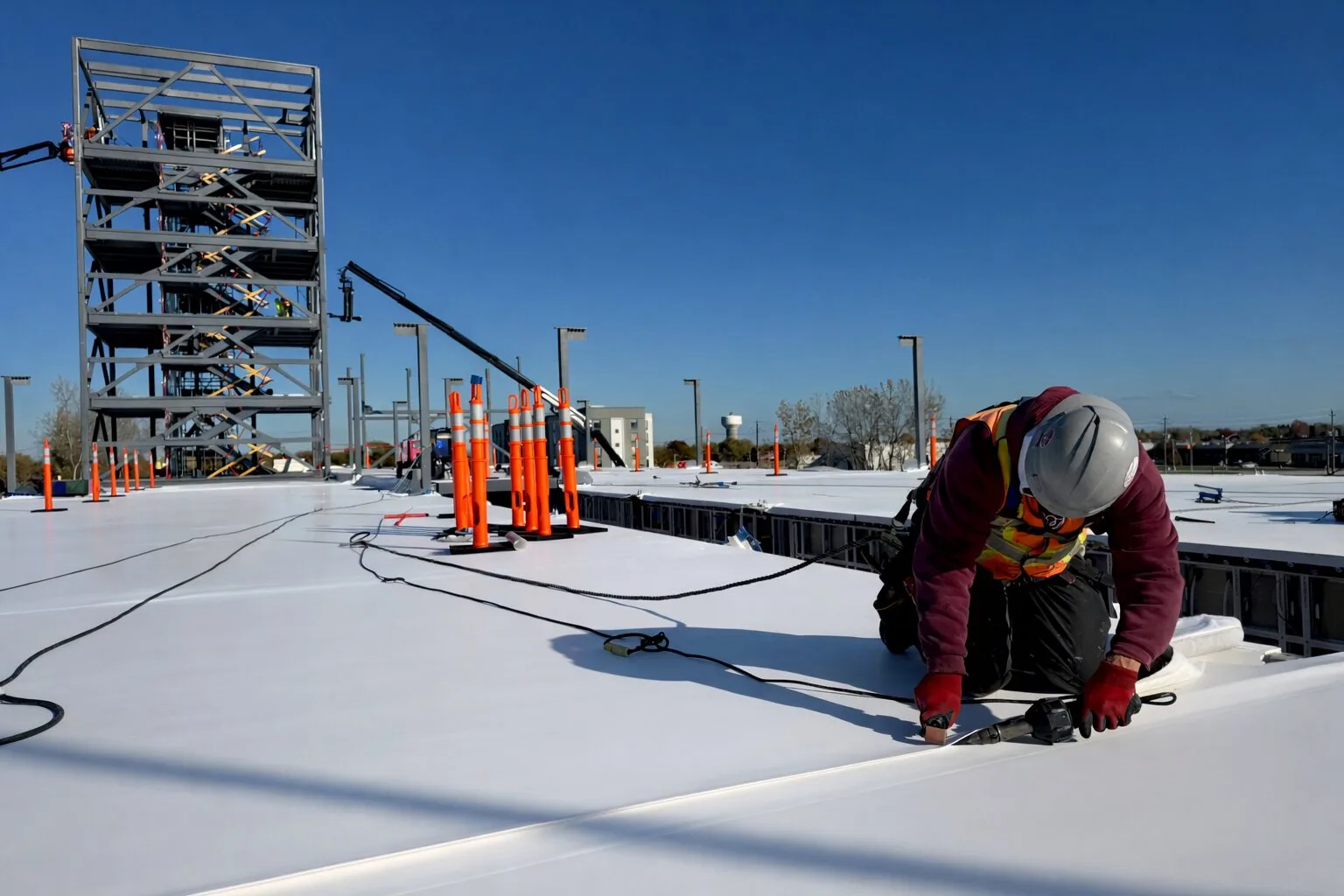
TPO Roofing in Sherman, TX
TPO single-ply roofing in Sherman, TX: how the welded membrane moves, where it fails, how we test seams, and how repairs and replacements are built.
A TPO sheet is white, flat and quiet. Underneath, it is working. Sunlight heats it, night cools it, and the sheet grows and shrinks with every swing. Sherman, TX has recorded 113 F and -3 F, a spread of 116 degrees. Each degree moves the sheet a little. The movement collects at seams, at wall flashings and at the plates that hold the sheet to the deck. Good TPO roofs are built to tolerate that movement. Failed ones show it first at the welds.
Owners rarely see any of this. The roof looks the same for years. Then a tenant calls about a stain. By then the water has been moving under the sheet for months. A routine probe finds the problem earlier and costs far less.
This is how we read a TPO roof. We start with the mechanism. Then we test. Then we match the repair to what we find.
Know What TPO Is Made Of
TPO stands for thermoplastic polyolefin. It is a sheet of plastic and rubber blended together. It melts when heated and sets when cooled. That is why it can be welded. Crews pass a hot-air tool along each lap. The two sheets fuse into one. A good weld is stronger than the sheet around it.
Fasteners and plates hold the sheet down at the seams. Some systems are fully adhered instead. Adhered sheets rely on a bond to the substrate across the whole field. Each method has its own weak points. Mechanically attached sheets can flutter in wind. Adhered sheets can blister where the bond fails. We note the method on the sketch before we plan a repair.
The sheet is usually white. White reflects sunlight and keeps the roof surface cooler. A cooler surface reduces heat cycling. Less cycling means less strain at the seams. The effect is real but modest, and it fades as dust and algae darken the sheet, which is why cleaning is part of upkeep. Thickness varies. Thicker sheets resist punctures and wear better. Reinforcement inside the sheet, a polyester scrim, resists tearing.
Watch for How TPO Fails
Most TPO failures begin at a seam. A weld that never fused leaves a channel. Water finds it. A weld made over dirt can peel. A weld made too cool can look fine and still be weak. Heat cycling then pulls on the weak spot until it opens. The result is a seam that peels back a quarter inch, then an inch.
Flashings fail next. The sheet turns up a wall or a curb. Thermal movement pulls it away from the termination. Sealant dries. A gap opens. Fasteners can back out of the deck and push a bump up through the sheet. Ponding speeds all of it. Standing water holds dirt, grows algae and stresses welds.
Foot traffic adds wear. Technicians walk the same path to the same units. The sheet thins along that path. Walk pads protect it. Chemicals also matter. Oils from kitchen exhaust soften some sheets. Different systems resist different chemicals, and the choice of sheet should match the exposure.
Begin With a Probe and a Moisture Scan
We walk the roof and draw a dull probe along every seam. A fused weld resists. An open weld lets the probe slide. We mark each open stretch with paint and a number. We photograph it. Then we scan for moisture. Infrared and a meter show where insulation has absorbed water. We confirm with core samples. A core is a small plug cut through the roof. It shows each layer and whether the insulation is wet.
The scan and the cores answer the main question. A roof that has not leaked can still hold a wet layer, and cores are the only way to see it. Cutting them is quick, and the repair patch is welded and probed the same day. Is the damage local or widespread? A local gap gets a repair. Wet insulation across a field gets a section replaced. The record goes to the owner with photographs.
We also look at the deck. Rust, loose fasteners and sags show up in cores and from below. A weak deck can fail long before the membrane does. The repair plan names deck work as its own line. The owner sees its cost and its reason.
Account for Hail and Wind
Sherman sits in North Texas, where April and May are the peak tornado months. On June 8, 2025, an EF1 tornado touched down southwest of Sherman, while hail the size of a half dollar was reported northwest of Denison. Hail leaves impact bruises. A bruise is a crushed spot in the sheet and insulation. It may not leak at first. It becomes a weak point. We press suspect spots and look for soft insulation below.
Wind pulls at edges first. A TPO roof depends on its perimeter attachment. We check edge metal, fastener plates and termination bars. A few fasteners get pulled as a test, and a weak result changes the plan for repair or replacement.
Ice and snow add load in winter. Sleet and freezing rain in December 2013 loaded roofs across Sherman and Denison with 4 to 5 inches of ice. Snow in January 2025 reached 9 to 11 inches at isolated points in Grayson and Cooke counties. Water frozen in a drain or on a seam can lift a weld. Snow load stresses the deck. After either event, we check drains and low spots first.
Build the Repair Step by Step
A repair starts with cleaning. Dust and oils prevent a weld. Then a trial weld on scrap shows the settings. The crew welds a patch over the open stretch. Rounded corners resist lifting. The weld is probed after it cools. The result goes in the record, with the date and the crew lead's initials. For larger damage the crew cuts out the section, dries or replaces the insulation and welds in new sheet.
Where a roof has many repairs, a coating or a replacement may cost less per year of life than another patch. We price each option. A coating can seal minor wear if the sheet is sound. A replacement resets the clock. A recover can add a new sheet over a dry roof. Price follows area, penetrations, insulation replaced and access.
See Where TPO Fits in Sherman
TPO suits the large, flat roofs common on industrial buildings. Progress Park has food and metals plants with rail access. In Denison, Foundation Business Park draws manufacturing and distribution users, and logistics buildings sit near US 75. A warehouse roof often has long runs and few penetrations. TPO handles that well, and the crew can weld long laps quickly with an automatic machine. Roofs with many curbs and grease exposure may call for PVC instead, and older asphalt roofs may suit modified bitumen. A roof near Progress Park or in Sherman gets the same test regardless of system.
Commercial Roofing Questions
How long does a TPO weld last?
A good weld lasts as long as the sheet when the roof is maintained. Dirt, ponding and movement shorten it.
Can TPO be repaired in cold weather?
Yes, with care. Hot-air welding works in cool weather if the surface is dry and clean. Very cold temperatures slow the work.
Does white TPO cool the building?
It lowers surface temperature. The effect on the interior depends on insulation and use.
When does a TPO roof need replacing?
When insulation is wet across the field, seams are widely open or the sheet is brittle.
What does a core sample cost the roof?
A small patch. The core is cut, the hole is sealed and the repair is probed.
Send the Address and the Leak History
Send the building address and any leak history. We will walk the roof with you and explain what the readings show about the weld and the insulation.
Related Roofing Work
Roof Coating Restoration
Commercial roof coating restoration in Sherman, TX: moisture scans, adhesion tests, seam prep and thickness checks that extend the life of a sound roof.
Commercial Roof Replacement
Full tear-off and replacement of low-slope and metal commercial roofs in Sherman, TX, planned around moisture findings, heat cycling and North Texas hail.
Warehouse Roofing
Warehouse roofing in Sherman, TX: how long flat roofs drain and move, where they leak, and how we inspect, repair, coat and replace them in use.
PVC Roofing
PVC single-ply roofing in Sherman, TX: how the welded membrane resists fats and chemicals, where it fails, and how we test, repair and replace it.