
PVC Roofing in Sherman, TX
PVC single-ply roofing in Sherman, TX: how the welded membrane resists fats and chemicals, where it fails, and how we test, repair and replace it.
PVC does something most roof sheets do not. It shrugs off fats and many chemicals. That matters on a food plant, a restaurant or any building with greasy exhaust. Sherman lists food processing among its plants, and exhaust from that kind of work can leave a film on a roof. Some membranes soften in that film. A PVC sheet stays flexible. The trade is cost and a slow loss of plasticizer over many years. We read both sides before we recommend it. Will it last? The measure is condition, not age. A twenty-year-old sheet that has stayed flexible can outlast a ten-year-old sheet that was welded poorly. So we test the sheet in hand.
The mechanism comes first. Then the test. Then the repair.
Know What PVC Is Made Of
PVC is polyvinyl chloride with plasticizers added. The plasticizers keep it soft. Seams are welded with hot air. The weld fuses the two sheets into one. The sheet is usually reinforced with polyester. Reinforcement resists tearing and holds fasteners. The sheet can be white, gray or tan. Light colors reflect sunlight.
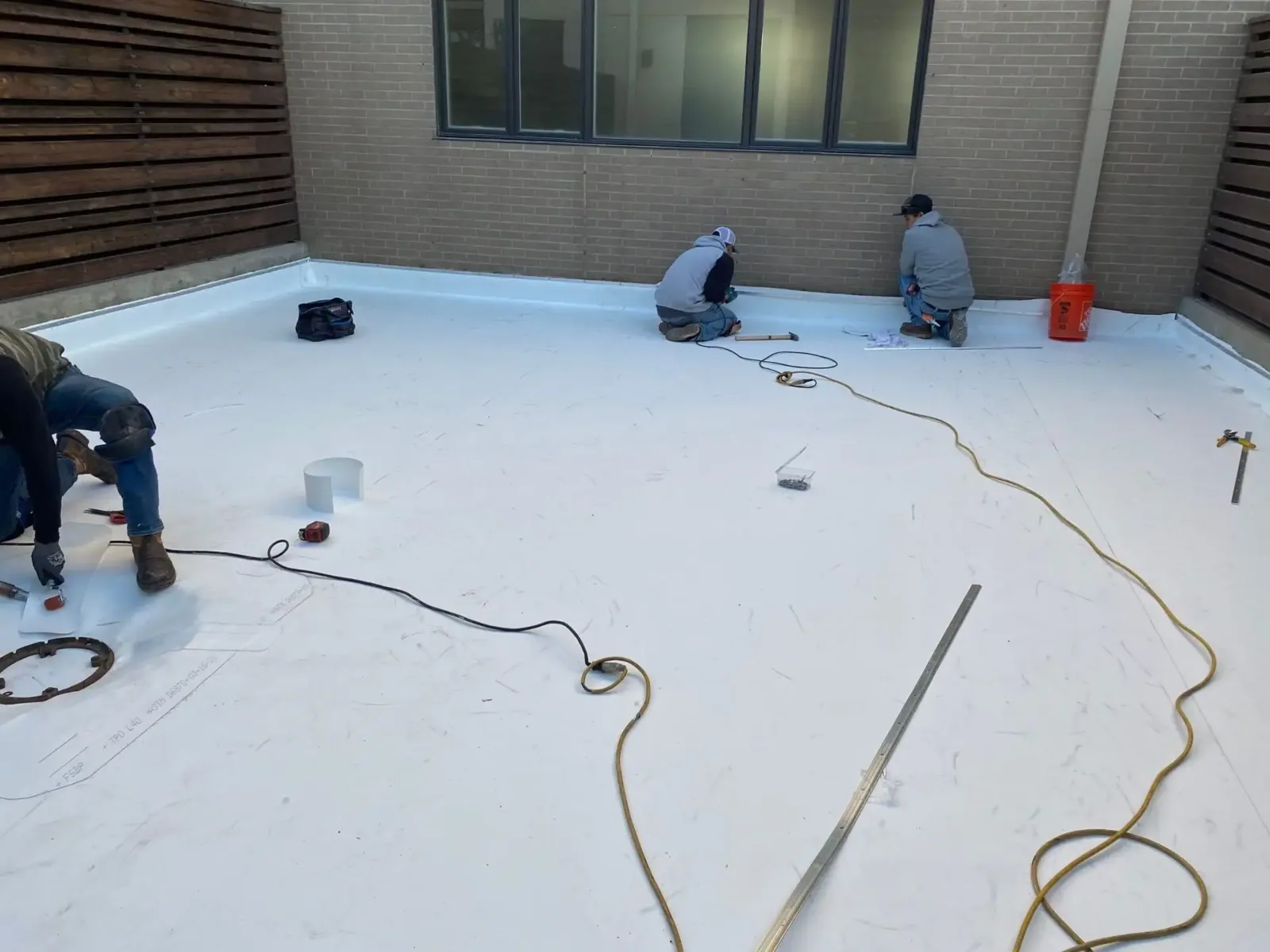
Flashing is a strength. Prefabricated corners and boots weld into the field sheet. A welded corner has no seam to open at the point of greatest stress. Pipes, curbs and drains get boots sized to fit. The detail takes less time than hand-cutting, and it holds up under thermal movement.
PVC resists many animal and vegetable fats. It resists many acids. It is also naturally fire resistant. These traits suit kitchens, plants and labs. Plant exhaust can carry oils that soften other sheets. PVC holds up. That is why roofs under exhaust call for it.
Fire behavior matters in plants. PVC contains chlorine, which slows burning. The sheet tends to self-extinguish when the heat source is removed. That does not make a roof fireproof. It does mean the sheet will not feed a small fire. Code and insurance reviews can raise it, so we note it in the scope.
Watch for How PVC Fails
Plasticizers migrate. Over years they leave the sheet slowly. The sheet gets stiffer. Stiff sheet cracks at folds, at flashings and at corners. Welds can open if they were made over dirt. Shrinkage pulls the sheet away from walls. Sealants dry. Fasteners back out and bump up through the surface.
Punctures matter. A dropped tool or a heavy boot can cut a stiff sheet. Walk pads protect routes. Ponding speeds aging. Standing water holds grease, dirt and algae, and heat cycling works on the sheet beneath. We look for all of these. We photograph each one, mark it on a sketch and number it.
Stiffness can be tested. We bend a small cut edge by hand and look for cracking. A pliable sample bends and returns. A stiff one snaps or shows white lines. The result goes in the file. It tells the owner how many years of service are likely left, and whether new flashing will bond.
Test the Seams and Scan for Moisture
A probe runs along each seam. We mark open stretches. A moisture scan follows. Infrared shows warm, wet areas at dusk. A meter confirms. Core samples show each layer and whether the insulation is dry. For a food plant, we also check the exhaust area. We note grease on the surface and in drains. Grease in a drain can block it.
The results go in a report. We list each finding, a likely cause and a price to fix it. The report is written so an owner can hand it to a plant manager or a lender.
Drains get special attention on food plant roofs. Fat and food residue can collect in strainers and in the pipe below. A blocked drain turns a roof into a pond. We clear the strainer, flush the line and photograph the water level before and after. If water still stands, we look at the slope and the drain body height.
Match PVC to Sherman Buildings
Sherman lists food processing, semiconductor, laser, valve and metal enclosure plants in its industrial base. The list includes Tyson, Coherent, Emerson, Eaton B-Line and Presco. Progress Park has food and metals plants served by BNSF rail. A food plant roof near Progress Park may carry exhaust fans, vents and drains. Foundation Business Park in Denison lists manufacturing and distribution tenants as well, and the same questions apply there. PVC's resistance to fats helps there. A manufacturing plant roof often has many penetrations as well, and welded flashings handle them well.
Account for Sherman Weather
Sherman has seen 113 F and -3 F. That range works on any sheet. Hot days soften PVC. Cold days stiffen it. In December 2013 an ice event coated the Sherman and Denison area with 4 to 5 inches. Ice in a drain lifts a weld. Cold PVC is also less flexible, so crews take care walking it, and a snow and ice event gets a drain and seam check afterward. In spring, April and May bring the peak tornado months. Sherwood Shores took an EF2 tornado on March 21, 2022. Wind pulls at edges, so edge attachment gets a pull test.
Hail is a documented local stress. On June 8, 2025 hail measuring 1.25 inches was reported northwest of Denison. Smaller hail fell near Sadler and Luella in April 2014. PVC resists impact better when it is warm and worse when it is cold. We press suspect spots, look for crushed insulation below and record each bruise.
Build the Repair Step by Step
The area is cleaned with the right cleaner. A trial weld on scrap sets the heat and speed. A patch with rounded corners is welded over the damage. The weld is probed. Larger damage gets a section cut out, the insulation dried or replaced and a new sheet welded in. Stiff old sheet can be hard to weld. We test it first. If it will not fuse, we say so and price a larger repair or a replacement.
Where grease is the cause, we add a fix for the source. A grease tray under a fan. A cleaning schedule. A walk pad. These cost little and protect the sheet. The scope lists each one as a line, with a price, so the owner can add them or skip them. A plan that treats the cause of grease damage lasts longer than one that only replaces the damaged sheet.
Ask What the Record Shows
We explain the plan on the ground first. At the end of the work the owner gets the record. Photographs. Probe results. Moisture maps. The materials list. The dates of the next visits. A KEE membrane is a related sheet with extra resistance to oils. A TPO sheet is a lower-cost welded option for roofs without exhaust.
Commercial Roofing Questions
Is PVC better than TPO on a kitchen roof?
PVC resists fats better. TPO costs less and suits many other roofs. The exhaust decides.
Does PVC get brittle?
Slowly. Plasticizers leave over years. A stiff sheet cracks at folds, and we test it before any repair.
Can PVC be welded years after install?
Often yes, if the surface is clean and the sheet is not too stiff. A trial weld proves it.
What does PVC cost compared with other sheets?
Usually more than TPO or EPDM. The scope prices the difference line by line.
How is grease handled on a PVC roof?
By source control. Trays, cleaning schedules and clear drains protect the sheet.
Send the Address and the Leak History
Send the building address and any leak history. We will walk the roof with you and explain what the readings show about the sheet, the seams and the exhaust area.
Related Roofing Work
Progress Park
Commercial roofing in Progress Park, Sherman, TX: scans, seam repair and recovers for food, beverage and metals plants, with baseline surveys for new buildings.
Manufacturing Plant Roofing
Manufacturing plant roofing in Sherman, TX: how process heat, exhaust and equipment load roofs, where plant roofs leak, and how we inspect and repair them.
Snow and Ice Roof Damage Repair
Repair of snow load and ice damage on commercial roofs in Sherman, TX: drain blockage, frozen seams, ponding, crushed insulation and a documented repair scope.
Commercial Roof Replacement
Full tear-off and replacement of low-slope and metal commercial roofs in Sherman, TX, planned around moisture findings, heat cycling and North Texas hail.