
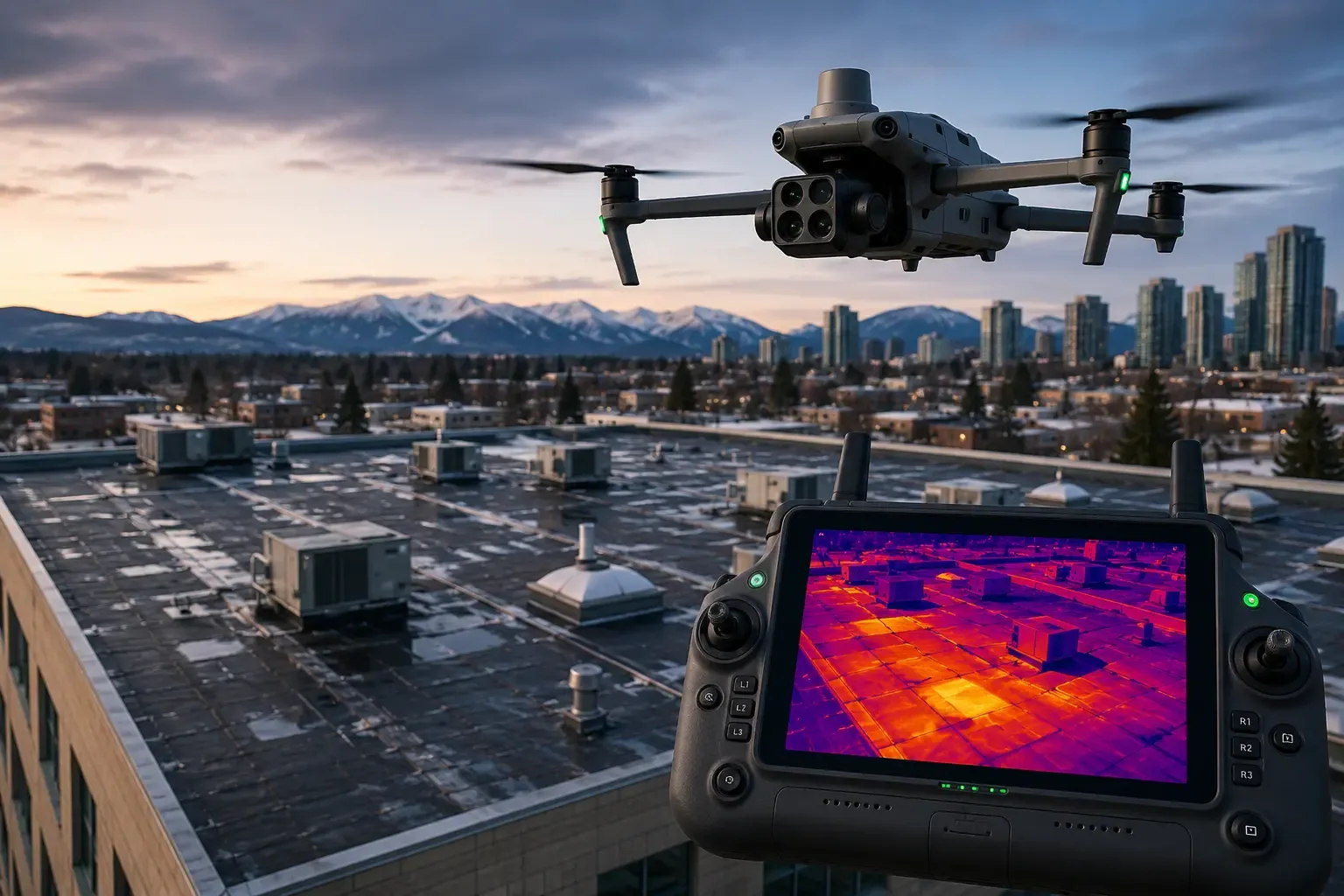
Infrared Moisture Survey in Sherman, TX
Infrared and core-cut moisture surveys for commercial roofs in Sherman, TX, mapping wet insulation so repair and replacement dollars go where water sits.
Insulation holds water the way a sponge does, and a sealed membrane keeps that water from drying out. The result is a wet layer that adds weight, loses its insulating value and corrodes the steel deck below. None of this shows from the surface. An infrared survey makes the hidden layer visible. Water stores heat longer than dry insulation, so after a sunny day the wet areas cool more slowly after sunset and glow on a thermal camera. We then confirm the glow with a meter and a core. In Sherman, TX where summer sun is strong, the method works well, and it lets an owner see where the money should go before the budget is set.
Scanning the Roof After the Sun Goes Down
A good scan needs the right conditions. The roof must be dry on top, the day must have been sunny, and the evening must be calm and clear. We start about an hour before sunset, mark a grid on the roof and walk the grid with the camera as the surface cools. Wet insulation stays warm for longer, so it shows as a bright zone against cooler dry areas. We record each image with a position on the plan and paint the boundary of any wet zone on the surface. Ballasted roofs and dark membranes behave differently, so we adjust the timing to the roof type. When conditions fail, we reschedule rather than guess.
The camera needs a trained eye. A bright zone could be wet insulation, but it could also be a thick board, a metal duct below or a patch of newer material. We compare each image with the roof plan, the age of each section and the drainage pattern before we mark anything as wet. The scan shortens the work. The judgment comes from reading it against the roof.
Proving the Reading With Meters and Cores
A thermal image is a lead that still needs checking. Standing water, thick sections of insulation and metal fasteners can all create warm spots. So we check each suspect zone with a capacitance moisture meter, and then we cut a small core to see the assembly with our own eyes. The core shows how many layers are present, whether the insulation is wet, how deep the water goes and whether the deck is rusted. Each core is patched the same day with a matching material. When the cores agree with the scan, we have a drawing the owner can price from. When they do not, we widen the sample and adjust the map.
We record the moisture reading at every core, with a photo of the layers and a note on the deck condition. Those numbers sit in the report beside the thermal image so any reviewer can follow the path from picture to proof. If the deck is rusted, we flag it, since deck repair is a separate cost that changes the replacement scope.
Turning the Map Into a Repair or Replacement Decision
The survey drawing is a decision tool. If the wet area is small, a section cut-out and repair costs far less than a new roof, and the rest of the membrane can stay. If wet insulation covers most of the plan, patching only delays the problem and replacement is the sounder spend. If the wet zones sit under a single drain or curb, the cause is local and the fix is local. We express the results as square feet of wet insulation, percent of the roof and likely cause, with a cost range for each path. Owners then compare options with real numbers, instead of arguing from a stain on one ceiling tile.
The drawing also helps with timing. A roof with small wet zones can be repaired this season and rescanned next year. A roof with wide wet areas needs a replacement date, a budget line and an interim plan for leaks until the work is done. Putting a date on each path lets the owner commit funds without guessing.
Why Local Weather Fills Insulation With Water
North Texas weather finds the weak points in a membrane. Hail reported at half-dollar size northwest of Denison on June 8, 2025 can bruise the sheet, and dime-size hail has been reported north of Sadler. The bruises and cracks let water in later. The December 2013 sleet storm iced the Sherman and Denison area with four to five inches of accumulation, and snow reached nine to eleven inches in isolated Grayson County spots in January 2025. Meltwater pushes through small gaps at seams and flashings, and each thaw drives a little more into the insulation. A survey after a bad season tells an owner how much entered. A hail damage file benefits from that record.
Putting Surveys to Work on Different Buildings
Different buildings gain different things. A large industrial roof in Progress Park may be surveyed before a planned recover to find out whether the old insulation can stay. A hospital or school owner may want a survey as part of a capital plan, ranking roofs by moisture. Buyers in Sherman or Denison use the survey to price the roof into a purchase. In each case, a moisture map is more convincing than an opinion.
Facilities with sensitive interiors, such as hospitals and schools, gain from knowing which roofs hold water before it reaches a ceiling. A survey run on a regular cycle, every few years, turns hidden decline into a trend line the owner can plan around.
Understanding What the Survey Will and Will Not Show
A moisture survey shows where water is stored, not where it enters. The entry point may be some distance from the wet zone, so a follow-up leak trace pairs well with the scan. A survey also misses moisture in assemblies with thick ballast, some coatings and fully adhered systems with reflective surfaces unless conditions are right. We say what the method can and cannot read for each roof before the visit. For a leak that is active now, start with leak repair, then use the scan to see how far the water has spread. After repair, an annual rescan shows whether new areas are forming.
A scan is also a baseline. Saved with the report, it lets a later scan show whether a repaired zone stays dry and whether new wet areas have formed.
Commercial Roofing Questions
Can a survey run on any roof?
Most low-slope roofs can be scanned. Ballast, heavy coatings and some metal systems limit what the camera reads, so we choose the method for each assembly. We tell the owner in advance if the method will not work on a given roof.
How long does a scan take?
A mid-size roof takes a few hours on site, mostly waiting for the surface to cool. The report follows within days. Evening work keeps the daytime schedule of the building undisturbed.
Do cores damage the roof?
Each core is a small hole, patched the same day with matching material and sealed. We keep the number of cores to what the map requires.
What does the survey cost compared with a replacement?
It is a small fraction of replacement cost. The purpose is to avoid replacing a dry roof or patching a wet one. Knowing the wet area before bidding keeps the scope tied to the roof and not to a stain on a ceiling.
Will the results support an insurance claim?
A dated scan and core record document wet insulation and its extent. Whether the loss is covered depends on cause, which the insurer decides.
Ask Us to Map the Wet Areas
Send the address, the roof type and the age if you know it. We will schedule an evening scan, confirm it with cores and give you a drawing with costs.
Related Roofing Work
Commercial Roof Replacement
Full tear-off and replacement of low-slope and metal commercial roofs in Sherman, TX, planned around moisture findings, heat cycling and North Texas hail.
Hail Damage Roof Repair
Hail damage roof repair in Sherman, TX: find bruises, fractured membranes and dented metal with moisture scans and core samples, then repair and document.
Progress Park
Commercial roofing in Progress Park, Sherman, TX: scans, seam repair and recovers for food, beverage and metals plants, with baseline surveys for new buildings.
Sherman
Commercial roofing in Sherman, TX for fabs, food plants, hospitals and the college: moisture scans, seam repair, recovers and storm checks on flat roofs.