
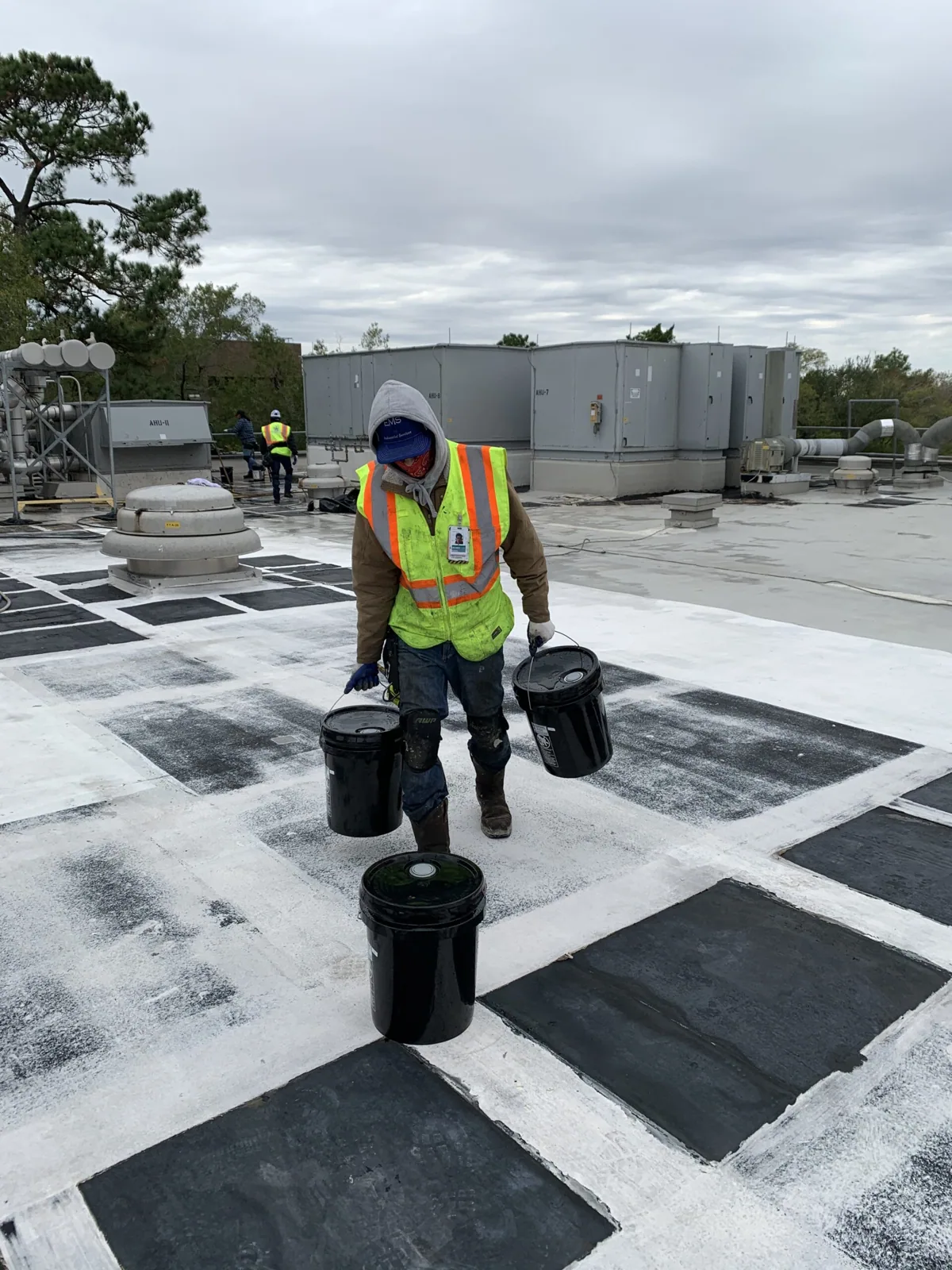
Emergency Roof Repair in Sherman, TX
Round-the-clock emergency roof repair in Sherman, TX: tarping, dry-in and temporary fixes after storms, with full documentation for your insurance claim.
The first hour after roof damage sets the cost of everything that follows. Open membrane lets rain reach insulation, and insulation soaks up water like a sponge. Wet insulation adds weight to the deck, corrodes fasteners and carries moisture to every room below. Sherman, TX sees storm cells fast, and North Texas puts its heaviest tornado activity in April and May. When a call comes in, our crews are staffed to answer around the clock, on weekends and on holidays. The goal on arrival is simple: stop water entry, protect the building and record what happened so the lasting repair can be planned properly.
Walking the Roof Before Touching It
A safe roof comes first. Wind-damaged decks can be weaker than they look, and a torn membrane can hide a soft spot. We walk the perimeter from the ground, check the edges and look for loose metal that could fall. Then we test the roof surface as we step and choose a safe path. Electricity matters too. If water is dripping on lights or panels inside, we call the facility team to cut power to the affected circuits before we begin work above. Only after those checks do we start tarping, so no crew member is on a surface that could give way.
We also look for where water is going inside. If it is collecting above a ceiling, we advise the facility team on where to relieve it safely, because a ceiling that holds hundreds of pounds of water can fall without warning.
Closing the Opening With a Dry-In
A dry-in is a temporary roof built to hold for days or weeks. We remove loose debris, cut back torn membrane to sound material and lay reinforced tarps or temporary membrane over the opening. Edges are strapped or battened to the deck, and sandbags or bracing prevent the wind from catching a loose corner. On low-slope roofs we pay close attention to drains, since a blocked drain turns a covered opening into a pond. Where storm debris has punctured the roof, we patch the hole itself before covering the area. The tarp is a bridge to the permanent repair, not a repair on its own, and it should be replaced by one as soon as the weather and the schedule allow.
On metal roofs the dry-in differs. Panels that have lifted at a seam need to be pulled back down and fastened before a cover goes on, and exposed fasteners are sealed. Metal edges are especially sharp after wind damage, so we cut away bent trim before it can slice a tarp.
Reading the Damage Pattern From Local Storms
Different storms leave different marks. Hail leaves bruises and cracked scrim. Straight-line wind tears edge metal and peels membrane from the perimeter inward. Tornadoes tear whole sections and throw debris. A violent tornado killed 73 people in Sherman on May 15, 1896, and the NWS Fort Worth office still ranks it among the deadliest in the region. More recent history is smaller but real: an EF2 tornado heavily damaged Sherwood Shores on March 21, 2022, and an EF1 touched down southwest of Sherman on June 8, 2025. Knowing the pattern helps us find hidden damage in places the storm did not obviously touch, such as the side of the roof opposite the visible tear. For tornado damage, we also check the deck and structure.
Prioritizing the Buildings That Cannot Wait
Some losses cannot sit for a day. A hospital wing, a school, a food plant such as Tyson's, or a data room needs the roof closed fast, because water shuts down operations and damages equipment. Tyson, Sherman ISD and Carrus Hospital rank among the largest employers in Sherman, and a storm that reaches buildings like theirs puts occupied space at risk. We triage by risk when several calls arrive after a storm: occupied buildings with active water entry first, vacant buildings and minor damage after. We tell each caller where they stand in the order and give a realistic arrival window.
Responding When the Weather Turns Cold
Winter emergencies bring different problems. In December 2013 freezing rain built roughly four to five inches of ice around Sherman and Denison, and January 2025 snow totals topped nine inches at isolated Grayson County locations. Ice can pull roofing loose, plug drains and trap water that leaks the moment it thaws. In cold weather, adhesives cure slowly, so our temporary materials are chosen for low-temperature application. We clear drains, remove ice from the edge of openings where it is safe and install a dry-in that tolerates freezing. After the thaw, we inspect again, since freeze damage often shows itself as water in the days after the cold breaks.
Documenting the Loss for Your Insurer
Insurance claims depend on records. Before we cover anything, we photograph the damage from several angles, mark its location on a roof plan and note the date and weather. We keep a log of materials and hours used for the dry-in, since many policies reimburse reasonable temporary repair costs. Our claim documentation support gives an adjuster a clear picture of cause and scope. If the loss is wind or hail, we also record the age and condition of the roof system as we find it. Keeping receipts and a daily record protects the owner, and it speeds the path from a temporary repair to a permanent one.
Moving From Temporary to Permanent
Once the building is dry, the real planning starts. A moisture scan finds insulation that took on water during the opening. The permanent repair may be a section replacement, a new flashing set or a larger storm damage repair, depending on the findings. We give the owner a written scope and a price before work starts. For facilities in Sherman, Denison and Howe, we coordinate access, hours and any special handling with the facility team so permanent work follows the dry-in without a gap. If the roof is near the end of its service life, we explain when replacement makes more sense than a section fix.
Commercial Roofing Questions
What do I do in the first ten minutes of a roof emergency?
Move people and valuables away from the leak, switch off power to wet circuits and photograph the damage. Do not climb onto a storm-damaged roof. Then call us with the address and what you can see from the ground, so the crew arrives with the right materials.
How long does a temporary dry-in last?
A well-built one holds through several weeks of normal weather. Strong wind, freezing temperatures or foot traffic shorten that, so the permanent repair should follow quickly. We inspect the dry-in on a set schedule until the permanent crew arrives.
Does a tarp count as the repair for insurance?
A tarp is generally treated as a temporary measure to prevent further loss. Keep the receipts and the photos, and the permanent repair is handled as the covered scope.
Can you work at night or in light rain?
We can stabilize an opening in difficult conditions with lights and rated temporary materials. Adhesive repairs wait for a dry surface. Safety decides every call, so wind speed and lightning are checked before anyone goes up.
What if the damage covers the whole roof?
We secure the worst areas first, then cover the rest in order of risk. A full roof loss may also need a structural check before any replacement work begins. Triage keeps the most vulnerable spaces dry while the larger plan comes together.
Call With the Address and the Damage
Give us the building location and describe what you see. We will send a crew, close the opening and start the record for your claim.
Related Roofing Work
Tornado Damage Roof Repair
Tornado damage roof repair in Sherman, TX: emergency dry-in, structural review, debris impact checks and phased rebuilds for commercial and institutional roofs.
Roof Insurance Claim Assistance
Documentation and coordination for commercial roof insurance claims in Sherman, TX: dated photos, moisture maps, test squares, scope lines and adjuster visits.
Storm Damage Roof Repair
Commercial storm damage assessment and repair in Sherman, TX: wind uplift, hail bruises and debris impact found, documented, dried out and rebuilt in order.
Sherman
Commercial roofing in Sherman, TX for fabs, food plants, hospitals and the college: moisture scans, seam repair, recovers and storm checks on flat roofs.