
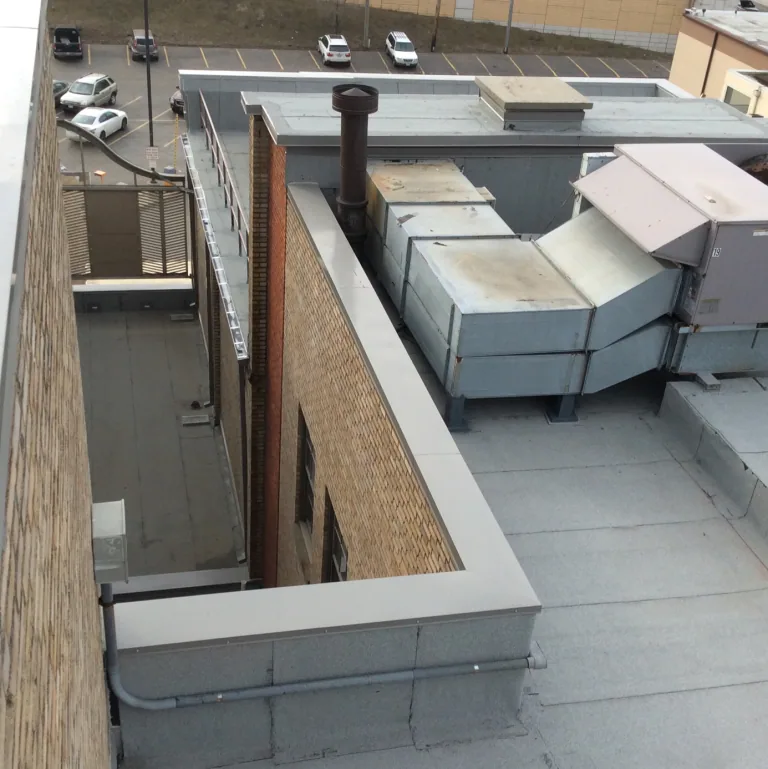
Carlisle SynTec Roofing Systems in Sherman, TX
Carlisle SynTec single-ply roofing in Sherman, TX: seam checks, flashing repairs, ponding fixes and replacement planning for TPO, EPDM and PVC membranes.
A single-ply roof lives or dies at its seams. The sheet itself is a few dozen thousandths of an inch thick, made in wide rolls and joined on the roof. Every join is a place where the factory sheet gives way to field workmanship. Carlisle SynTec makes single-ply membranes in several families, including thermoplastic and rubber types, along with the insulation, fasteners and flashings that go with them. In Sherman, TX the seams get tested hard. Highs of 113 F and lows of -3 F on record stretch and shrink the sheet, and the movement collects at laps, corners and penetrations. We read those details first when we inspect any Carlisle SynTec roof.
Tell the Membrane Families Apart
Single-ply is not one product. A thermoplastic sheet, such as TPO or PVC, joins by heat welding, which fuses the two layers into one. A cured rubber sheet, such as EPDM, joins with adhesive or seam tape, because it cannot be welded. The surface, the seam and the failure pattern differ for each.
We identify the family before we plan anything. A white, smooth sheet with a welded lap points to TPO or PVC. A black or light rubber sheet with taped laps points to EPDM. A probe, a close look at the seam edge and a core sample settle the question. The building file records the family, the thickness, the attachment method and the insulation below, so later work uses the right tools and materials.
Attachment adds a third variable. A single-ply sheet may be fully adhered to the substrate, mechanically fastened through the laps, or held down by ballast. Each method resists wind in a different way and fails in a different way. A fully adhered sheet can lift where the bond fails. A fastened sheet can flutter between fasteners and wear at the plates. We find the method by probing near the edges and checking for fastener heads, and the answer shapes both the repair and the uplift review.
Probe Every Lap
On welded sheets, a good seam shows a clean bead along the edge and a lap that resists the probe. A weak weld shows a gap, a lifted edge or a surface that peels. A weld made over dust or at a low temperature can look sound and still be weak, and the daily stretch of the sheet works at that spot until the lap opens.
On adhered or taped seams, the failure is different. Adhesive can lose grip, tape can lift at the edge, and the splice can open at the end of a lap where movement concentrates. We press along the edge and look for lift. We mark every open or suspect lap on the plan with a number, photograph it and record the length. A repair then starts from a map, not from a guess.
The same probing applies to the T-joints where three sheets meet, because those corners carry the most stress.
Moisture follows the seam. Water that enters at an open lap travels along the top of the insulation until it meets a joint or a fastener, then drops into the building at a spot far from the defect. That is why a ceiling stain rarely marks the leak. We trace the path from the stain back up to the nearest suspect lap and confirm with a moisture scan before cutting or welding anything.
Check Flashings and Curbs
Flashings join the sheet to walls, curbs, pipes and drains. They are cut by hand and fitted in the field, so quality varies. Thermal movement pulls them away from their terminations. Sealant dries. Corners open. Rooftop equipment sits on curbs whose flashing takes repeated vibration and foot traffic from technicians.
We inspect termination bars, sealant beads, pipe boots and curb corners. Where a boot has cracked, we replace it with a compatible component and weld or adhere it to the sheet. Where a flashing has pulled away, we re-secure it and renew the sealant. Our flashing failure repair follows the same steps, and the log records which flashing failed, why and what we did. Hail adds another test. A June 8, 2025 report northwest of Denison gave half-dollar stones, and stones that size can bruise a sheet without piercing it.
Fix the Water That Stays
Standing water speeds up everything else. It holds dirt, grows algae, stresses welds and adds weight. A pond that clears within a day is usually minor. A pond that remains for days points to a low spot, a settled insulation board or a drain set too high.
We measure ponding after rain, mark its outline and record its depth. Fixes include clearing drains, resetting drain bowls, adding drains and installing tapered insulation or crickets to lead water to an outlet. Some single-ply warranties limit coverage where ponding persists, so the repair is also a way to protect the paper. Our ponding water roof repair sets out the method for a specific roof.
Plan the Replacement or Recover
When seams open across a wide area, when insulation is wet or when the sheet is brittle, repair stops making sense. We lay out the options: a recover over a dry roof, or a tear-off with new insulation and a new membrane. Moisture scans and cores decide which one is possible.
The new roof is specified to the requirements the local building department enforces. Insulation levels and wind uplift requirements follow from them. A replacement scope shows the membrane, the insulation, the attachment, the edge metal and the flashing details, each priced as a line. Another family, such as the systems from Versico, can be compared on the same sheet.
The decision also depends on what the roof will carry. Heavy rooftop equipment, solar arrays and frequent service traffic all favor a membrane with a thicker wear layer and well-planned walk routes. We note these loads in the scope, so the new sheet and the walk pads suit the way the building actually works. If the owner expects to add equipment, the scope can include extra curbs or sleepers at the same time.
Work Around the Building
Single-ply roofs cover buildings of every type in Sherman, from plants in Progress Park to hospital and school buildings. Access, equipment and tenant hours shape the schedule. We confirm the route to the roof, the equipment on top and the hours when noise is acceptable. On occupied buildings we work in sections and close each section before the crew leaves.
Weather shapes the schedule as well. North and Central Texas tornado counts crest in April and May, so we avoid leaving roof openings overnight. Welding and adhesive work need dry surfaces and suitable temperatures, and we plan around forecasts. A written scope sheet states the sequence, so the owner and the crew work from the same plan.
A manufacturer name does not change who is responsible for the roof's day-to-day care. Drains still need clearing, seams still need checking and flashings still need renewing. Systems from Holcim Elevate and others call for the same habits. We build those habits into a maintenance plan with dated visits and a log, so the roof reaches the end of its service life with its condition on record.
Commercial Roofing Questions
Do you work on all Carlisle SynTec membranes?
We inspect, repair and replace thermoplastic and rubber single-ply roofs. We identify the family first.
Can an open seam be repaired?
Yes, with a compatible method. Welded sheets are re-welded or patched. Taped seams are cleaned, primed and re-taped.
Does ponding void a warranty?
Some warranties limit coverage for ponding. The terms decide, so we read them and fix the drainage.
How do you know if hail damaged a single-ply roof?
By inspecting the surface for bruises and scanning for wet insulation. A core confirms the finding.
What does replacement include?
Membrane, insulation, attachment, flashings and edge metal, each priced as a line in the scope.
Send the Address and the Roof Papers
Send the building address, any leak history and the roof papers you have. We will walk the roof with you and explain what the readings show.
Related Roofing Work
TPO Roofing
TPO single-ply roofing in Sherman, TX: how the welded membrane moves, where it fails, how we test seams, and how repairs and replacements are built.
PVC Roofing
PVC single-ply roofing in Sherman, TX: how the welded membrane resists fats and chemicals, where it fails, and how we test, repair and replace it.
EPDM Roofing
EPDM rubber roofing in Sherman, TX: how the sheet stretches and shrinks, where splices and flashings fail, and how we test, repair, ballast and replace it.
Flashing Failure Repair
Flashing failure repair in Sherman, TX: find open terminations, cracked sealant and torn base flashing at walls, curbs and penetrations, then rebuild them.