
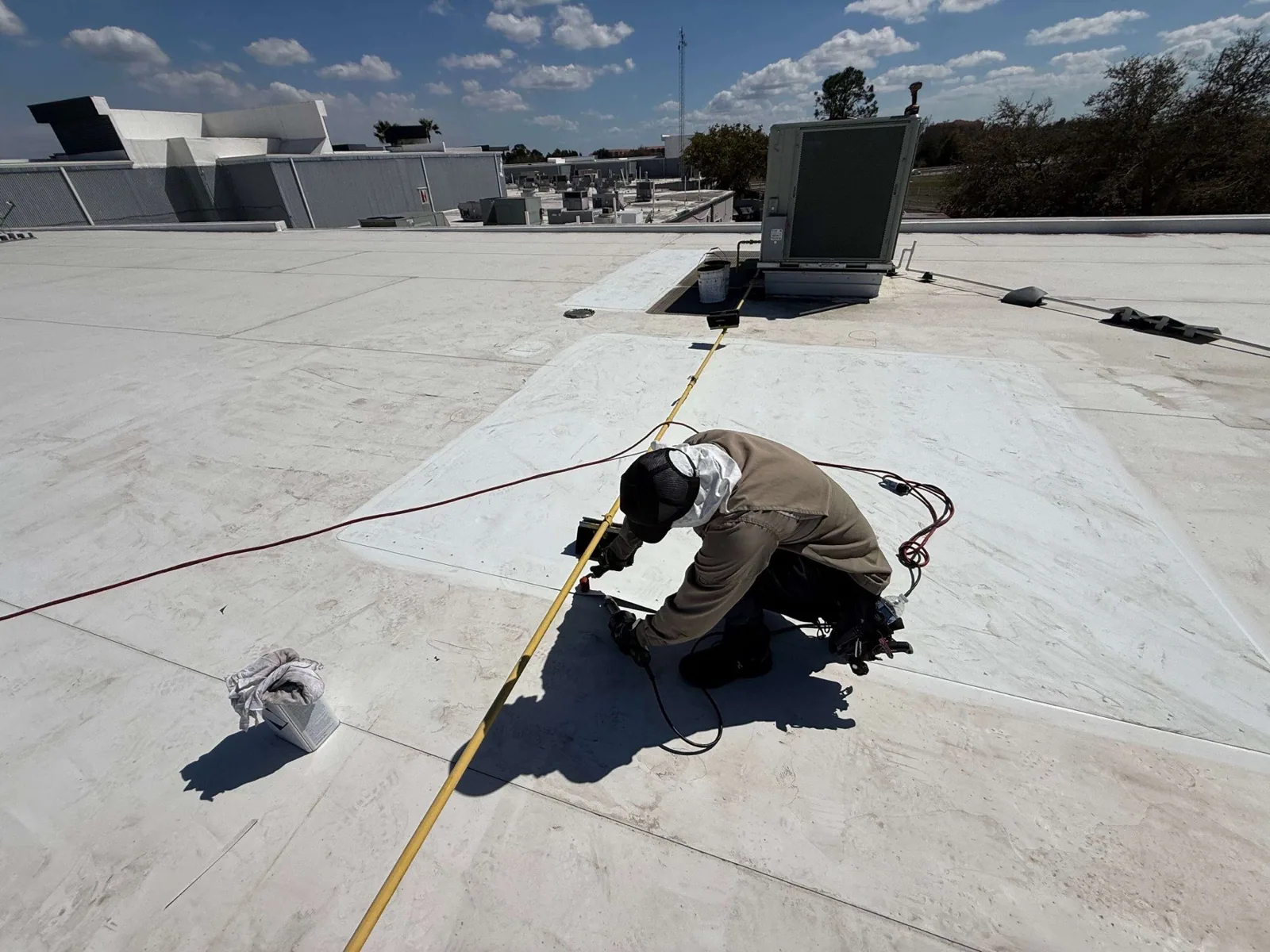
Commercial Roof Repair in Sherman, TX
Planned repair of commercial membranes, flashings and seams in Sherman, TX, matched to the cause of the failure so the fix lasts through heat, hail and freeze.
Membrane splits, open laps and cracked flashings all trace back to one thing: the roof moved more than the material could follow. Sherman, TX offers plenty of motion. The record high is 113 F and the record low is -3 F, so a single-ply sheet shrinks and swells across a wide range every year. Repair is the work of finding where that movement has beaten the assembly and rebuilding that spot so it can move without tearing. A good repair does not just cover the opening. It removes the cause, dries what is wet and restores the detail to the standard the surrounding roof still meets.
Locating the Failure Before Cutting Anything
Water travels. It enters at a seam, runs along the deck and drips from a light fixture thirty feet away. So the first hour on a repair goes to tracing. We walk the roof against the interior stain pattern, check every penetration and probe the seams with a blunt tool. Where the path stays unclear, we run a moisture scan or a controlled water test. A leak repair aims at one active entry point. A broader repair covers a failing detail class, such as every pipe boot or every curb corner on the same building. The difference changes the scope, the crew size and the cost, so we settle it on the roof, not in the truck.
Matching the Patch to the Membrane
A repair material must bond to what is already there. Thermoplastic sheets such as TPO take a heat-welded patch after the surface is cleaned. EPDM needs primers and cured seam tape, because rubber does not weld. Modified bitumen takes torch or cold-applied patches. Built-up roofs take flashing cement, felts and a new surfacing. Putting the wrong patch on the wrong base is a common cause of a repair that opens again in a season. Before we start, we identify the membrane, its age and its surface condition. Aged membranes are often chalked and dirty, and a patch will not hold until we clean to bare material and test adhesion on a small area.
Rebuilding Flashings, Seams and Penetrations
Most repairs are detail repairs. Wall flashings pull loose when the parapet moves. Pitch pans dry out and crack. Pipe boots split from sun exposure, and curbs lose their sealant at the corners. We replace these parts instead of smearing them with mastic, since a smear lasts one summer. A flashing failure gets new flashing set to the proper height with a termination bar and sealant. A seam failure is cleaned, welded or taped, and probed. Where a membrane has been punctured by foot traffic or dropped tools, a patch with rounded corners spreads stress and resists peeling at the edges.
Clearing Water That Sits After the Rain
Ponding water ages a repair faster than any other condition. A puddle that remains forty-eight hours after a storm adds weight, grows algae and works on every seam beneath it. Before we patch a ponded area, we find out why it holds water. A clogged drain, a deck that has sagged between supports or a crowned insulation board each has a different remedy. Sometimes cleaning the drain and adding a small tapered cricket solves it. Sometimes a section of deck needs framing. We include the drainage fix in the repair scope, because a perfect patch under standing water simply postpones the next call.
Repairing After Hail and Wind Season
Spring in North Texas brings fast storm cells. On June 8, 2025 half-dollar-size hail was reported northwest of Denison, and the Weather Service surveyed an EF1 tornado along Rockport Road southwest of Sherman. In April 2016 an EF1 tornado damaged homes and the high school in Howe, just south of Sherman. After events like these, we look for hail bruising, torn flashings and lifted edge metal. Small impact marks on a membrane rarely leak at once. They crack the reinforcing fabric inside the sheet, and water finds the crack during the next freeze. Repair after a storm should cover the bruises and the edges, not only the visible tear.
Timing Repairs Around Cold Weather
Cold slows adhesives and weld quality. When temperatures fall, we use materials rated for the lower range, warm the surface and test before we trust a seam. Sleet and freezing rain in December 2013 stacked ice four to five inches deep across Sherman and Denison. Snow on January 9 and 10, 2025 piled up between nine and eleven inches at isolated Grayson County sites. Ice damages drains and lifts laps, so a pre-winter repair of drains, scuppers and open seams is worth the schedule. When a leak cannot wait for a warm day, a temporary dry-in holds until conditions allow a lasting fix. We record the temporary repair so it is replaced and not forgotten.
Logging the Work and Knowing When Repair Stops Making Sense
Every repair we complete is logged with a photo before, a photo during and a photo after, along with the location marked on a roof plan. That record answers three questions later: what was done, where it was done and how it has held up. It helps a facility manager see repeat trouble at the same curb. It also supports a warranty claim or an insurance file when a storm adds new damage on top of old work. Owners who keep these logs from year to year can budget repairs by pattern instead of reacting to each call, and they hold a clear history if the building is ever sold.
Every roof reaches a point where more repairs cost more than the building gains. Wet insulation across a wide area, a membrane that cracks when it is bent, or repeated failures at new places all signal that the system is near the end. We make that call openly and put the numbers on paper. For a building where the roof is aging but not finished, a maintenance program can extend its life and keep repairs small. When the findings point to replacement, we explain why before the first proposal. Owners in Sherman, Van Alstyne and Whitesboro can send an address and a few photos to start the conversation.
Commercial Roofing Questions
How can I tell a repair from a replacement?
Look at how much of the roof is wet. A moisture scan that shows small patches points to repair. A scan that shows wet insulation across most of the surface points to replacement.
Why did the same spot leak again after a patch?
The cause was probably still there. Movement at the seam, a failing flashing or standing water can undo a patch laid over the symptom. We fix the cause first.
Do repairs affect my manufacturer's warranty?
They can. Many warranties require repairs by an approved method and a written record. We read the terms before we start and document each repair in a form the manufacturer can review. Using the wrong patch product can void coverage on its own, so the match between product and membrane matters as much as the workmanship.
Can repairs wait until the budget year turns over?
Small ones often can, with a temporary dry-in. Leaks over insulation, electrical gear or inventory cannot wait. We rank each item as urgent or planned, with a price, so you can budget by priority.
What should the repair proposal list?
Each item by location, with the cause, the method and the price. Photos tie every line to a spot on the roof, which makes the work easy to check afterward. We also list what the proposal does not cover, so nothing surprises the owner mid-job.
Send Photos and the Leak History
Tell us where the water shows up and what has already been tried. We will walk the roof, find the cause and price each repair item separately.
Related Roofing Work
Commercial Roof Leak Repair
Tracing and stopping active commercial roof leaks in Sherman, TX with moisture mapping, water testing and repairs matched to the real entry point.
TPO Roofing
TPO single-ply roofing in Sherman, TX: how the welded membrane moves, where it fails, how we test seams, and how repairs and replacements are built.
EPDM Roofing
EPDM rubber roofing in Sherman, TX: how the sheet stretches and shrinks, where splices and flashings fail, and how we test, repair, ballast and replace it.
Flashing Failure Repair
Flashing failure repair in Sherman, TX: find open terminations, cracked sealant and torn base flashing at walls, curbs and penetrations, then rebuild them.