
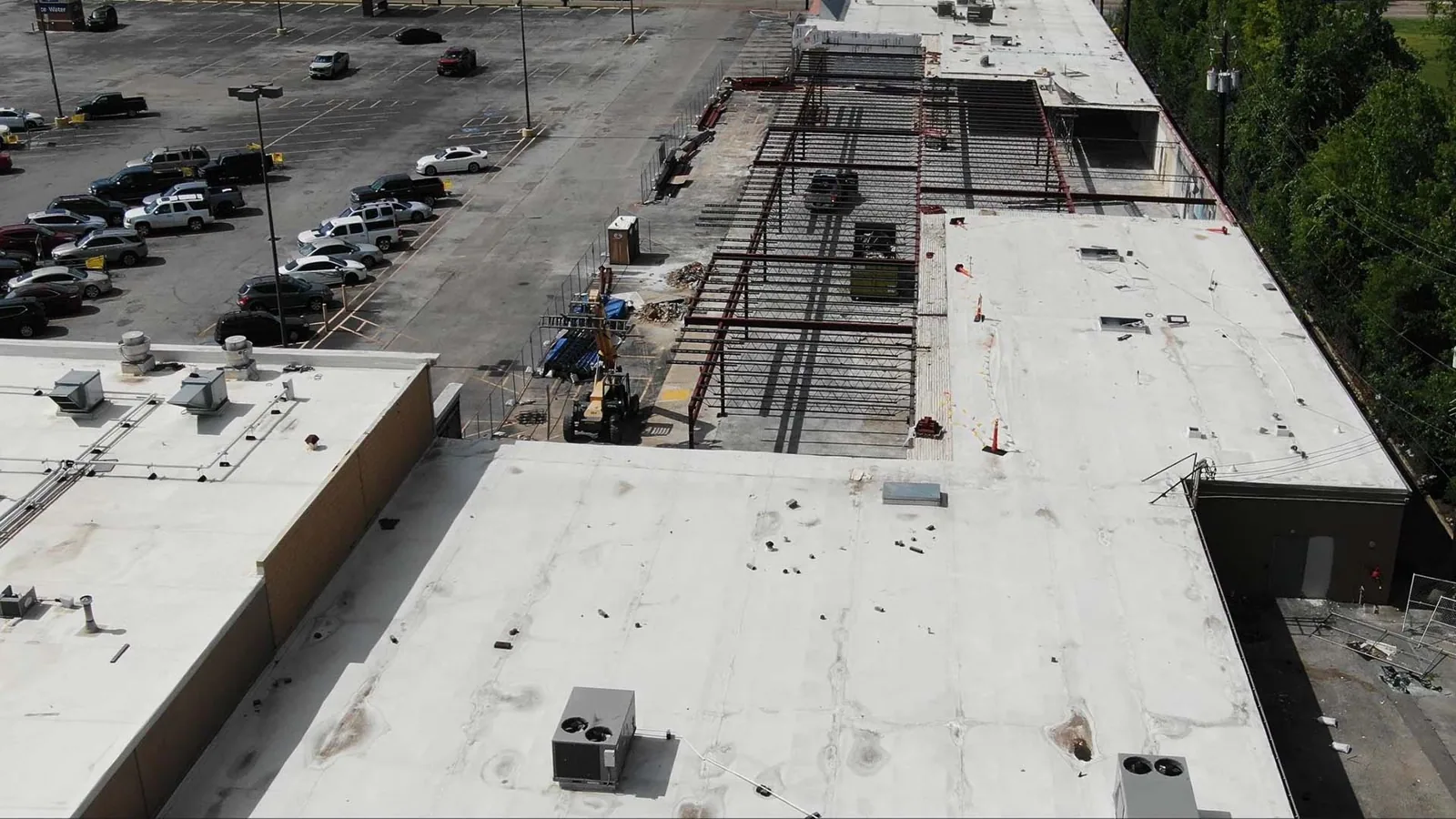
Storm Damage Roof Repair in Sherman, TX
Commercial storm damage assessment and repair in Sherman, TX: wind uplift, hail bruises and debris impact found, documented, dried out and rebuilt in order.
Wind does not push a roof down. It pulls up. Air moves fast over the roof and drops the pressure on top. The higher pressure beneath lifts the edge. Once an edge peels, wind gets under the membrane and the peel runs. Hail works the other way. It strikes the surface, cracks the membrane and crushes the insulation under it. Both damage types start small and show late.
Storm repair in Sherman, TX follows from that physics. Secure the edge. Find the bruises. Dry the insulation. Rebuild in order. The sequence matters more than speed alone.
Make the Building Safe Before Anything Else
The first visit is short. We look for hazards. Loose panels, hanging coping and lifted edge metal can fall. Open membrane lets rain into the building. We secure what is loose and cover what is open.
A tarp is a temporary fix. It must be fastened to structure, not just weighted. Wind under a tarp acts like wind under a sail. We use battens and fasteners, and we lap each sheet so water runs off. For larger openings we may use temporary sheet membrane.
This step is the same as emergency roof repair. The permanent scope comes after the roof is dry and the damage is recorded. We also check the interior. Ceiling tiles that sag hold water. We open them to let it drain and to protect the room below. Electrical gear gets covered, and we tell the facility contact where the water entered so staff can move stock.
Read the Damage by Type
Wind damage shows at edges and corners. We look for lifted coping, peeled membrane, bent edge metal and displaced ballast. Rooftop units may have shifted. Sheet-metal flashings may be torn.
Hail damage shows on the surface. Look for round marks, granule loss, cracks and dents. A bruise may be soft to the touch. Under it, insulation may be crushed. A moisture scan finds wet insulation behind a bruise that has already leaked.
Debris damage looks like punctures and scrapes. Branches and flying panels can cut membrane. Each type needs a different repair. A wind damage roof repair rebuilds the edge. A hail damage roof repair replaces bruised sections. Uplift damage often hides under the surface. A membrane that looks flat may have lost its bond to the deck. We press along edges and seams to feel for hollow spots. Hollow spots mark where the sheet has let go and will flutter in the next gust.
Know What Storms Sherman Roofs Face
April and May are the peak tornado months for North and Central Texas. On June 8, 2025 an EF1 tornado touched down along Rockport Road southwest of Sherman. A half-dollar hail report came from northwest of Denison the same day. Howe, the town that borders Sherman on the south, took an EF1 tornado in April 2016 that damaged its high school and homes.
A roof does not need a direct tornado hit to suffer. Gusts alone can lift an edge. Hail alone can bruise a whole field. So we assess after any severe storm warning, not only after a tornado. Sherman's weather swings add stress between storms. A roof that cycles from -3 F to 113 F has seams and sealants that are already worn. A storm finds the weakest of those. So an assessment looks at age and prior repairs as well as the new damage.
Record the Damage Before Repair Hides It
Once repaired, damage is gone from view. So the record comes first. We photograph each finding with a number and a plan location. We take wide shots and close ones. We note the date, the weather and the storm if known.
For hail, we mark test squares and count hits per square. For wind, we map every lifted edge. For leaks, we scan for moisture and mark wet areas.
The record serves the owner and the insurer. It shows what the storm did and what the roof looked like before. A roof insurance claim built on this record moves faster. Disputes shrink when photos and readings agree. We also record ambient conditions on the roof: the weather, wind direction and time. Those details help match damage to a specific storm. Matching matters when more than one event passed over the building in a season.
Dry the Insulation or Replace It
Water in insulation does not leave on its own. It spreads sideways under the membrane. It corrodes decks. It breeds mold. A small hole can wet a large area.
We map wet zones with infrared and confirm them with cores. Small wet zones get cut out and replaced. Large ones may call for section replacement. Drying in place is rarely reliable, and a membrane laid over damp board traps moisture.
We check the deck as well. Deck fasteners can loosen in a wind event. Corrosion shows where water has sat. A damaged deck is repaired before new roofing goes over it. Wet insulation also adds weight. A saturated board can weigh several times what a dry one does, and a roof that already sits near its design load may sag. We note any deflection at drains and low spots, since a sagging deck makes ponding worse.
Rebuild From the Edge Inward
Edges first, because wind starts there. We reset or replace coping and edge metal, and we fasten to the structure. We re-weld lifted membrane and re-flash corners. Then we repair the field, patch punctures and replace bruised sections.
Equipment comes next. Rooftop units that shifted are reset on their curbs. Flashings are rebuilt. Penetrations are resealed. Finally we clear drains and check that water leaves the roof.
The last step is a walk with the owner. We compare the roof to the photos. We hand over the record. Fastening upgrades are discussed with the owner. If the old pattern was thin at corners and edges, we propose a denser one. The change costs little at the time of repair and adds resistance to the next gust. The plan lists the pattern before and after. Every fastener we add or replace is logged by count and location. The count lets the owner check the work later.
Prepare Before the Next Storm Arrives
A repaired roof should be stronger at the edges than before. We check fastening patterns and upgrade where the old one was thin. A spring baseline survey records edge metal, seams and ballast. After the next storm, the comparison is quick.
Owners in Howe, Denison and across Grayson County use the same record format. A tornado damage roof repair is faster when a baseline exists. Loose items are part of the baseline. Vent caps, satellite mounts and roof signs can become projectiles. The baseline lists them and says who secures them. A short list and a firm owner make the roof safer for the next event, and for people below.
Commercial Roofing Questions
How soon after a storm should a roof be inspected?
As soon as it is safe. Water enters within hours. A same-week inspection catches hidden damage.
Can hail damage be seen from the ground?
Rarely. Bruises are small and flat. A roof walk and a moisture scan find them.
Does a tarp count as a repair?
No. It is a temporary cover. The permanent repair follows once the roof is dry.
What if the insurer disagrees with the damage?
Dated photos and moisture readings settle most disputes. We supply both.
Will repairs match the old roof?
We use compatible materials. Color and age may differ slightly. Function matches.
Send the Address and the Storm Date
Send the building address and the date of the storm. We will walk the roof, record the damage and explain what the readings show.
Related Roofing Work
Emergency Roof Repair
Round-the-clock emergency roof repair in Sherman, TX: tarping, dry-in and temporary fixes after storms, with full documentation for your insurance claim.
Wind Damage Roof Repair
Wind damage roof repair in Sherman, TX: edge metal, fastener, membrane and flashing checks after storms, with moisture scans and written repair scopes.
Hail Damage Roof Repair
Hail damage roof repair in Sherman, TX: find bruises, fractured membranes and dented metal with moisture scans and core samples, then repair and document.
Roof Insurance Claim Assistance
Documentation and coordination for commercial roof insurance claims in Sherman, TX: dated photos, moisture maps, test squares, scope lines and adjuster visits.