
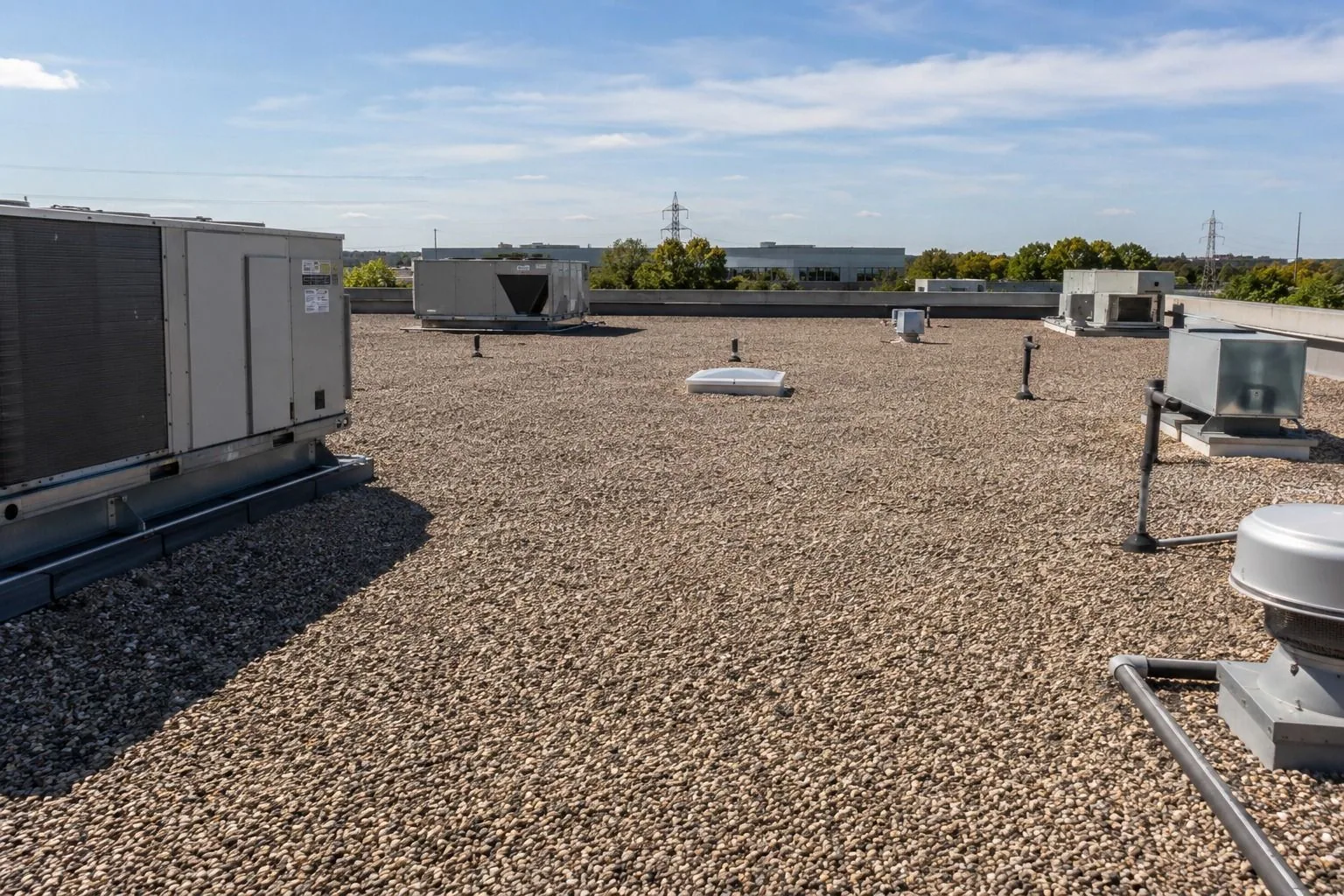
Johns Manville Roofing Systems in Sherman, TX
Johns Manville roofing and insulation assemblies in Sherman, TX: moisture scans, dew point checks, cover boards and repair or replacement planning.
Warm, humid air from inside a building wants to move toward cold, dry air outside. It travels through any gap in the roof assembly, and when it meets a cold surface it drops its water. That point is the dew point, and in a roof it usually falls somewhere inside the insulation. If the insulation is wet, it stops insulating. Johns Manville makes roofing membranes and roof insulation, so its assemblies put both halves of that story in one package. In Sherman, TX, where 113 F and -3 F are both on record, the temperature difference across a roof swings widely, and the insulation has to cope with it. We read the assembly from the top down.
Read the Assembly Top to Bottom
A roof assembly has layers, and each has a job. The surface takes sun and traffic. The membrane keeps water out. A cover board protects the insulation from hail and foot traffic. The insulation holds heat and sets the slope. A vapor retarder, where one is used, slows moisture from below. The deck carries it all.
We learn the layers by looking at cut edges, taking core samples and checking the drawings. The core shows the thickness of each layer and the condition of the insulation and deck. We record the findings in the building file. A roof that looks like a single sheet can hold two membranes and two insulation layers from past recovers, and that history decides what repairs and replacements are possible.
Attachment completes the picture. Insulation boards may be mechanically fastened to the deck, adhered with a bonding material or held by the membrane above. Each method leaves a different trace in a core and responds differently to wind uplift. We note the method in the file because it controls how a section can be opened for repair without loosening the boards around it.
Find the Wet Insulation
Wet insulation is among the costliest hidden problems on a low-slope roof. It adds weight, loses insulating value and can corrode deck fasteners. A roof may feel firm underfoot and still hold wet board. An infrared moisture survey shows where heat is retained, and cores confirm the boundaries.
We map the wet areas on a plan, with the extent in square feet and the depth of wetness from the core. The map lets the owner see how much of the roof can be saved. A small wet area can be cut out and replaced. A large one points to a tear-off of that section. Our insulation and cover board work follows the map, replacing only what is wet and restoring the thermal and fire details around it.
The map also guides the sequence. We start repairs at the highest wet area and work downslope, so water draining from freshly opened sections does not run into finished work. Each patch of new insulation is tied into the surrounding board and sealed at its edges. The log lists the board type, thickness and fastening for every replaced area, so the next inspection can find them.
Check Dew Point and Vapor Drive
Some buildings push more moisture toward the roof than others. Food processing plants, cleanroom fabs and buildings with humidified or air-conditioned interiors all hold a difference between inside and outside. Sherman's industrial base includes food processing and semiconductor plants, and the Texas Instruments wafer fab in the city began production in December 2025. These are examples of operations where the interior environment is controlled, which makes vapor behavior worth checking.
We do not assume anything about a specific roof from the use below. We check whether a vapor retarder exists, whether the insulation is sealed at the edges and whether rooftop penetrations let air leak into the assembly. Where a roof is replaced, we review the insulation thickness and vapor control so the dew point stays inside the insulation and above the deck.
Protect the Insulation With a Cover Board
Insulation boards are soft compared with hail. A stone that strikes the membrane can crush the board below without breaking the sheet. That damage is hard to see, and it traps water. A cover board, a dense layer between the membrane and the insulation, spreads the impact and reduces the crushing.
A June 2025 storm that produced half-dollar hail near Denison and an EF1 southwest of Sherman is the sort of event that triggers a walk. After such an event we walk the roof, probe for soft spots and scan for moisture. If the roof has no cover board, we note it and discuss adding one at the next replacement. The added layer costs money up front, and the scope shows what it adds and what it protects.
Buildings across Sherman and Denison share the same exposure to spring storms, so the cover board question applies to warehouses, schools and clinics alike. Tornadoes cluster in April and May, which makes late winter a sensible time to review the roof before storm season. The review costs far less than the first leak that follows a missed bruise.
Prepare Drains and Deck for Ice
Winter loads the roof in ways summer does not. The December 2013 sleet put four to five inches of ice across Sherman and Denison, and isolated points in Cooke and Grayson counties saw nine to eleven inches of snow in January 2025. Ice blocks drains. Melt refreezes at edges. Weight sits on the deck.
Before winter we clear drains, check the drain sump and look at deck conditions at known weak spots. After a freeze we look for splits at laps and flashings, where cold-brittle material cracks under movement. Ice and snow loads are a deck and drainage question, and the answer begins with a sound deck and a drain that works. A snow and ice damage review follows major events.
Choose Repair, Recover or Replacement
Once the assembly is understood, the path is clear. A dry roof with a worn surface may take a coating or a recover. A roof with scattered wet areas may need targeted cut-outs. A roof with widespread wetness needs a replacement. In each case we show the cost of the choice and the cost of waiting.
The new assembly is specified to the requirements the local building department enforces. Insulation thickness and vapor control follow from them. Systems from GAF and Duro-Last can be compared in the same scope, and the owner sees them side by side.
Industrial campuses such as Progress Park, with Kaiser Aluminum and Sunny Delight among the tenants, raise a further point. Large roofs with many penetrations are best handled in phases, with moisture mapping first, so crews replace only the board that needs it. The scope divides the roof into sections, prices each one and sets the order of work around operations below.
Commercial Roofing Questions
How do you know my insulation is wet?
A moisture scan maps it, and core samples confirm. Both go in the report.
Can wet insulation dry in place?
Rarely. A sealed membrane traps the moisture. Cutting out wet sections is usually needed.
Do I need a cover board?
It helps against hail and foot traffic. We state what it adds and what it costs in the scope.
Does a vapor retarder always belong in a roof?
No. It depends on the interior environment and the climate. We review it case by case.
What happens to ice on the roof?
Clear drains let melt leave. Blocked drains hold water that refreezes. We clear drains before winter and check after freezes.
Send the Address and the Roof History
Send the building address and any leak history. We will walk the roof with you and explain what the moisture readings show.
Related Roofing Work
Infrared Moisture Survey
Infrared and core-cut moisture surveys for commercial roofs in Sherman, TX, mapping wet insulation so repair and replacement dollars go where water sits.
Roof Insulation and Cover Board
Insulation, tapered systems and cover board for Sherman, TX commercial roofs: thermal value, compressive strength, vapor control and hail protection.
Sherman
Commercial roofing in Sherman, TX for fabs, food plants, hospitals and the college: moisture scans, seam repair, recovers and storm checks on flat roofs.
Denison
Commercial roofing in Denison, TX: parapet and flashing repair on older brick flat roofs, plus moisture scans and recovers for plants, clinics and schools.