
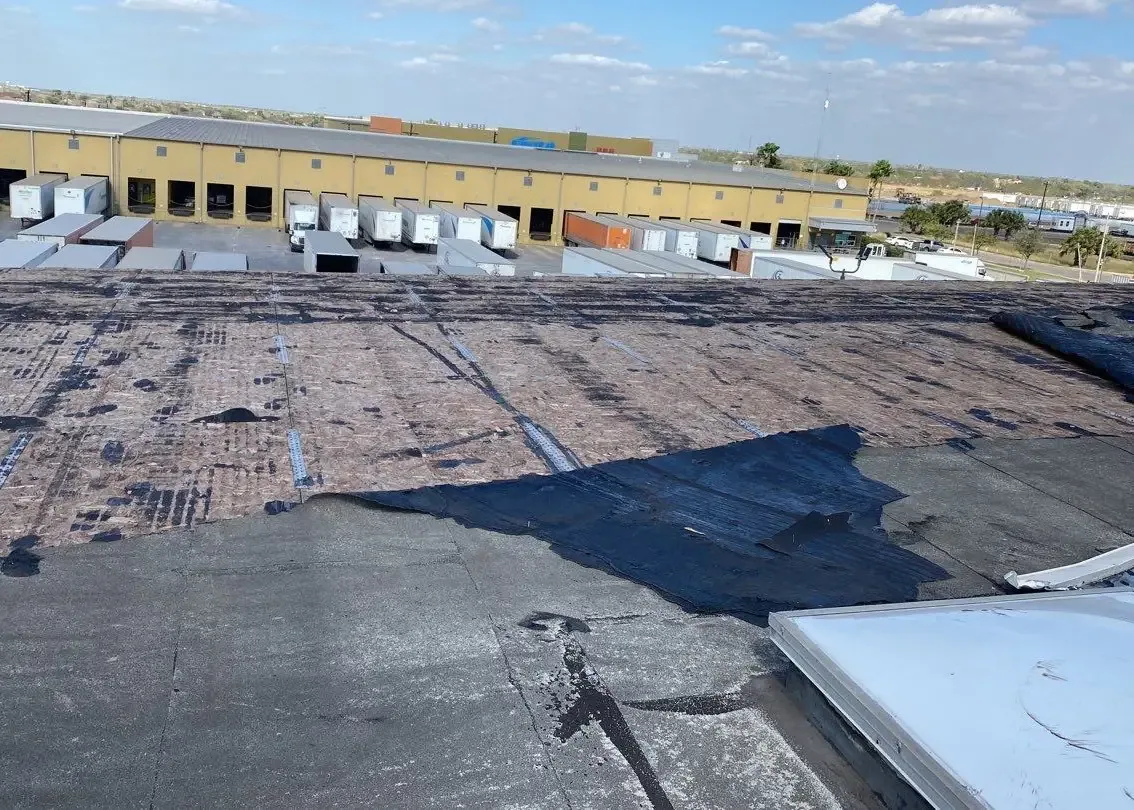
Wind Damage Roof Repair in Sherman, TX
Wind damage roof repair in Sherman, TX: edge metal, fastener, membrane and flashing checks after storms, with moisture scans and written repair scopes.
Air moving across a flat roof speeds up at the corners and edges. Fast air carries lower pressure. The roof surface then sits under higher pressure from below, and the difference lifts the membrane. That lift is called uplift. It begins at the perimeter, where edge metal and the first rows of fasteners hold the sheet to the deck.
In Sherman, TX, April and May bring the strongest storms of the year. The wind that arrives with them tests every edge detail on every commercial roof. After a storm, we start at the perimeter, work inward and record what moved, the same sequence used in storm damage repair generally.
Follow the uplift path
Uplift follows a pattern. The highest forces act on corners. Next come the edges, then the field. A roof that fails in wind usually fails at one of three places: the edge metal, the attachment of the membrane, or a rooftop unit that was never fully secured.
We map damage in that order. First comes the edge metal, where we look for lifted cleats, bent coping and open joints. Then we check the membrane near the edge for flutter, which is movement the sheet makes when it lifts and drops. A fluttering sheet works its fasteners loose over time. Last, we look at units and curbs. Each stage has its own cause and its own repair.
Check the edge metal first
Edge metal is a thin strip of formed metal that covers the roof edge. It also pins the membrane. When wind lifts it, the membrane beneath loses its grip, and the sheet peels back from the edge. We press along the metal to find loose sections and look at the fasteners that hold it.
A bent strip can sometimes be straightened and refastened. A torn or kinked one needs replacement. If the metal has come loose, the sheet under it is checked for tears and for broken seams. Reaching the perimeter in time often saves the field of the roof from damage, which is why edge metal and coping work comes first after a storm.
Gutters and scuppers sit on the same edge. A scupper is an opening through the parapet that lets water out, and wind can bend its sleeve or open its seal. We check each one, since a bent sleeve both leaks and slows drainage. The same pass records the height of the parapet and the condition of its cap, because a short parapet gives wind an easier path under the sheet.
Test the fasteners and the deck
Mechanically attached membranes hold with screws and plates driven into the deck. Wind movement can back those screws out or enlarge the hole around them. A raised plate under the membrane is one sign. A sheet that moves under hand pressure is another.
We run a moisture scan to see whether rain entered at a loose area, then take a few core samples where the readings are high. A core shows the layers: membrane, insulation, deck. It also shows whether the deck fasteners are still tight. If fasteners are loose, we add new ones at a closer spacing before the membrane is repaired. Fully adhered and ballasted systems fail differently, so the first walk records which system we are looking at.
Ballasted roofs hold with stone or pavers, not fasteners. Wind can scatter the stone and expose the sheet. We count what moved and compare it with the original layout. Fully adhered sheets hold with glue across the whole surface. Wind lifts them in patches, and we find the patches by tapping and by moisture scan. Each system has its own repair, and mixing them up wastes money.
Read the Sherman storm record
Spring is the wind season, with tornado counts in North Texas cresting in April and May. The EF1 that came down southwest of Sherman in June 2025 tracked along Rockport Road and then southeast across Ford Road. Straight-line wind and tornado winds produce different loads, but both attack the same details. Sherman's tornado of May 15, 1896 killed 73 people and still counts among the region's deadliest.
A building that sits near an open field takes more wind at its edges than one sheltered by neighbors. Rooftop equipment and parapets add turbulence. At the strongest end, a tornado-damaged roof adds debris impact and deck damage to the picture.
Grayson County also sees hail damage and ice, and those loads weaken a membrane before the wind arrives. A sheet already bruised by hail tears more easily when it flutters. We note earlier damage on the same walk, because it changes the repair.
Build the repair in sequence
The repair follows the damage. First the area is made safe and dried in. Then loose metal is refastened or replaced. Next, the membrane is cut back to sound material and rejoined, with seams welded or re-taped to suit the sheet. Wet insulation is cut out and replaced. Flashings at the edge are rebuilt.
The last step is a seam check and a final photo set. The owner receives a written scope that lists each repaired area, the cause and any area that should be watched. When the damage covers a large share of the field, the scope compares a repair with a standing seam metal retrofit or a new membrane, so the owner sees the options on one page.
Match the check to the building
The same wind meets different buildings. Sherman's industrial plants range from food processing to semiconductor work, and Progress Park holds tenants such as Tyson Foods and Kaiser Aluminum. Plants like these carry rooftop exhaust, makeup air units and long runs of edge metal. Each unit is a possible lift point.
A logistics site near Denison, or one along US 75 and US 82, may sit on open ground with long, low walls. Wind builds speed across open ground. A warehouse with few neighbors takes more load at its corners than a building in a tight cluster. For a warehouse roof, we pay close attention to the corners and to the dock-side parapet, where wind can enter under the sheet.
Expect this on site
The first visit is a walk with a moisture scan. The crew photographs each damaged area, marks it on a roof plan and covers open areas with a temporary seal. If rain is coming, the work stops at a watertight point. Occupied space below is protected with plastic and, where needed, buckets and drains cleared of debris.
Repairs come next. The crew works in sections, so only a portion of the roof is open at any time. Noise from fastening and cutting is scheduled with the building manager. When the work is done, the owner receives a photo set, a repair list and notes on what to watch. The same photos and scope also serve as the record for an insurance claim.
Commercial Roofing Questions
What does wind damage look like from the ground?
Often nothing. Look for loose coping, hanging metal, debris on the roof or water stains inside. A roof walk finds the rest.
Can wind damage be repaired without replacing the roof?
Yes, when damage is local and the deck and insulation are sound. Moisture scans and core samples show whether that is true.
How soon should a roof be checked after a storm?
As soon as it is safe to reach. Early checks stop small openings from becoming leaks.
Does wind damage qualify for an insurance claim?
It can. We document cause and extent with dated photos so the owner can file with the carrier.
Why do edges fail before the field?
Wind pressure peaks at corners and edges, so the perimeter takes the largest uplift forces.
What if the wind only lifted part of the membrane?
Partial lifts still let water in at the edges of the lifted area. We cut back to sound material, rebuild the attachment and weld or tape the seams.
Send the address and leak history
Send the building address and any past leak history. We will walk the roof, run the moisture scan and explain what the readings show.
Related Roofing Work
Sherman
Commercial roofing in Sherman, TX for fabs, food plants, hospitals and the college: moisture scans, seam repair, recovers and storm checks on flat roofs.
Storm Damage Roof Repair
Commercial storm damage assessment and repair in Sherman, TX: wind uplift, hail bruises and debris impact found, documented, dried out and rebuilt in order.
Edge Metal, Coping and Gutters
Edge metal, coping, gutter and downspout repair for commercial roofs in Sherman, TX: cleat fastening, joint sealing, thermal movement and wind uplift.
Tornado Damage Roof Repair
Tornado damage roof repair in Sherman, TX: emergency dry-in, structural review, debris impact checks and phased rebuilds for commercial and institutional roofs.