
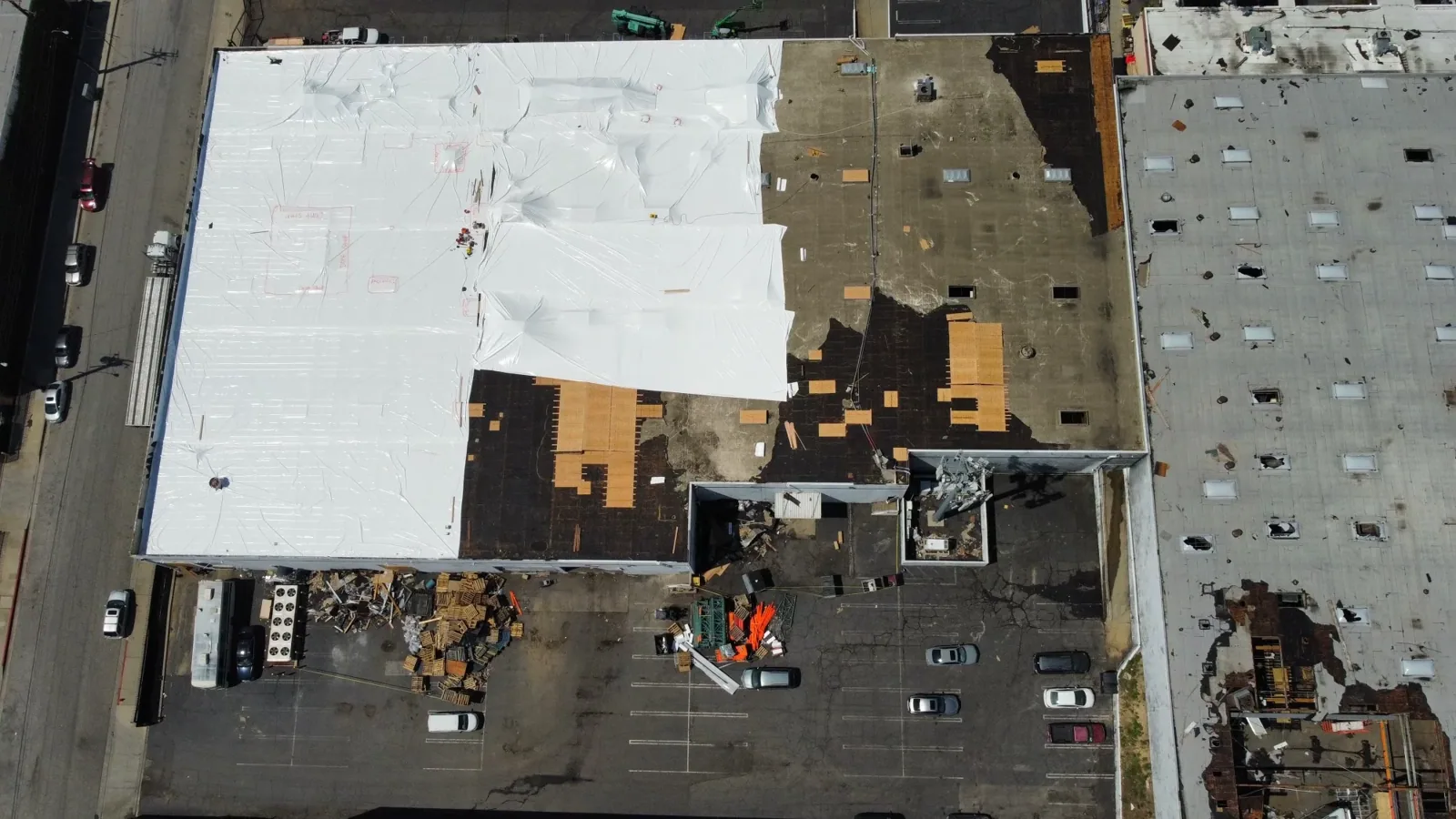
Tornado Damage Roof Repair in Sherman, TX
Tornado damage roof repair in Sherman, TX: emergency dry-in, structural review, debris impact checks and phased rebuilds for commercial and institutional roofs.
A tornado loads a roof in three ways at once. Suction lifts the membrane and the deck. Wind-driven debris punches through the surface. Rapid pressure change tries to pull the building envelope apart. Ordinary wind repair deals with one of these. A tornado brings all three, and the damage can reach the structure itself.
That is why tornado repair starts with a structural question, not a roofing question. Is the deck still attached? Are the supports sound? In Sherman, TX, the answer is never assumed. The May 15, 1896 Sherman tornado killed 73 people, and only one other storm on the Fort Worth weather office's list of North and Central Texas tornadoes killed more. We begin with safety and work toward the roof.
Place the risk in the local record
North and Central Texas see their peak tornado months in April and May. Grayson County has felt them. The June 8, 2025 EF1 followed Rockport Road southwest of Sherman, then moved southeast across Ford Road. On March 21, 2022, an EF2 tornado caused heavy damage in Sherwood Shores on the Red River. In April 2016, Howe, on Sherman's southern border, lost part of its high school and several homes to an EF1.
South of the county line, a May 9, 2006 F3 tornado hit Westminster in northeast Collin County, and a tornado warning that night covered southeastern Grayson County. These events show that tornadoes of different strengths cross this area. A weak one still strips membranes and tears off edge metal. A strong one can remove the deck. Each calls for a different level of repair.
The pattern for owners is clear. A tornado does not need to hit a building directly to damage it. Outer winds and flying debris reach well beyond the funnel, and the damage swath of a strong storm can be wide. Roofs several blocks from the track still deserve a walk after a warning night. Small openings found early are cheap to close, and they keep a minor storm from becoming a major loss.
Secure the building first
After a tornado, a building may be unsafe. Walls can lean, decks can sag and power lines can be down. We do not walk a tornado-damaged roof until the structure is cleared. If there is doubt, a structural engineer examines the building first, and we work from the engineer's limits.
Once the roof is safe, the first job is dry-in. Open areas are covered with tarps or temporary membrane, fastened against the wind that may follow. Debris is cleared from drains before the first tarp goes down, since a blocked drain turns a temporary cover into a pond. Interior spaces are protected from water. The emergency roof repair that follows is a stopgap, and it holds the building until permanent work starts. Photos taken at this stage record the loss before cleanup.
Utilities come next. Rooftop units may have shifted on their curbs, with gas, electric and refrigerant lines stretched or cut. We ask the owner to confirm that power and gas to the roof are shut off, and we mark every damaged unit so a licensed trade can clear it before anyone works nearby. Rushing past this step puts the crew and the building at risk.
Map the damage by zone
Tornado damage is patchy. One corner may be gone while the opposite corner is untouched. We divide the roof into zones and grade each one. The worst grade means deck, insulation and membrane all come off. The middle grade takes out membrane and some insulation but keeps the deck. The lightest grade is a repair.
Scans and cores support the map. Moisture readings show where rain entered. Cores show the condition of each layer. We also check for impact damage from debris, since a flying board can crack a deck panel without leaving a large hole. Damage to rooftop units, curbs and skylights is logged with the roof. The record forms the basis for the scope and for the insurance claim.
Debris is its own category. Roof gravel, sheet metal, insulation and pieces of other buildings can land on a roof and sit there. We remove loose debris first, since it adds weight and blocks drains, and then we look at what the debris did on impact. A heavy piece can crush insulation below a sound-looking sheet, so we probe under every impact mark.
Rebuild to resist the next storm
A rebuild is a chance to improve. We confirm with the local jurisdiction what applies to the building before design, because wind design values and product approvals can change the scope. A roof rebuilt after a tornado should be designed to meet them.
Practical steps help. Fastener spacing is tightened at the perimeter and corners. Edge metal is heavier and fastened more closely. Parapets are checked and capped. Insulation is attached with more fasteners or adhesive. These are the details that fail first in the wind, and the same checks appear in wind damage roof repair. A roof rebuilt this way gives the owner a stronger edge on the next event.
Permitting and inspection follow the jurisdiction's rules. Some rebuilds need engineered drawings, wind uplift calculations or product approvals. We gather what is needed early so the schedule does not stall at the permit counter. When the work is complete, the final inspection and the closeout photo set go into the building file.
Pick materials for the exposure
Material choice affects how a roof handles debris. Ballasted roofs can scatter stone and become projectiles. Stone and pavers are loose until they are locked in place, so a rebuilt ballasted roof should use fewer loose pieces or a restraint that keeps them down. Light membranes tear more easily. A standing seam metal roof sheds wind well when its clips and edges are right. Thicker membranes and cover boards resist debris impact better. Hail, which often travels with tornadic storms, adds its own damage, and hail damage repair addresses the bruises it leaves.
We show the owner options with their cost drivers and their wind-resistance trade-offs. The choice depends on the building, the budget and the schedule. We record the decision and its basis in the building file.
Work around the building's use
Tornado repair on an occupied building is complex. Schools, a category that includes the Howe high school damaged in 2016, need work finished before term. Hospitals need infection control. Plants need to restart production. Retail needs customers to return. We phase the work so the most critical areas return to service first.
For a school roof, we coordinate with the district on access, noise and student safety. For work in Howe, Sherwood Shores and the rest of the county, the owner gets a zone map, a written scope, a calendar and a closeout set of photographs. The record helps for years afterward.
Commercial Roofing Questions
What comes first after a tornado?
Safety. The structure is cleared, then the roof is dried in with temporary protection.
Do I need an engineer?
If decks sag, walls lean or supports look bent, yes. We work within the engineer's limits.
Can part of a tornado-damaged roof be saved?
Often. Zones with sound decks and limited damage can be repaired while others are replaced.
How long does a rebuild take?
Time varies with damage, materials and weather. We phase work so key areas return to use early.
What records support an insurance claim?
Dated photos, a zone map, moisture readings, core samples and a written scope.
Send the address and damage history
Send the building address and any past leak history. We will walk the roof once it is safe, map the damage and explain what the readings show.
Related Roofing Work
Emergency Roof Repair
Round-the-clock emergency roof repair in Sherman, TX: tarping, dry-in and temporary fixes after storms, with full documentation for your insurance claim.
Roof Insurance Claim Assistance
Documentation and coordination for commercial roof insurance claims in Sherman, TX: dated photos, moisture maps, test squares, scope lines and adjuster visits.
Wind Damage Roof Repair
Wind damage roof repair in Sherman, TX: edge metal, fastener, membrane and flashing checks after storms, with moisture scans and written repair scopes.
Standing Seam Metal Roofing
Standing seam metal roofing in Sherman, TX: how clips and seams let panels float, where they fail in wind and hail, and how we inspect and repair them.