
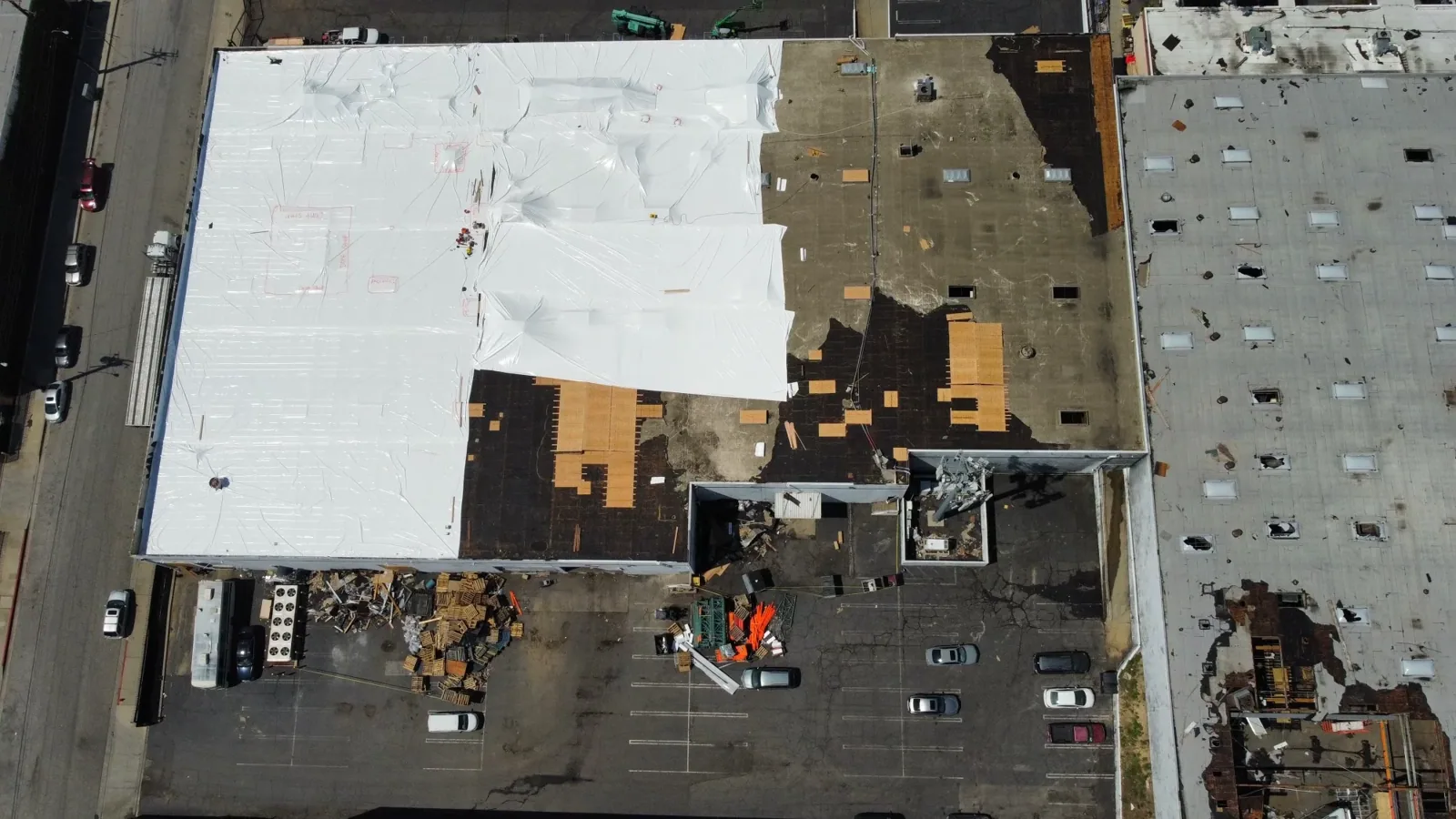
Hail Damage Roof Repair in Sherman, TX
Hail damage roof repair in Sherman, TX: find bruises, fractured membranes and dented metal with moisture scans and core samples, then repair and document.
A hailstone hits a roof at speed. The energy has to go somewhere. On a hard surface it dents or cracks the material. On a soft assembly it crushes the layer below. A membrane over insulation takes the blow like a bruise on skin. The surface may stay whole while the material under it breaks.
That hidden damage is what makes hail hard to judge. A roof can look fine from the ground and from the edge. The membrane may be fractured at the fiber layer. The insulation may be crushed. Water then enters through tiny cracks over months. In Sherman, TX, we judge hail damage by test, not by sight. A moisture scan and a few core samples show what the surface hides.
Read the local hail record
Grayson County sees hail in spring and early summer. A June 8, 2025 report from northwest of Denison put the stones at half-dollar size, the same day an EF1 touched down southwest of Sherman. Earlier, on April 3, 2014, the weather service logged dime-size stones north of Sadler and penny-size stones in the Luella area, southeast of Sherman.
Those reports show a range. Penny and dime hail can bruise thin membranes and dent metal. Half-dollar hail is larger and strikes harder. The size matters, but so does the roof. An old, brittle sheet breaks under smaller hail than a new, flexible one. A roof with a thin cover board or none takes more crushing than one with a firm layer. We note the date of each storm in the file and compare it to what the roof shows.
Hail often travels with other severe weather. The June 2025 hail report came the day of a tornado touchdown, so a roof may carry both hail bruises and wind damage. Where a funnel has crossed the area, the work on a tornado-damaged roof adds debris and structural checks to the hail survey. Separate causes are logged separately, since they follow different repair paths.
Inspect without guessing
The first step is a walk of the whole roof. We look for round marks, cracked granules on bituminous sheets, dented metal edges, bent vents and broken skylights. Soft metal, such as flashing and gutters, shows hail marks first. Their count and size tell us how hard the storm hit.
Then we scan. A moisture scan finds wet insulation, which proves water has entered. We mark each wet zone and cut core samples at the worst points. A core shows crushed insulation, a fractured membrane and any wet layer. A drone pass speeds up the survey on large roofs, and the drone roof inspection gives a clear photo record of marks that are hard to reach.
Skylights, vents and rooftop units deserve a close look. Plastic domes crack. Aluminum vents dent and split at the seams. Condenser coils bend and lose capacity. Each item is photographed and tagged with a location on the roof plan. A hail strike on a unit is also a leak risk at its curb, so the flashing around it is checked on the same pass.
Know how each material takes hail
Materials react differently. Thermoplastic sheets such as TPO and PVC can fracture where the stone hit, especially when old. Rubber sheets can tear or dent. Modified bitumen and built-up roofs lose their granule layer, which exposes the asphalt to sun. Foam roofs can be pitted and cracked. Metal roofs dent and may lose their coating.
Each result calls for a different repair. A fractured membrane gets a patch or a section replacement. Lost granules may call for a coating. Dented metal is often cosmetic unless the seams or coating are broken. We separate cosmetic damage from functional damage, since the two have different costs and different claims. A modified bitumen roof that lost granules, for example, may still keep water out for years if the asphalt is protected.
Age changes the answer. A roof near the end of its service life may have been losing water-shedding ability anyway, and hail speeds that up. A newer roof with a flexible sheet may shrug off the same stones. We record roof age and prior repairs where the owner can supply them, and we ask for the original specification when it exists.
Repair the functional damage first
Repair starts with anything that lets water in. Cracked membrane is cut out and patched. Crushed insulation is removed and replaced. Broken skylights and vents are replaced. Flashings that took hits are inspected and rebuilt where needed. A bruise with no crack may only need monitoring.
When damage covers a large share of the field, patching stops making sense. We compare the cost of many patches with the cost of a recover or replacement. If the insulation is crushed across the roof, a recover may not be possible, since the new layer needs a firm base. The scope shows both options with their cost drivers. Small punctures from hail debris follow the methods in membrane puncture repair, and storm-wide work follows storm damage roof repair.
After repair, we run a new moisture scan to confirm that the patched zones are dry. Core holes are sealed, and each repair is numbered on the plan. A recheck after the next heavy rain confirms that nothing was missed.
Document for the insurance claim
Hail claims turn on evidence. The carrier needs the storm date, the damage type and the extent. We supply a dated photo set, a map of hail marks, moisture readings and core samples. We also record roof age and condition where it is known, since older roofs may have wear that the carrier separates from storm loss.
A clean record helps the owner. It shows which damage came from the storm and which came from age. The insurance claim assistance we offer follows this method. The claim deadline matters too. Many policies limit the time to report, so the inspection should happen soon after the storm, not at the next leak.
If the carrier sends its own adjuster, we can walk the roof with that adjuster and point to the same marks, cores and readings. Differences in findings are easier to settle when both sides stand over the same sample.
Adjust for the building
Hail meets many kinds of buildings. Sherman has food, semiconductor, laser, valve and metal plants, three hospitals and Austin College. Denison adds Foundation Business Park. Each has rooftop equipment, skylights and vents that hail can break. Sensitive sites, such as hospitals and clean-process plants, need fast repair of any opening. Retail and school roofs need quick work that clears public areas.
After a storm in Denison or Sherman, we triage. The most exposed buildings are walked first. Openings are sealed the same day. Full inspections follow as access allows, and the owner receives a ranked list of roofs and sections by urgency.
Progress Park, the master-planned industrial park in Sherman, and the logistics sites near US 75 can present long roof runs with many drains. Hail clogs drains with granules and debris, so each sump is cleared and checked after a storm.
Commercial Roofing Questions
Can hail damage a roof without a visible hole?
Yes. Bruises and fractures can let water in later. Scans and core samples find them.
How soon after a storm should the roof be checked?
Soon. Early inspection finds openings before they leak and fits most claim deadlines.
Do dented metal edges mean the roof failed?
Not always. Dents are often cosmetic. We check for broken seams, coating loss and water entry.
Will hail damage lead to a full replacement?
Only if damage is widespread or the insulation is crushed across the roof. Otherwise targeted repair works.
What proof helps an insurance claim?
Dated photos, a hail mark map, moisture readings and core samples tied to a storm date.
Send the address and storm date
Send the building address and any past leak history. We will walk the roof, run the moisture scan and explain what the readings show.
Related Roofing Work
Tornado Damage Roof Repair
Tornado damage roof repair in Sherman, TX: emergency dry-in, structural review, debris impact checks and phased rebuilds for commercial and institutional roofs.
Drone Roof Inspection
Drone roof inspections for large and hard-to-reach commercial buildings in Sherman, TX, with high-resolution imagery, thermal capture and a mapped report.
Modified Bitumen Roofing
SBS and APP modified bitumen roofing in Sherman, TX: how layered asphalt sheets move, where laps and flashings fail, and how we test, repair and replace them.
Membrane Puncture Repair
Membrane puncture repair in Sherman, TX: find cuts, tears and impact bruises from foot traffic and debris, check the insulation below and patch to match.