
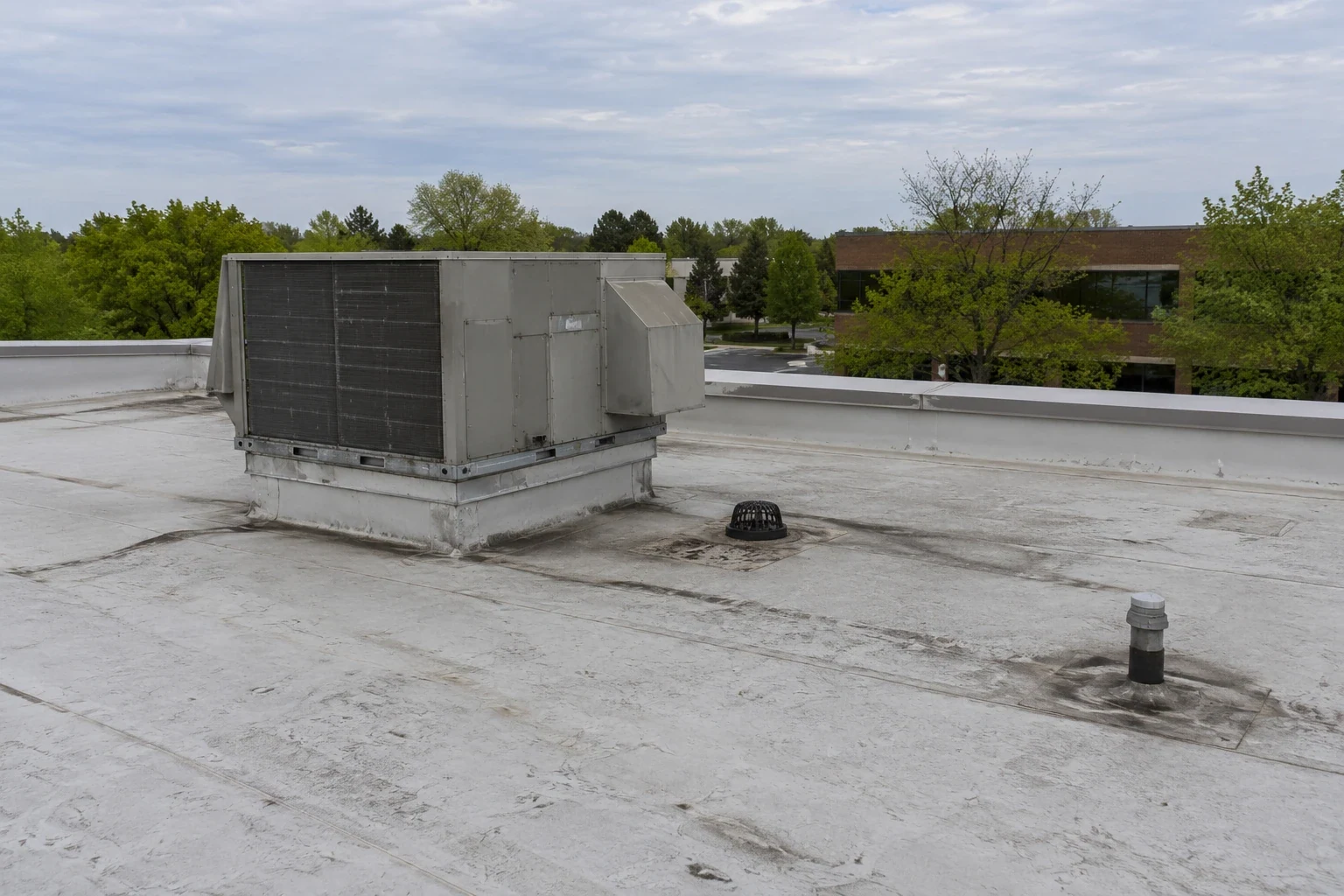
Office Building Roofing in Sherman, TX
Office building roofing in Sherman, TX: curb and drain repair, tenant-friendly scheduling and moisture scans that separate roof leaks from HVAC condensate.
Condensate and roof water leave the same stain on an office ceiling tile. The cause is different, and so is the fix. Rooftop air handlers drip when a drain pan clogs. A membrane leaks when a seam opens or a flashing lets go. In Sherman, TX both problems get worse in July, when a roof that has seen 113 F pulls hardest on every joint.
An office roof is usually quiet. It carries units, drains and a few skylights. Tenants never see it. They see a stained tile, a wet carpet edge or a call from the facility manager. We start by sorting the cause, then repair the part that failed.
Read the Ceiling Before the Roof
Water travels. It enters at a seam, runs along a joist, and drops where the line breaks. A stain sits below the exit point, not the entry point. We map every interior stain on a floor plan before we go up.
Then we compare the map with the roof plan. Stains in a line often follow a drain run or a deck joint. Stains in a cluster often sit under a curb. Both patterns narrow the search before any tool touches the roof. A leak repair then targets the right spot.
A dry-weather stain points to condensate. A stain that appears only after rain points to the membrane. Facility staff notes on when each stain appeared help here. We add them to the file.
Track Rooftop Units and Their Curbs
Most office roofs hold packaged units on curbs. Each curb is a box cut through the membrane. Its flashing climbs the side and tucks under a counterflashing. Heat cycling opens that tuck over time. Sealant dries and cracks. Water then rides the curb wall into the building.
We check every curb for gaps, torn corners and loose fasteners. We also check the cabinet itself. A unit with a failed gasket lets rain into the duct, and that rain looks like a roof leak.
Refrigerant lines and electrical conduit cross the roof too. Each support under them is another small penetration. Where they are crowded, a fluid-applied flashing often closes the gaps better than a cut sheet patch.
Work Around Tenants and Suites
An office does not stop for a reroof. Phones ring, meetings run, and clients arrive. We plan the work in zones. Each zone is opened, repaired and sealed in one day. No section sits open overnight.
Noise is the main complaint. Tear-off and deck fastening are loud. We schedule them for early hours or for the suites with the fewest meetings below. Hoisting stays on the side away from the entrance.
A reroof over occupied space works best when the manager shares the lease calendar with us. Quiet-hour clauses and move-in dates drive the sequence. We put them into the schedule from the start and keep the tenant notice short and plain.
Check Drains, Parapets and Edges
Low-slope office roofs drain to interior bowls or perimeter scuppers. Both clog. Leaves, grit and spent sealant collect there. Water that stays on a flat roof for two days speeds up membrane wear and adds weight to the deck.
Parapet walls hold their own risk. Coping stones shift. Reglets lose sealant. Water finds the gap and runs behind the flashing. The wall looks fine from the sidewalk. We probe it from the roof side.
Edges take wind first. Uplift peels back a coping or a perimeter flashing, and then the membrane can follow. After a storm, we check the edge metal before we check the field. Our edge metal and coping work follows that order.
Count Heat, Hail and Snow Into the Plan
Rain, sleet and snow fall on roughly 79 days a year in Sherman. North Texas tornadoes crowd into April and May. Hail of dime size fell north of Sadler in April 2014, small by hail standards, yet enough to bruise a thin office membrane.
Hail leaves impact bruises in the insulation under the membrane. The surface may look intact. A moisture scan finds the bruise, and a core sample confirms it. That evidence matters for a hail damage repair decision and for any claim.
Winter adds load. Isolated Grayson County spots took 9 to 11 inches of snow in January 2025. Drains and scuppers that were clear in October can sit blocked in January. A fall walk-through costs little.
Choose Between Patch, Recover and Replace
A patch fits a roof with a few isolated openings and dry insulation. A recover fits a roof with sound insulation and a membrane near the end of its life. A replacement fits wet insulation or a failed deck. The scan and the cores tell which one applies.
The lowest first cost is a patch, and a patched roof can need patching again. We show the repair, the recover and the replacement side by side, with what each leaves untouched. The owner decides which fits the budget.
A white membrane such as TPO cuts rooftop heat and eases cooling load on the units below. A thicker membrane or added cover board helps against hail. Each choice has a tradeoff, and we state it.
Match Office Roofs to Sherman and Denison
Denison, about 11 miles north of Sherman on US 75, counts Cigna and Anthem among its employers, and the city was founded in 1872 beside a rail depot, so its downtown stock runs to older brick and flat roofs. Sherman, the county seat, sits where US 75 and US 82 cross, with offices along both highways.
Older brick buildings need parapet and drain work first. Newer suburban offices need unit curbs and seam checks first. A Denison office roof and a Sherman one can share a record, so the owner of both sees one ranking, much as a medical office in the same portfolio would.
An owner of office space may also hold medical suites. A medical suite brings stricter dust and noise limits than a plain office, and a hospital roof brings stricter ones still. When one owner holds both kinds of space, we sequence the quiet suites last and write the limits into the plan before the first day.
Surface condition varies by age. A roof from the last ten years may need only seam checks and drain cleaning. An older roof may need cores at every low spot. We set the scope from what the scan finds, not from the age on the lease.
Commercial Roofing Questions
How do I tell a roof leak from an air handler drip?
Check the weather. A stain that grows on a dry, humid day points to condensate. A stain that appears after rain points to the roof. A moisture scan settles the cases in between.
Will tenants lose power or air during a reroof?
Not for roof work alone. Units stay on their curbs unless the curb itself needs replacing. If one must shut down, the building engineer picks the hour and tenants get notice first.
Does a flat office roof need a special drain plan?
Yes, because standing water is the common cause of early wear. We check slope with a level and add tapered insulation or a new drain bowl where water sits more than two days.
What records help most at lease renewal?
Dated photos of each repair, the moisture map and the core results. A tenant or buyer can read them in minutes. They show what was fixed and what remains open.
Is a coating enough for an aging office roof?
Only over dry insulation and a sound membrane. A coating seals the surface and cuts heat. It cannot dry wet board. The scan decides whether coating is a real option.
Send the Address and the Stain Map
Send the building address, the floor plan with stain locations, and any past leak history. We will walk the roof with you and explain what the readings show.
Related Roofing Work
Commercial Roof Leak Repair
Tracing and stopping active commercial roof leaks in Sherman, TX with moisture mapping, water testing and repairs matched to the real entry point.
Occupied Building Reroofing
Reroofing Sherman, TX hospitals, schools, plants and offices while they stay open, with sectioned tear-off, dust and noise control and daily closure.
Edge Metal, Coping and Gutters
Edge metal, coping, gutter and downspout repair for commercial roofs in Sherman, TX: cleat fastening, joint sealing, thermal movement and wind uplift.
Hail Damage Roof Repair
Hail damage roof repair in Sherman, TX: find bruises, fractured membranes and dented metal with moisture scans and core samples, then repair and document.