
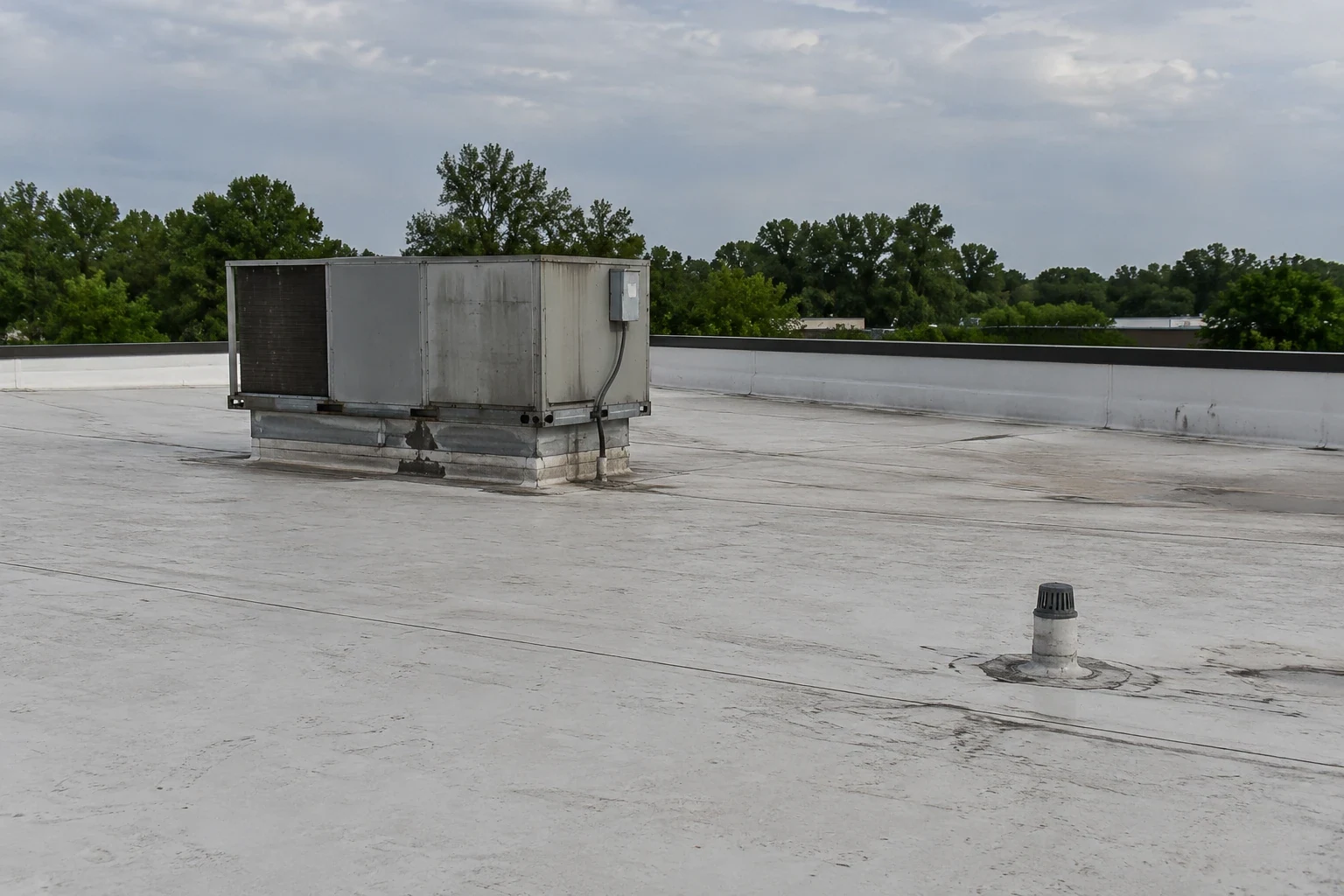
Flex and Light-Industrial Roofing in Sherman, TX
Flex and light-industrial roofing in Sherman, TX: shared roofs over tenant bays, wall flashing, rooftop units and repairs that respect each tenant's schedule.
A flex building has one roof and many tenants. Underneath are office fronts, storage bays and small shops split by demising walls. Above them is one continuous membrane. Water does not respect the lease line. A leak over bay three can come from a flashing over bay five. Heat does not either. A dark roof over a bay with a heavy cooling load works the same seams as the roof over an empty one.
In Sherman, TX the stretch from a record 113 F to a record low of -3 F is the daily engine behind most flex-roof failures. Seams, curbs and wall terminations move with every swing. We read the roof as one assembly, then tie each finding to the bay it affects, so the owner and the tenants hear the same story.
Trace the Roof Across the Demising Walls
Most flex buildings are low-slope with a membrane over rigid insulation on a steel deck. The deck rides on joists, and the walls are tilt-up concrete or pre-engineered metal. Drains are few and set near the long walls, with scuppers as overflow. Between tenants the roof is uninterrupted, so one failed seam can wet several bays.
We map the roof against the bay layout. That tells us which tenant sits under which drain, which curb and which wall flashing. It also shows where the roof slopes toward a shared wall, since that is where water collects when a drain slows down. We mark those low zones and measure how deep the water stands after rain. A tenant who reports a drip in a back corner may sit under a drain on the next bay over. Without the map, a repair lands in the wrong place. With it, we go to the high point, follow the water and fix the actual opening.
Seal the Wall-to-Roof Joint
The joint where roof meets wall is the most worked part of a flex roof. Tilt-up panels shift a little as they heat and cool. The membrane is glued or fastened at the base and turned up under a cap or reglet. If the cap loosens, water runs behind it. If the glue lets go, the membrane sags and pulls away.
We check the wall base along its full length. We press the membrane at the turn-up and look for gaps at the cap. Where sealant has split, we cut it out and reseal, and where the flashing has pulled, we replace it. A section of failed wall flashing is a short repair, often finished in a single visit once the cap is lifted and the old sealant is cleaned out. Left alone through a few winters, it becomes a wet wall and a wet deck. A drain and scupper check goes with it because the two points usually fail in the same corner.
Keep Tenant Equipment From Wearing the Roof
Flex buildings add rooftop units one tenant at a time. A new tenant brings a new unit, a new curb, a new line set and a new technician walking the roof. Over time the roof carries a loose collection of equipment, each with a different installer and a different level of care. Condensate lines run across the membrane. Panels get left open. Screws drop into the seams.
We track each unit, flange and pipe on the roof drawing. Weak curbs get rebuilt, and walk paths get protective pads where technicians reach the same unit again and again. Our work on rooftop equipment curbs and supports includes written rules for tenants so one contractor does not undo another's repair. A foot path to the units is cheaper than a patch under them.
Fit the Roof to Sherman and Denison Business Parks
Foundation Business Park in Denison offers 3 to 20 contiguous acres fronting State Highway 91 for manufacturing and distribution, and low-slope roofs over metal and tilt-wall buildings should be common there. Tenants include Kwikset, Florestone Products, J&L Wire and FOH Furniture. A roof in Foundation Business Park sees the same heat cycling and storm exposure as any other low-slope roof in Grayson County.
In Sherman, a 60,000 square foot industrial building with 30 foot clear height and subdividable bays sits within two miles of US 75 and US 82. At Progress Park, 64 acres went under contract in 2017, so new buildings keep arriving beside older ones. A newer roof still needs a first-year walk to catch fastener backout and loose caps. An older roof needs a moisture scan before anyone decides on a coating. Each building has its own history, and the park name does not tell us the roof.
Read the Roof After Hail and Wind
The June 8, 2025 storm sent half-dollar hail across the area northwest of Denison and an EF1 southwest of Sherman. Hail hits all bays at once, but the roof records it unevenly. Facing, tree cover and parapet shadow change the pattern. After a storm we scan the roof and count impact marks in test squares across the whole building, not just over the tenant who called.
Wind works at the edges. Flex buildings have long perimeter runs, and coping or edge trim loosens at joints. We check each section. Preventive visits, scheduled around tenant hours, catch these items before they leak. A written maintenance plan gives the owner a file for the lender, the insurer and the next buyer.
Schedule Around Tenants and Shared Docks
Flex roofs are re-roofed in phases. We start over the empty bays, then move over the active ones. Tenants get notice of noisy days and the hour the lift will sit by their door. Dock doors stay clear. Ceiling protection goes in before work above sensitive stock, and the crew sweeps the lot before leaving each evening. Occupied building reroofing works best with a written phase plan that every tenant has seen. Owners with larger shells may also compare the warehouse approach or the distribution center approach, which add dock seals, tall walls and heavier drain loads.
Phasing also protects the budget. A phase that covers the worst third of the roof first stops the leaks that cost tenants money. The remaining sections follow on a plan that matches lease dates and cash flow. We price each phase on its own, so the owner can approve one at a time and see exactly what each stage covers.
Commercial Roofing Questions
Why does a tenant report leaks that start in a different bay?
Water runs along the deck and the insulation before it drops. The entry point is often at a drain, curb or wall joint several bays away. We trace the path from the roof side.
Who pays when tenant equipment damages the roof?
That depends on the lease. We document the cause, the location and the repair with photographs so the owner has the facts when the question comes up.
Can one tenant's section be fixed without touching the rest?
Usually. A localized repair at a curb, seam or wall joint stays inside that bay. If the membrane is failing building-wide, a phased plan makes more sense.
What should a new owner check on a flex building roof?
Start with drains, wall flashing and the condition of every curb. Then get a moisture scan. Those three findings set the budget for the first few years.
How do you protect stock or machinery during roof work?
We tarp or screen the interior zone below the work, coordinate with the tenant on timing and keep open seams to a minimum. We close every open section before the crew leaves each evening.
Send the Building Address and Bay Layout
Share a sketch of the bays, the tenants who have reported leaks and any past repairs. We will walk the roof and explain what the seams, drains and walls show.
Related Roofing Work
Roof Drains and Scuppers
Drain, scupper and ponding correction for commercial roofs in Sherman, TX: sump repair, overflow sizing, crickets and tapered insulation that clear water.
Rooftop Equipment Curbs and Supports
Rooftop unit curbs, equipment rails and pipe supports for Sherman, TX commercial roofs: load paths, curb flashing, vibration, walkway wear and timing.
Foundation Business Park, Denison
Commercial roofing in Foundation Business Park, Denison, TX: tilt-wall parapet repair, metal roof restoration and membrane scans for plants and warehouses.
Progress Park
Commercial roofing in Progress Park, Sherman, TX: scans, seam repair and recovers for food, beverage and metals plants, with baseline surveys for new buildings.