
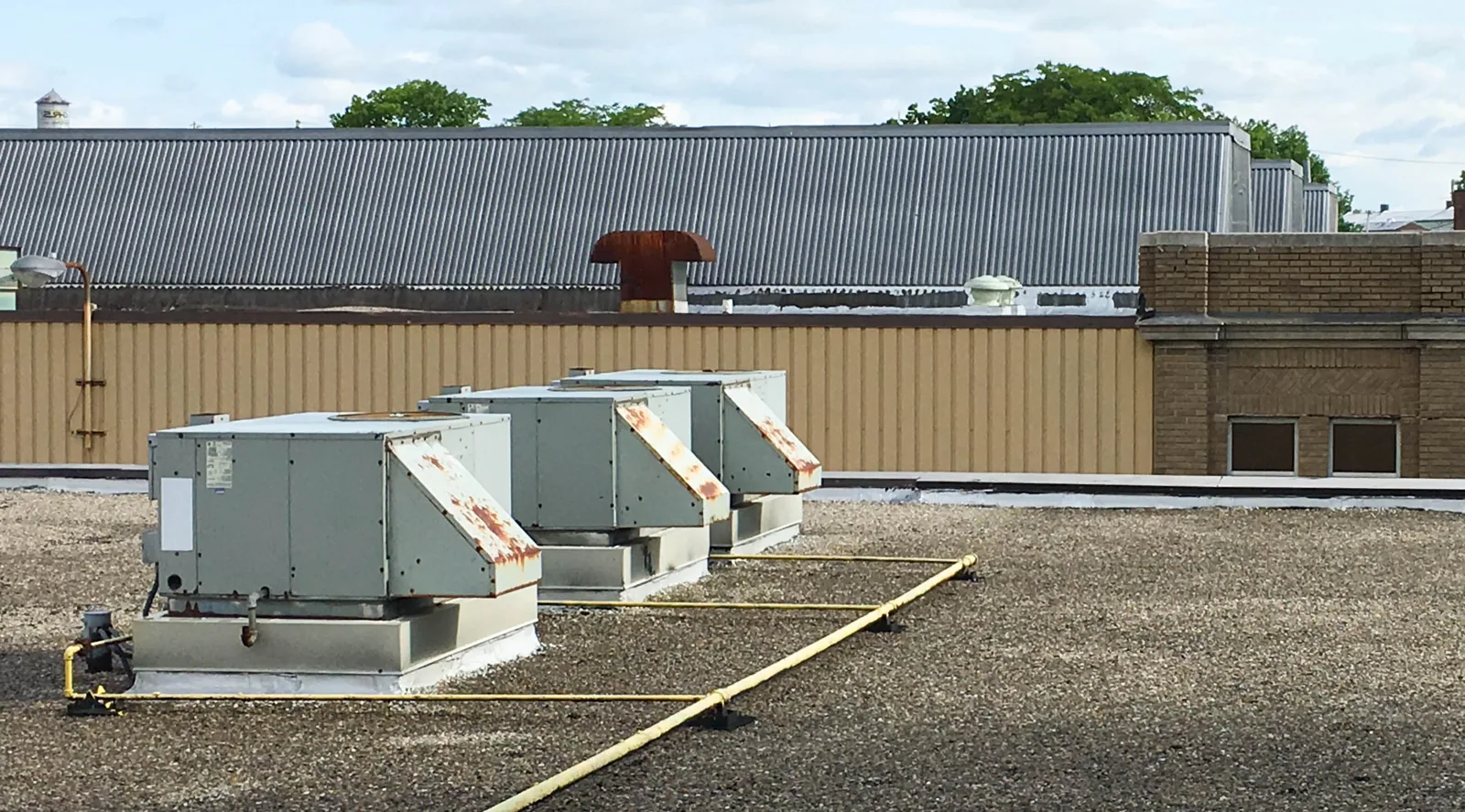
Rooftop Equipment Curbs and Supports in Sherman, TX
Rooftop unit curbs, equipment rails and pipe supports for Sherman, TX commercial roofs: load paths, curb flashing, vibration, walkway wear and timing.
A rooftop unit is heavy and it hums. The weight lands on a few small feet. The hum shakes the frame. Both effects pass into the roof. The membrane under a foot gets crushed. The seal around a curb gets worked loose. Water finds the gap.
Equipment is the usual reason a roof is penetrated, and the usual reason it leaks. On commercial roofs in Sherman, TX, a plant or a hospital may carry dozens of units, vents and pipes. Each needs a support that carries load and a flashing that stays tight. The path from equipment to deck is the path we follow.
Trace the Load From Unit to Deck
Weight starts at the unit. The unit sits on a curb or a rail. The curb sits on the deck. The deck sits on joists or purlins. If any link is weak, the roof sags or leaks.
We check each link. Is the curb fastened to structure, or only to the deck? Does the deck have a support under the curb? Do rails spread the load or point-load it? A unit on a thin steel deck without framing under it bends the deck over time, and the sag becomes a pond.
We also check for added units. Over the years, owners add units. Each addition adds load. The roof may not have been designed for the total. A structural review shows the margin. If the margin is thin, we note it for the owner's engineer. Wind loads matter too. A unit is a sail. Tie-downs and curb straps resist uplift. We check straps for rust and loose bolts. A unit that rocks in a gust works its curb loose, and then the flashing tears.
Inspect Curbs as Boxes That Must Stay Sealed
A curb is a box. It raises the unit above the roof. The membrane runs up its sides and the cap flashing covers the top. Water should run off the cap and down the outside.
Curbs fail at corners, at the base and at the top edge. Corners open where membrane is folded. The base cracks where the membrane pulls from the field. The top edge leaks where the cap lifts or the sealant fails. We check all three.
Curb height matters. Too low, and water splashes in. Too high, and wind loads rise. The right height follows the maker's detail and the roof's insulation thickness. If the roof has been built up, the curb may now be too short. Raising it is part of the fix. A skylight and penetration flashing repair uses the same sequence. Curb material varies. Wood curbs rot. Steel curbs rust. Insulated curbs hold moisture in the core if the cap leaks. We probe, we tap and we look for signs inside. When a curb is past repair, we replace it with a new one built to the unit. A moisture meter on the curb wall shows damp insulation inside. A damp core means the cap or the base has been leaking for a while, and the interior of the curb needs replacing, not just resealing.
Control Vibration and Wear at the Supports
Fans and compressors vibrate. Vibration moves through the frame into the curb. Over time it loosens fasteners and cracks sealant. Isolation pads and spring mounts reduce it. We check that they are present and sound.
Pipe supports are another weak point. A pipe laid on the membrane rubs it. Thermal movement slides the pipe a little each day. Over a year, the membrane thins. Pipe sleepers, blocks and rollers lift the pipe and spread the load. We use ones that suit the pipe size and the temperature, and we put protection pads under each.
Walkways matter too. Technicians visit units often. Their route wears the membrane. Walkway pads protect it. The plan marks the route, and the pads go down before the roof is released. Noise tells a story. A rattle at a unit points to a loose mount. A drumming from the deck points to a loose fastener line. We listen on the roof and below. Both clues go on the sheet.
Plan for Heavy Equipment in Industrial Buildings
Sherman's industrial base includes food processing, semiconductor, laser, valve and metal enclosure plants. Tyson, Coherent, Emerson, Eaton B-Line and Presco are among them. Plants like these can carry large exhaust fans, dust collectors, chillers and ducts. The loads and the penetrations are bigger than those on an office roof.
Buildings in Foundation Business Park, which serves manufacturing and distribution users, are expected to be pre-engineered metal and tilt-wall with low-slope roofs. Added equipment on such roofs needs framing checks. A manufacturing plant roof may also carry process piping that crosses the roof on stands.
We list every item with weight, footprint and support type. The list goes to the owner's engineer before any change is approved. A hospital or a plant that adds process equipment adds load. Cooling equipment and exhaust grow with the process. A condenser deck that was sized for one unit may now hold three. The check is simple, and the answer protects the roof.
Sequence a Curb Replacement With the Unit
When a unit is replaced, the curb should be checked at the same time. A new unit on a failing curb wastes the investment. We coordinate with the mechanical contractor. Curb sizes are compared. Adapters are used if the new unit differs.
The order of work is fixed. The old unit is disconnected and lifted. The curb is inspected and repaired or replaced. The membrane is re-flashed. The new unit is set. Final connections follow. A crane date is set early, because crane time is the tightest item. For a plant in Progress Park or a school in Denison, the lift is planned around operations, and the occupied building reroofing plan sets the access hours.
Flashing is done before the unit is set. After it is set, access is limited. Any leak behind a unit is hard to reach. So the flashing is tested with water first. Temporary curbs and caps are used when a unit is out for service. An open curb opening is covered with a rated cap, tied down. Rain should never reach an open duct. The foreman checks the cap each evening. The permit and the crane operator's lift plan are checked against the roof. The lift plan states the unit weight and the swing radius, and we mark the pick point on the sketch.
Account for Heat, Weight and Winter
Summer heat softens membrane under supports. A dark roof under a metal frame runs hot. The membrane gets soft, and the foot of the support sinks into it. Pads spread the load and shield the surface.
Winter snow loads the roof. Drifts build against units. Ice forms at supports. Meltwater runs under pipes. We check drainage near equipment and add crickets where water collects. TPO roofing and other single-ply membranes need protection from sharp edges on frames. Condensate lines drain onto roofs in summer. A line that dumps in one spot stains and wears the membrane. We run lines to drains or to splash pads. Algae growth there is a warning sign.
Commercial Roofing Questions
Can a unit be added to an existing roof?
Maybe. A structural review checks the deck and framing first.
Why do curbs leak?
Corners open, sealant ages, caps lift. Vibration speeds all three.
What are pipe sleepers?
They are supports that lift a pipe off the membrane. They prevent rubbing and spread load.
Should the curb be replaced with the unit?
Usually, if it is old or damaged. A new unit on a failing curb leaks.
Do walkway pads help?
Yes. They protect membrane on routes that technicians use often.
Send the Address and the Equipment List
Send the building address and a list of rooftop units and pipes. We will walk the roof, check each support and explain what the readings show.
Related Roofing Work
Skylight and Penetration Flashing
Skylight, curb and penetration flashing repair for commercial roofs in Sherman, TX: pipe boots, vent stacks, dome seals and curb details that stop leaks.
Foundation Business Park, Denison
Commercial roofing in Foundation Business Park, Denison, TX: tilt-wall parapet repair, metal roof restoration and membrane scans for plants and warehouses.
Manufacturing Plant Roofing
Manufacturing plant roofing in Sherman, TX: how process heat, exhaust and equipment load roofs, where plant roofs leak, and how we inspect and repair them.
Progress Park
Commercial roofing in Progress Park, Sherman, TX: scans, seam repair and recovers for food, beverage and metals plants, with baseline surveys for new buildings.