
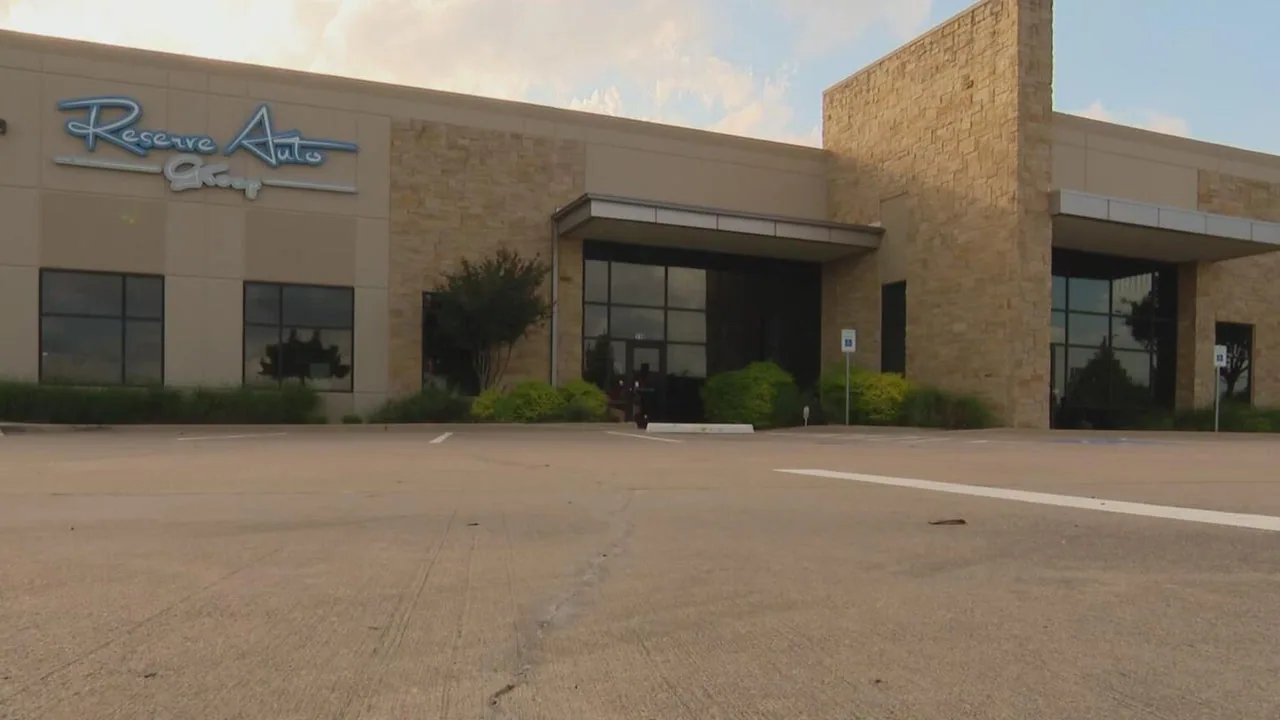
Auto Dealership Roofing in Sherman, TX
Auto dealership roofing in Sherman, TX: showroom, service bay and canopy roofs, hail and heat stress, and repairs scheduled so sales and service keep running.
A dealership is three roofs under one sign. The showroom has a tall, glass-heavy edge. The service wing has a wide, flat deck with large exhaust fans. The canopy over the delivery lane is a thin steel plane with a rain gutter. Each one moves at its own rate. Each one leaks at a different joint. In Sherman, TX the air has reached a record 113 F and dropped to -3 F, so every seam on all three is stretched and relaxed again and again.
A leak in a showroom ruins a ceiling the customer sees from the moment they walk in. A leak in a service bay drips on a lift or an electrical panel. We start by finding which of the three roofs is wet, then match the repair to its construction.
Protect the Showroom Ceiling First
The showroom parapet is the weak point. Glass walls, aluminum storefront and a tall wall of stucco or panel all end at the roof edge. Each material expands at its own rate. The joint between them is sealed with caulk, and caulk dries out. Water enters behind the coping and runs down the inside face of the wall. It shows up as a stain at the ceiling tile nearest the window.
Glass-heavy edges concentrate heat, so the sealant at the storefront joint sees more movement than the wall beside it. We choose a sealant rated for that movement and tool it deep enough to flex without tearing.
We check the coping joints, the counterflashing and the scupper at the low corner. We pull back a small section of membrane at the wall and look at the substrate beneath. Wet insulation under a showroom is common after a long-term wall leak. We cut it out and replace it with dry board before the new flashing goes on. A showroom refresh is the time to rebuild the roof edge, since new trim hides a wet wall.
Keep Exhaust, Lifts and Wiring Dry
The service wing is a different problem. The roof is wide and low-slope. Exhaust fans, make-up air units and gas lines all pass through it. Every pipe, curb and fan has a flange, and every flange is a place for sealant to fail. Paint fumes and exhaust gases are also hard on membrane near the fans. They soften some materials and stain others.
We mark each penetration on a sketch and test the flashing with a probe. Where a curb is old, we rebuild it rather than patch it. A curb and support rebuild costs less than the interior damage from a wet panel. Drains matter here as well. A clogged drain over the service bay sends water down the wall toward the lifts and the floor drain system. We clear and test every outlet and photograph the water level before and after.
Count the Hail Before the Cars Dry
A hail storm on a dealership lot gets attention for the vehicles. The roof takes the same hit. On June 8, 2025 a hail report from northwest of Denison gave half-dollar stones, and in April 2014 dime-size hail fell north of Sadler and penny-size hail fell in Luella. Hail of that size bruises single-ply membrane and cracks the top of a built-up roof. The bruise does not leak the first day. It leaks after the next several freezes.
We walk the roof after any hail report in the area. We count the impact marks per test square and photograph them beside a ruler. If the pattern is strong, we write the findings up for the insurer in plain terms. A hail damage repair with a written record of marks, drains and flashings helps the claim and speeds the insurer's review. Our claim assistance keeps the measurements in one file.
Choose a Membrane That Handles Heat and Traffic
Technicians walk the service roof to reach fans. Foot traffic wears membrane at the access path. A white TPO membrane reflects heat and welds at the seams, which suits a long, flat service roof. A thicker sheet and walk pads near the equipment protect it from wear. A coating can extend a membrane that is still dry beneath. Where the deck is wet, only a section replacement fixes it.
Cool roofing is worth weighing here. A reflective surface lowers the roof temperature on summer afternoons and reduces the daily stretch in the seams. Interior savings depend on the insulation, the HVAC load and the roof orientation, so we do not promise a number. We explain the trade-offs and let the owner decide.
Insulation matters as much as the membrane. A showroom with a high ceiling and a service wing with a metal deck gain heat in different ways. Where tapered board or new cover board goes in, ponding at the low corners drops, and the membrane sits on a firm, flat base. Heat cycling then works the seams less, and the next hail event finds a harder surface to land on.
Schedule Around Sales Hours and Delivery Days
Showroom roofs are loud. Service roofs are loud and smelly. We start early on weekdays, finish the noisy tear-off before customers arrive, and work on the quiet side of the building when the showroom is busy. Delivery lanes stay open for car haulers. Materials stay away from the front door and the customer lot.
Dealerships along US 75 and US 82 depend on visibility. A tarp, a crane or a lift in front of the sign costs sales. We plan the staging area with the general manager and clear the lot at the end of each day. Denison sits about 11 miles north of Sherman on US 75, so a group with lots in both cities needs a separate staging plan for each.
Owners of retail groups compare roof options across shopping centers and big-box stores. A dealership has the same membrane choices but a harsher set of fumes, traffic and glass. We write the scope for the building in front of us, not for a generic retail box.
Commercial Roofing Questions
Why does the showroom leak near the windows?
The roof edge meets glass, metal and stucco, and each expands differently. Sealant fails at the joint and water runs down the inside of the wall. We open the edge, check the substrate and rebuild the flashing.
Do exhaust fans damage a roof membrane?
Fumes and heat from fans can soften or stain some membranes near the discharge. We check the area around each fan and add protection or a different material where wear shows. A stained patch next to a discharge is a sign that the membrane there has already started to age faster than the field.
Will hail on the lot mean hail damage on the roof?
Not always, but the same storm hits both. We count impact marks on the roof in test squares and photograph them with a ruler. Those records tell the insurer what the roof took.
Can the canopy over the delivery lane be fixed separately?
Yes. The canopy is a thin steel deck with its own gutter and seams. We reseal the laps, clear the outlets and replace any rusted panels without touching the main roof. Gutter hangers and downspout bases get checked too, since a canopy that sheds water onto the pavement near the delivery doors creates a slick patch in winter.
How do you keep the sales floor open during work?
We schedule loud steps for early hours, protect interior ceilings with tarps and screens, and set up on the side of the building away from the front entry.
Send the Dealership Address and Leak Locations
Tell us which ceilings have stained and whether the storm damage was recent. We will walk the showroom, service wing and canopy and explain what the moisture readings show.
Related Roofing Work
Rooftop Equipment Curbs and Supports
Rooftop unit curbs, equipment rails and pipe supports for Sherman, TX commercial roofs: load paths, curb flashing, vibration, walkway wear and timing.
Hail Damage Roof Repair
Hail damage roof repair in Sherman, TX: find bruises, fractured membranes and dented metal with moisture scans and core samples, then repair and document.
Roof Insurance Claim Assistance
Documentation and coordination for commercial roof insurance claims in Sherman, TX: dated photos, moisture maps, test squares, scope lines and adjuster visits.
TPO Roofing
TPO single-ply roofing in Sherman, TX: how the welded membrane moves, where it fails, how we test seams, and how repairs and replacements are built.