
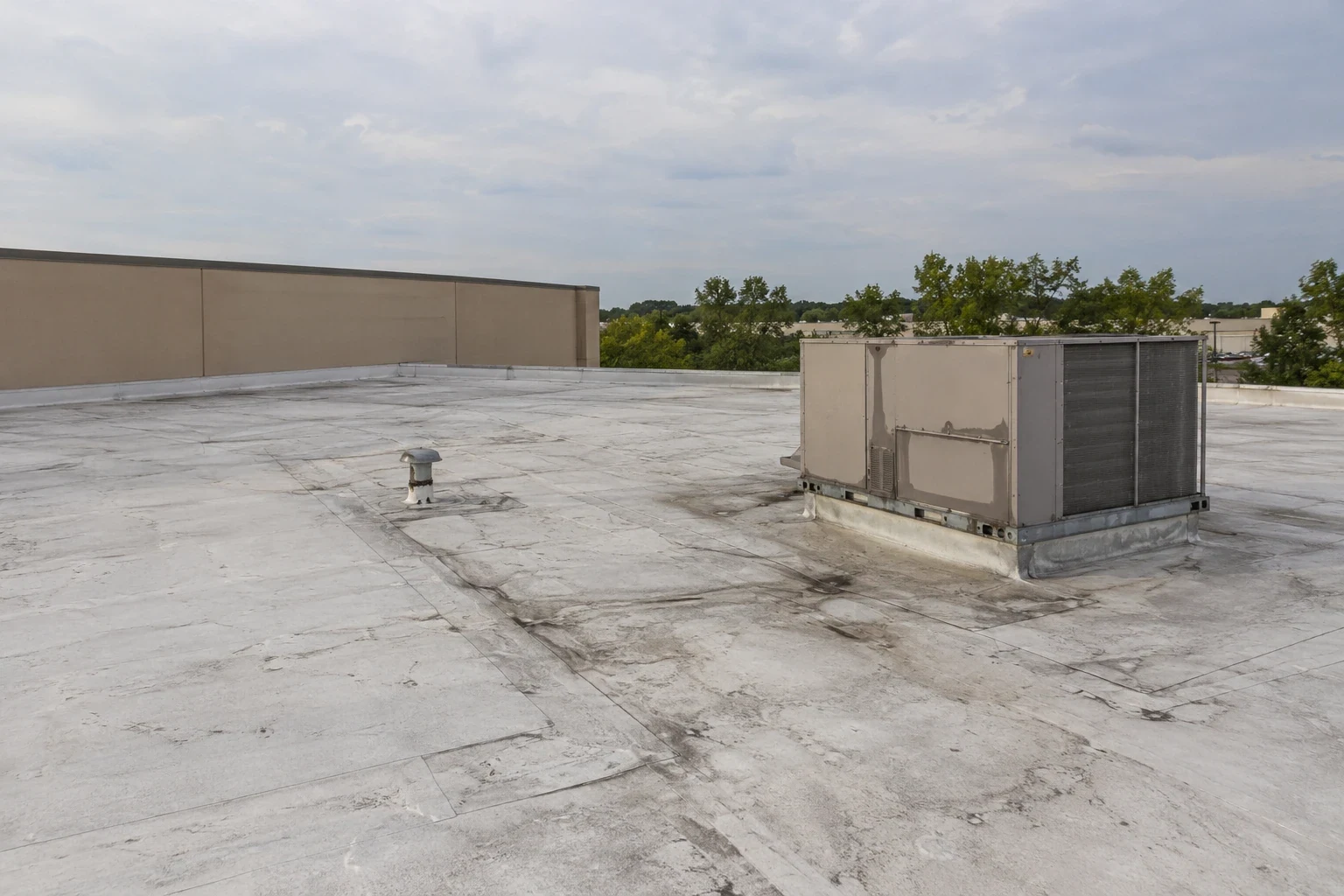
Big-Box Retail Roofing in Sherman, TX
Big-box retail roofing in Sherman, TX: moisture scans, fastener checks and phased repairs that keep a large store open while the roof is worked on.
A big-box roof is one long membrane held down by thousands of fasteners. Wind pulls up on it. Heat stretches it. Cold shrinks it. In Sherman, TX the thermometer has gone from 113 F to -3 F on record. Over years, that cycle loosens deck fasteners and lifts seams. A loose fastener pushes up under the sheet and can wear a hole from below.
So the first check is a fastener pull sample. We test a few in each section and note the results. The next check is a moisture scan across the whole field. Together they show how the roof is holding on and where water has gotten in. The owner then sees the facts before any money is committed.
Size changes the economics of every decision. A small leak on a large roof still costs an interior loss. A short delay in repair can mean a ruined stock aisle. That is why the order of work matters as much as the materials.
Test the Roof Against Uplift
Wind does not push on a roof. It pulls. Air passing over the surface lowers the pressure above it. Higher pressure below lifts the membrane. Edges and corners see the most force, so they fail first.
A mechanically attached roof relies on fasteners and plates. A ballasted roof relies on stone weight. An adhered roof relies on bond to the substrate. Each system loses strength in a different way. We identify the system, then check what that system needs. Fasteners get pulled. Ballast gets surveyed for bare spots. Adhesion gets tested by hand.
Spring is the season to check this, because tornado activity in North Texas peaks in April and May. An EF1 came down southwest of Sherman in June 2025. A roof that has passed its pull test in March has a better chance in June.
Rooftop equipment adds load. Each unit on a curb gives wind something to grab and gives water a place to enter. We check curb flashing, unit hold-downs and refrigerant line penetrations. A loose cable tray or a missing cap on a conduit can lift in a gust and tear a membrane. The fix is usually a few fasteners and a bead of sealant. The cost of missing it is far larger.
Find the Hail Damage You Cannot See
Hail near Denison on June 8, 2025 reached 1.25 inches. April 3, 2014 brought dime hail north of Sadler and penny hail around Luella. Large roofs take many hits. Each hit can bruise the membrane and crush the insulation underneath it.
Bruises are hard to see. The surface may look whole. But the insulation below has lost its shape, and water collects there. A moisture scan finds those soft spots. We mark them on a sketch and take cores to confirm. The sketch then goes to the owner and, if needed, to the insurer.
Documentation wins claims. A dated photo set from before a storm and a second set from after it tells the story. Our storm damage repair work starts with that comparison.
Protect the Sales Floor
A leak above a sales floor stops sales. Water drips on stock and fixtures. It makes a hazard on the floor. It also draws a customer complaint. So the work plan puts interior protection first.
We map every drain, unit and skylight before work starts. Then we plan temporary protection above any sensitive area. Roof sections are opened one at a time. Each section is dried in the same day. Weather watches stay open throughout, and the crew stops work when a storm cell nears.
Retail logistics matter too. Deliveries come to the back dock. Staging for roofing materials has to stay away from that traffic. We set staging areas in writing and share the map with the store manager. For a store that stays open all day, we work early. For one that closes at night, we work late.
Winter has its own rules. In December 2013 sleet and freezing rain built ice 4 to 5 inches thick across Sherman and Denison. Ice on a large roof blocks drains and sheds off the edge in sheets. Before the first freeze we clear every drain and check the scuppers. After the thaw we walk the roof again and look for seams the ice lifted.
Records close the loop. At the end of the job the owner receives photographs, material lists and a maintenance schedule. The next manager inherits a roof with a history.
Know the Stores Along the Highways
Large retail follows traffic. Sherman sits where US 75 and US 82 cross. Denison employers include Walmart. Anna on US 75 counts Walmart among its largest employers at 450 jobs. Melissa on US 75 counts Buc-ee's among its largest at 313.
Those are different buildings with different roofs. Every roof starts with a walk, a scan and a record. The record shows the membrane type, the insulation and the condition. Only then does a recommendation follow.
Fast-growing towns add stores quickly, and fast construction can leave seams unwelded or flashings unsealed. We suggest a first-year inspection for any new store, and we log the baseline for later comparison. Anna, which more than doubled to an estimated 35,245 people by 2025, is where that first-year check matters most, and Denison stores get the same treatment.
Pick Repair, Recover or Replace
The cheapest fix is the one the evidence supports. A dry roof with a sound sheet can take a coating. Scattered wet areas are cut out and patched. Wet insulation across the plan means replacement.
Recover over the old roof saves tear-off cost. It only works when the old assembly is dry. Trapped moisture turns to vapor in summer, and vapor drive makes blisters under the new sheet. We scan before any recover is approved.
Single-ply membranes dominate this building type. A TPO membrane reflects heat and uses welded seams. A PVC membrane resists grease and chemicals, which suits stores with food service. Either way, welding quality matters more than the brand name. We probe seams by hand to check them.
A grocery store or a shopping center faces the same choices with cold cases and shared walls added to the mix.
Edge metal, drains and flashings get priced as separate lines. They fail first and cost little to fix well. Skipping them to save money on a new membrane is the most common false economy on large roofs.
Commercial Roofing Questions
How do you check a big-box roof for wind damage?
We pull a sample of fasteners in each section and look at edges, corners and seams. We note any lifted laminate or loose plate. The results rank the roof's uplift risk.
Can the store stay open during a reroof?
Usually yes. We work in sections and dry in each one the same day. Interior protection goes up over sensitive areas first.
What causes blisters on a flat retail roof?
Trapped moisture under the membrane. Heat turns it to vapor, and the vapor pushes the sheet up. A moisture scan finds the wet insulation behind it.
When should a new store roof be inspected?
Within the first year. Early seam and flashing defects show up after the first few heat cycles. An early look fixes them under warranty.
Does hail always require replacement?
No. Many hail-bruised roofs need only section repair. A scan shows how far the damage runs, and a core sample confirms the insulation condition.
Send the Store Address and Leak History
Share the store address, the roof system if you know it and any past leaks. We will walk the roof with you and explain what the readings show.
Related Roofing Work
Storm Damage Roof Repair
Commercial storm damage assessment and repair in Sherman, TX: wind uplift, hail bruises and debris impact found, documented, dried out and rebuilt in order.
Anna
Commercial roofing in Anna, TX: baseline scans on new roofs, refrigeration-aware grocery roof checks, school and clinic scheduling, and storm-ready repairs.
Denison
Commercial roofing in Denison, TX: parapet and flashing repair on older brick flat roofs, plus moisture scans and recovers for plants, clinics and schools.
TPO Roofing
TPO single-ply roofing in Sherman, TX: how the welded membrane moves, where it fails, how we test seams, and how repairs and replacements are built.