
Shopping Center Roofing in Sherman, TX
Shopping center and strip retail roofing in Sherman, TX: shared-roof leak tracing, rooftop unit curbs and phased reroofing that keeps every tenant open.
A strip center has one long roof and many tenants. Water that enters at one unit can run along the deck and drip three suites away. That is the first problem. The second is thermal movement. A long roof expands and contracts along its whole length. Sherman, TX has recorded 113 F and -3 F, and that spread stresses every expansion joint and every seam.
So we trace leaks the slow way. A tenant reports a stain. We scan the roof for moisture, mark the wet areas and walk the deck line. The stain location rarely sits under the entry point. The landlord gets a map that shows both. Then the repair goes where the water enters, not where it shows.
Check the Rooftop Units First
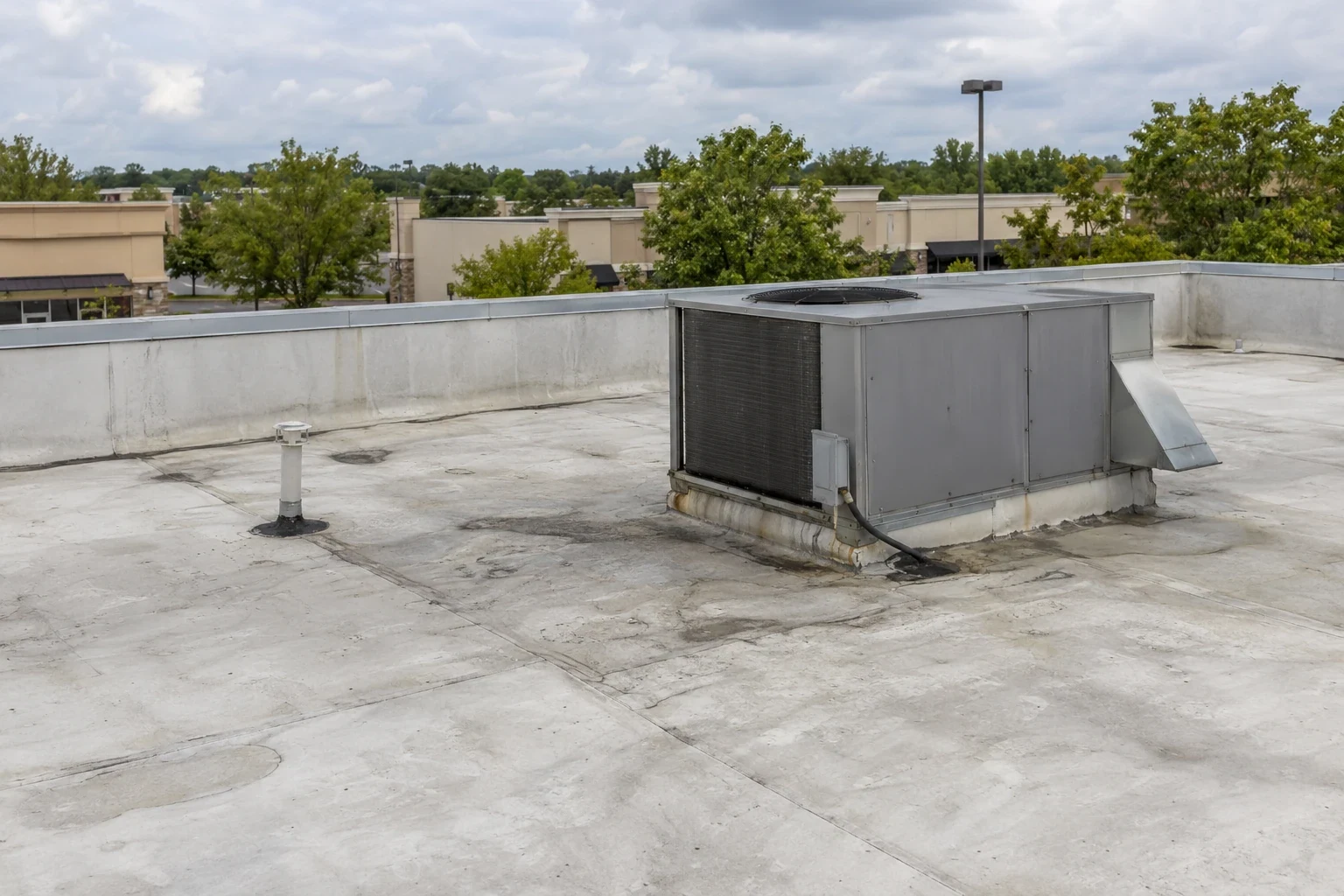
Rooftop units are the busiest part of a retail roof. Every unit sits on a curb. Every curb has flashing. Every refrigerant line, drain line and electrical conduit passes through the membrane. That is a lot of openings on a surface that must stay watertight.
Technicians visit the roof often. They walk the membrane, drop tools and drag panels. Those visits cause punctures and scuffs. We inspect the walk paths first. Where traffic is heavy we recommend walk pads. Where curbs have split sealant, we reseal them and log the date.
Condensate drains deserve attention. A clogged drain line overflows onto the membrane. The standing water breaks down the surface and finds the nearest seam. We check each line and clear it. Good curb and support work prevents most of this.
Large end-cap tenants raise the stakes. A large store at the end of a strip often has heavier equipment and more penetrations than its neighbors. The big-box store roof and the strip roof beside it may be different ages and different systems. We record each one so a repair on one does not damage the other.
Food tenants add grease and moisture to the roof. Exhaust fans on a restaurant or bakery unit leave grease on the membrane, and grease eats most single-ply sheets. A restaurant roof needs grease traps on its fans and a scheduled wash. We include that line in the scope for any center with food users.
Plan for Hail, Wind and Ice
Retail roofs are large and flat, and hail finds them. Hail reports in the county run from penny-size stones around Luella in April 2014 to 1.25 inch stones northwest of Denison in June 2025. Each event bruises membranes in a different pattern.
After a hail report, we scan the field and the edges. Bruises show as soft spots in the insulation. Core samples confirm them. The record then supports a claim. Without it, a landlord has only a suspicion.
Winter adds ice. Ice dams along a canopy edge push water under flashing, and the December 2013 sleet left 4 to 5 inches of it on roofs around Sherman and Denison. We check the drains and canopies before the cold arrives. After a thaw, we check them again. Our hail damage repair work follows the same order.
Know the Corridors That Feed Retail
Sherman sits where US 75 and US 82 cross. Retail follows traffic, so shopping centers cluster on those roads. Melissa sits farther south, where US 75, State Highway 5 and State Highway 121 meet. Anna lies on US 75 as well, and Walmart is among its largest employers at 450 jobs.
New retail goes up fast in growth towns. Fast construction can leave early defects. A seam missed on a Friday afternoon becomes a leak in the first heavy rain. We recommend an inspection within the first year of any new strip center. It costs little and fixes the issue while the warranty still stands.
An older center in Sherman or Denison has been through more heat cycles, and its seams, pitch pans and flashings show it. We rank those roofs by risk and cost.
Edge conditions deserve a note. A parapet wall at the front of a strip hides a gutter or scupper system. When that system clogs, water backs up behind the parapet and soaks the cap. Many of the leaks that show at the storefront begin there. We clear the scuppers, check the coping and seal open joints before the spring storms arrive.
Keep Every Tenant Open
A retail tenant cannot close for a week. So the work plan follows store hours. Noisy steps move to early morning or night. Material storage stays out of fire lanes and customer parking. Deliveries avoid peak traffic.
We reroof in sections. One section is stripped, dried in and covered each day. No open deck is left overnight. A tarp and a temporary seal protect the interior if weather turns. Tenants get written notice of the schedule at least a few days ahead, with the quiet hours and the delivery windows marked so nobody is surprised by a lift at the front door.
Leases add another layer. Leases often split roof costs among tenants. A clear record helps a landlord explain a charge. Our written scope lists each cost driver, such as tear-off depth, insulation thickness and edge metal. A tenant can read it and see the logic.
Signs and canopies are part of the roof edge. A sign bracket that penetrates the roof or the fascia needs its own flashing. We note each one on the sketch. Mounting hardware that loosens after a windstorm often shows up first as a drip at the front door. A quick check after every high-wind day keeps small problems small.
Closeout includes photographs of every section, a list of materials used and a care schedule for the landlord. When a tenant leaves and a new one arrives, the landlord has a current roof record to hand over.
Choose the Right Fix
A dry roof with surface wear takes a coating. That is the lowest-cost path, and roof coating restoration adds years when the substrate is sound. A roof with scattered wet spots takes cut-and-replace repairs. A roof with wet insulation across much of its area needs replacement.
A recover over the old roof saves tear-off, but only when the insulation is dry. Moisture trapped under a new membrane turns to vapor in summer. Vapor drive lifts the membrane and forms blisters. We tell owners this before they commit.
Every scope includes edge metal, drains and flashings. Those are the parts that fail first. They are also the cheapest to fix well.
Commercial Roofing Questions
How do you find the source of a leak in a strip center?
We scan for moisture, then trace the deck line from the stain. Water often travels far from its entry point. The map shows both.
Can a center stay open during reroofing?
Yes. We work in sections and keep every store dry. Noisy work moves to quiet hours. Tenants get notice of each phase.
Should we coat or replace an aging retail roof?
Coat only if the insulation is dry. A moisture scan answers that first. A wet roof needs repair or replacement before any coating.
What does hail do to a flat retail roof?
It bruises the membrane and crushes insulation beneath it. The surface may not split. A scan and core samples confirm the damage. Strips along US 75 and US 82 are no exception.
Who pays for roof repairs in a multi-tenant center?
That depends on the lease. We provide a clear scope and cost breakdown so landlords and tenants can follow the charges.
Send the Center Address and Leak History
Tell us which suites have had stains, when the roof was last worked on and what your tenant mix looks like. We will walk the roof with you and explain what the readings show.
Related Roofing Work
Rooftop Equipment Curbs and Supports
Rooftop unit curbs, equipment rails and pipe supports for Sherman, TX commercial roofs: load paths, curb flashing, vibration, walkway wear and timing.
Big-Box Retail Roofing
Big-box retail roofing in Sherman, TX: moisture scans, fastener checks and phased repairs that keep a large store open while the roof is worked on.
Restaurant Roofing
Restaurant roofing in Sherman, TX: grease-resistant membranes, exhaust fan flashing and repairs scheduled so the kitchen and dining room stay open.
Hail Damage Roof Repair
Hail damage roof repair in Sherman, TX: find bruises, fractured membranes and dented metal with moisture scans and core samples, then repair and document.