
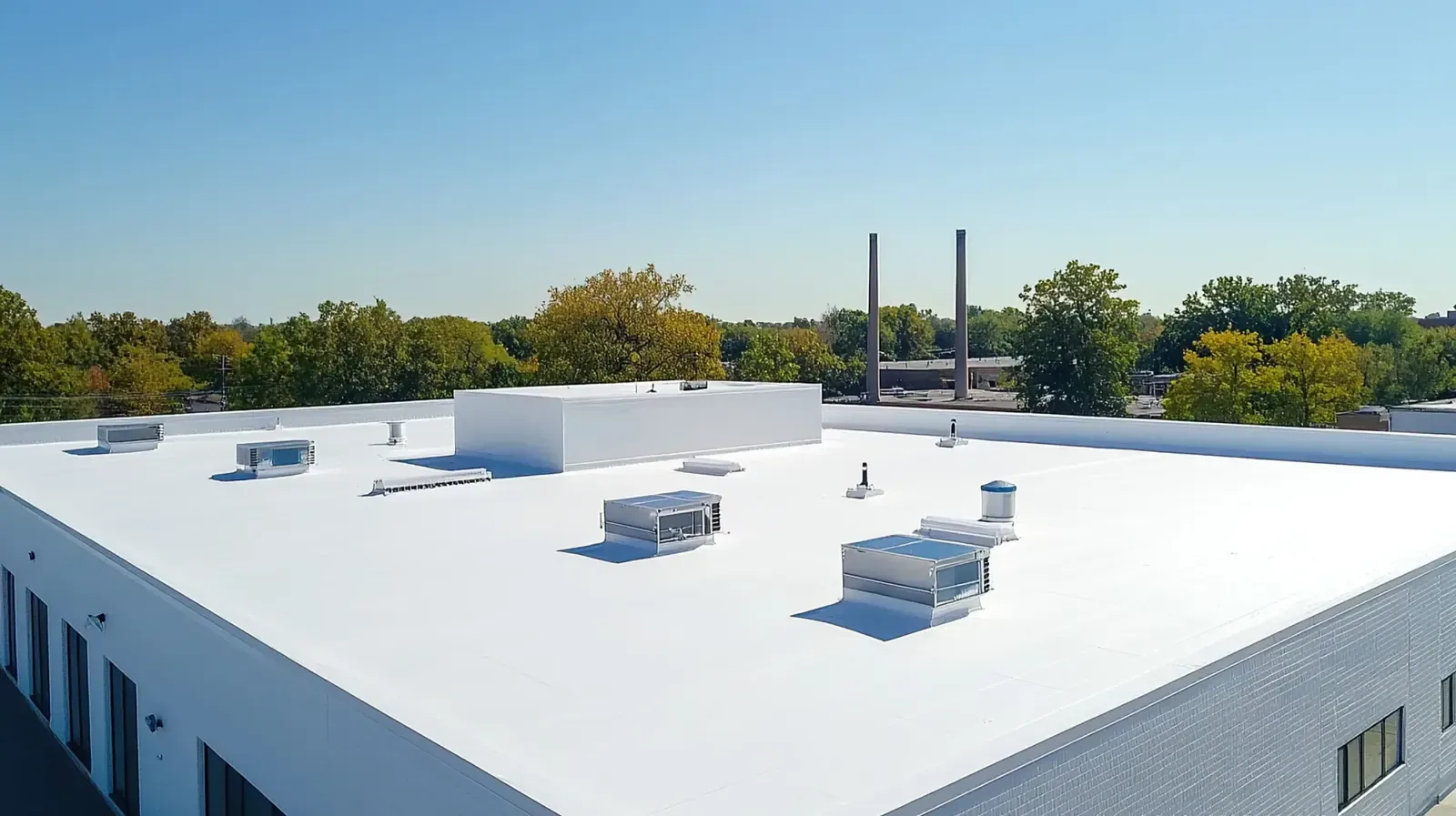
EPDM Roofing in Sherman, TX
EPDM rubber roofing in Sherman, TX: how the sheet stretches and shrinks, where splices and flashings fail, and how we test, repair, ballast and replace it.
EPDM is rubber. It stretches. It shrinks. It does both without cracking, which is why it has stayed in service for decades on flat roofs. Sherman asks a lot of rubber. Its records run from 113 F down to -3 F. A rubber sheet takes that range well. Its splices and flashings take it less well. The seam is where we start.
EPDM has a long record on large flat roofs. That record is the reason owners still choose it. It also means many EPDM roofs in the field are old. An old sheet needs a different eye than a new one. We look for chalking, shrinkage, cracked flashing and lifted tape. We ask when the last repair was made, what was used and who made it. Each answer shapes the plan.
This is the order we follow. Mechanism first. Then the test. Then the repair. At every step the finding goes on paper, with a photograph, so the owner can follow the reasoning and check it against the roof.
Know What EPDM Is Made Of
EPDM stands for ethylene propylene diene monomer. It is a synthetic rubber, like a thick inner tube. Sheets come in wide rolls, up to many feet across. That means few seams on a large roof. The sheet is black or white. Black absorbs heat. White reflects it. The sheet can be held down three ways. It can be adhered with glue. It can be fastened with plates. It can be ballasted with stone.
Seams are joined with adhesive or tape. Rubber does not weld. The splice is a chemical bond, and it depends on a clean surface and the right primer. A good splice lasts for years. A poor one may open in the first summer.
Flashing is built from the same rubber. Some flashings are made of uncured rubber, which conforms to odd shapes. Uncured rubber is soft when installed and cures over time. It handles corners and penetrations well. It also ages differently. We check it for stiffness and splitting. A cured strip bonded over it can extend life.
Watch for How EPDM Fails
Splices open. Tape edges lift. Primer fails. Flashings shrink away from walls. Rubber can shrink as it ages. A sheet that shrinks pulls on its terminations. A gap opens at the wall. Water enters. Surface cracking appears at folds and corners. Punctures happen at foot traffic routes.
Ponding is hard on EPDM. Water sitting for days leaves a ring of algae and dirt. Seams under standing water stay wet. Ballast can scour, moving stone off the sheet and exposing it to sun. Ballast also hides problems. A leak under stone is hard to find. We probe, scan and lift stone where we need to.
Test Splices and Read the Surface
We start at the walls. We measure any gap between the sheet and the termination. A shrunken sheet leaves a gap. We photograph it. Then we run a probe along splices. Lifted edges and loose tape show up. We scan for moisture with infrared and a meter. We take core samples to see the layers. A core also shows how thick the sheet is. A roof that has changed hands often carries splices from more than one repair crew, and the probe and cores tell later patches apart from the original seams.
On a ballasted roof, we map where stone has moved. Bare spots mean wind or water scour. We check drains for stone that has washed in. The report lists each finding, a cause and a price.
Thickness matters. EPDM comes in several thicknesses. A thicker sheet resists punctures and wear. Cores show the thickness in place. A thin old sheet may not take another repair well. We tell the owner when thickness is a limit, and we price alternatives.
Count Sherman Weather Into the Plan
Cold stiffens rubber less than it stiffens plastic, which is one reason EPDM does well in freeze-heavy regions. Sleet and freezing rain in December 2013 put 4 to 5 inches of ice on roofs around Sherman and Denison, and a March 2008 band dropped up to 6 inches of snow over Grayson County. Snow load matters. Ballast adds weight too. We check that the deck can carry both. Wind is the other force, and a ballasted roof has its own rules for it. An EF1 tornado damaged the high school in Howe in April 2016. Unballasted edges lift first in wind, so perimeter attachment gets a pull test.
Spring storms bring hail as well. Hail reported northwest of Denison on June 8, 2025 measured 1.25 inches. Rubber absorbs small hail better than rigid sheets, but large hail can bruise it and crush the insulation below. We press suspect spots and look for soft areas. Freeze-thaw also works on ballasted roofs. Water trapped under stone freezes and moves the stone.
Build the Repair Step by Step
The surface is cleaned. A primer is applied. A patch or a tape strip is rolled on with pressure. Edges are sealed. Large damage gets a section replaced. Ballast is raked back or replaced. Flashings that have shrunk are cut out and rebuilt with new rubber and new termination bars. The result is probed and photographed.
Compare options. A repair fixes a local fault, and it is the lowest-cost step. A coating can extend life if the sheet is sound. A recover adds a new sheet. A replacement resets the clock. Price follows area, penetrations, ballast handling and access.
Ballast adds cost to any repair or replacement. Stone must be removed, stored and replaced, and the deck may need protection while it sits. A ballasted roof with sound rubber and dry insulation may need only a few spot repairs. A ballasted roof with wet insulation under stone is costly to open. The scan tells us which case applies before we quote.
Match EPDM to Sherman Buildings
EPDM often appears on large, low-slope roofs with few penetrations. A distribution building of the kind North Texas Logistics Park serves, or a warehouse off US 75, can fit that pattern. A distribution center roof has long drainage runs. EPDM handles them with few seams. Schools and hospitals use it too. Austin College is in Sherman, and the city has three hospitals. In Sherman and Denison, a mix of schools, hospitals and light industrial buildings means each roof gets its own sketch and its own score.
Ask What the Record Shows
Before the crew climbs, we explain the plan. After the work, the owner gets the file. Photographs. Splice checks. Moisture maps. The ballast map where it applies. The next visit dates. Owners comparing sheets can look at TPO roofing and modified bitumen roofing as alternatives for the same roof.
Commercial Roofing Questions
Can EPDM be welded like TPO?
No. Rubber does not weld. Seams use adhesive or tape, so surface prep decides the result.
Why is EPDM often black?
Carbon black gives rubber its strength and UV resistance. White EPDM is available for reflectivity.
Does ballast protect the sheet?
It holds the sheet down and shields it from sun. It also hides leaks and adds weight to the deck, so the deck is checked before any change to the ballast.
How do you find a leak under stone?
By moisture scan and by lifting stone at suspect spots. The probe and the core confirm, and the stone is replaced the same day.
When should EPDM be replaced?
When insulation is wet across the field, the sheet is cracked or shrunk, or splices fail widely.
Send the Address and the Leak History
Send the building address and any leak history. We will walk the roof with you and explain what the readings show about the splices, the flashings and the insulation.
Related Roofing Work
Commercial Roof Replacement
Full tear-off and replacement of low-slope and metal commercial roofs in Sherman, TX, planned around moisture findings, heat cycling and North Texas hail.
Commercial Roofing at North Texas Logistics Park near Sherman, TX
Commercial roofing at North Texas Logistics Park near Sherman, TX: ponding control, wide-span roof scans, dock-friendly repairs and storm checks for flat roofs.
Distribution Center Roofing
Distribution and fulfillment center roofing in Sherman, TX: how very large flat roofs drain and leak, and how we inspect and repair them around dock schedules.
Sherman
Commercial roofing in Sherman, TX for fabs, food plants, hospitals and the college: moisture scans, seam repair, recovers and storm checks on flat roofs.