
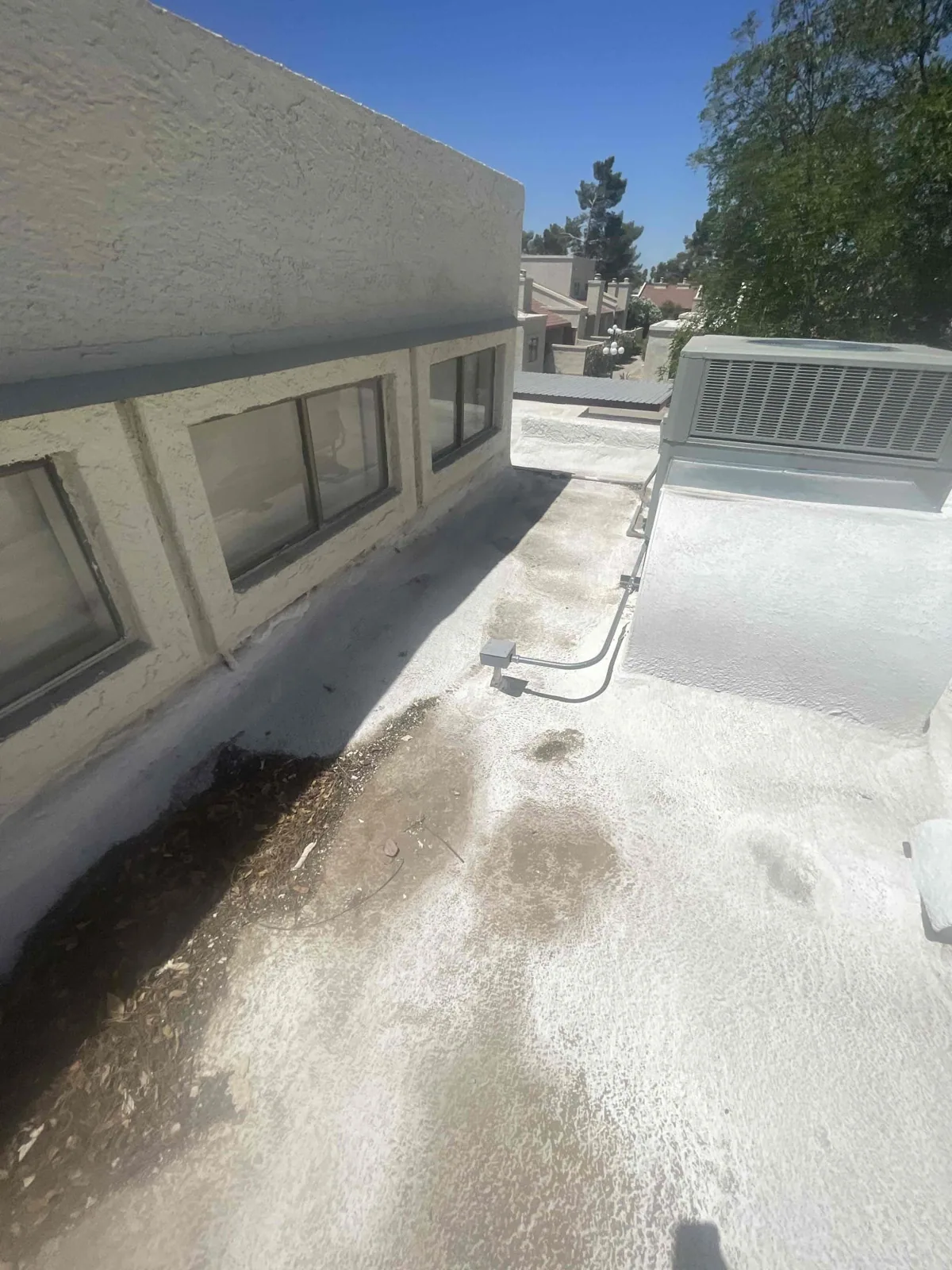
Ponding Water Roof Repair in Sherman, TX
Ponding water roof repair in Sherman, TX: find why water stands, check deck and insulation, clear drains, add slope and restore membranes that held water.
Water has weight. A puddle on a flat roof presses down on the deck, the insulation and the membrane. The deck bends a little under it. That bend makes the puddle deeper. A deeper puddle presses harder. The cycle feeds itself, and a small low spot becomes a permanent pool.
Standing water also ages the roof. The sheet stays wet for days. Dirt settles and holds moisture. Sun heats the water and the membrane beneath it. In Sherman, TX, where the record high reaches 113 F, a ponded area can run far hotter than the dry field around it. We start by measuring how deep the water stands and how long it stays.
Find why the water stays
Ponding has four common causes. The deck may have deflected. The roof may have been built with too little slope. A drain may sit higher than the field around it. Or a drain may be blocked, so water cannot leave.
We separate these by walking the roof after rain. Water standing at a drain points to a blocked or high drain. A wide, shallow pool in the middle of a bay points to deck deflection. A line of water along a wall points to slope that falls the wrong way. Each cause has a different fix, and a coating over the wrong cause only hides it. The written scope names the cause before it names the repair.
Flashing matters here too. A pool that backs up against a wall or curb puts constant water pressure on the flashing there. Termination bars loosen, sealant softens and water finds the gap. The fix then includes a rebuild of the failed flashing as well as the slope. We photograph each edge of the pool so the repair can be checked against the original condition.
Read the rain record
Across roughly 79 wet days a year Sherman collects about 44 inches, which is more than half an inch on each of them. A roof with marginal drainage can handle light rain and still pond in a downpour. Spring storms often drop a large amount of water in a short time, and a drain that clears a normal rain may fall behind.
Cold adds another problem. The sleet and freezing rain of December 5 to 6, 2013 coated Sherman and Denison in four to five inches of ice. Ice in a drain line or a scupper blocks it fully. When the ice melts, the roof can flood in minutes. We check drain lines and scuppers for freeze damage as part of the same walk. For work on the outlets themselves, roof drain and scupper service clears, resets and replaces them.
Scan for wet insulation
Water that stands on a membrane finds every small opening. A seam, a fastener head or a tiny puncture gives it a path. Once inside, it soaks the insulation. Wet insulation loses most of its thermal value and adds weight to the deck.
We run a moisture scan across and around the ponded area. The scan shows wet zones that the surface hides. Then we cut core samples where readings are high. A core shows how many inches of insulation are wet, whether the deck is rusted or stained, and whether the membrane has blisters beneath it. A dry area can be saved. A wet area is cut out. An infrared moisture survey speeds this work on large roofs, since it maps the whole surface in one pass.
Build slope where it is missing
The repair depends on the cause. If a drain is blocked, we clear it, check the sump and reset any sagging pipe. If a drain sits too high, we lower the sump or build a ring of tapered insulation around it. If the field is flat, we add tapered insulation to push water toward the drains. Tapered insulation is boards cut at a slight angle so each one adds a little fall.
When insulation is wet, it comes out before anything goes back. New insulation and cover board are installed over a dry deck, and the membrane is welded or adhered to match the existing sheet. Seams around the ponded area get a close look, since water has stressed them. A seam that has been under water for years may need a full pass with a probe, and the details are in the seam failure repair work.
After the repair, we flood-test where it is practical. We run water into the area, watch the drains and check that the pool clears within a day or two. A repair that still holds water has not worked, and the scope reopens until it does.
Choose a membrane that tolerates water
Not every roofing material handles standing water the same way. Some seams soften or weaken if they stay wet. Some coatings break down with constant moisture. Silicone coatings handle ponding better than most because they cure into a flexible, water-tolerant film. A silicone roof coating can restore a sound membrane in a ponded area, but only after the insulation is dry and the drains work.
Where the deck has sagged badly, a coating is a poor choice. The better answer is to rebuild the slope, then install a new membrane. We show both options with their cost drivers, so the owner can compare them and choose with the readings in hand.
Plan for building type
Large industrial and logistics roofs gather more water per drain than small ones. Sherman's industrial base runs from food processing at Progress Park to semiconductor plants, and Foundation Business Park in Denison and the North Texas Logistics Park are reached from US 75. Each of these roofs has a drain layout that was designed for a certain rainfall. When equipment is added or a drain is paved over, that design changes.
On a distribution center roof, we check the layout against the plan, count the drains and trace each line. A site with a few drains and a long roof is the first to show trouble in a heavy storm. We record the findings in the building file and mark the low spots on the plan, so the next walk compares like with like.
Expect this on site
The first visit comes after a rain, when the pools are visible. The crew marks each pool with chalk, measures depth and photographs the outline. Drains are tested with a hose. A moisture scan follows, and core samples are taken at flagged points. Each core hole is patched the same day.
Repair work proceeds by section. Only the area under repair is open. Occupied space below is protected, and tenants are told when noisy work happens. If rain threatens, the crew seals the opening before leaving. The owner receives a written scope with photos, readings and a comparison of repair options. The decision on how far to go belongs to the owner, and the numbers are there to support it.
Commercial Roofing Questions
How long can water stand before it is a problem?
Water that remains a day or two after rain counts as ponding. Longer periods age the membrane and stress the deck.
Does ponding void a membrane warranty?
Some warranties exclude damage from standing water. We read the terms before any repair is scoped.
Can a coating fix a ponding roof?
Only if the insulation is dry, the drains work and the membrane is sound. Otherwise the cause stays.
What does a ponding repair cost?
Cost depends on cause, area and whether insulation is wet. A cleared drain is minor. New tapered insulation is a larger job.
Do I need a new roof if water ponds?
Not always. If the deck and most of the insulation are sound, a local slope repair and new membrane can solve it.
Send the address and leak history
Send the building address and any past leak history. We will walk the roof after the next rain, run the moisture scan and explain what the readings show.
Related Roofing Work
Sherman
Commercial roofing in Sherman, TX for fabs, food plants, hospitals and the college: moisture scans, seam repair, recovers and storm checks on flat roofs.
Flashing Failure Repair
Flashing failure repair in Sherman, TX: find open terminations, cracked sealant and torn base flashing at walls, curbs and penetrations, then rebuild them.
Roof Drains and Scuppers
Drain, scupper and ponding correction for commercial roofs in Sherman, TX: sump repair, overflow sizing, crickets and tapered insulation that clear water.
Infrared Moisture Survey
Infrared and core-cut moisture surveys for commercial roofs in Sherman, TX, mapping wet insulation so repair and replacement dollars go where water sits.