
Versico Roofing Systems in Sherman, TX
Versico single-ply roofing in Sherman, TX: attachment methods, wind uplift at edges, recover options and repair of TPO, EPDM and PVC membranes.
Air does not press a flat roof down. It lifts. Air moving across a flat surface speeds up, pressure drops, and the roof is drawn upward like the top of a wing. The pull is strongest at corners and edges. How well a single-ply sheet resists depends on how it is attached. Versico is a single-ply roofing brand offering membranes in several families, including TPO, EPDM and PVC, in assemblies that can be adhered, mechanically fastened or ballasted. In Sherman, TX, where April and May are peak tornado months for North Texas, the attachment method is often the first thing we want to know about a Versico roof.
Identify How the Sheet Is Attached
A fully adhered sheet is bonded to the substrate across its field. A mechanically attached sheet is held at its laps by fasteners and plates driven into the deck. A ballasted sheet lies loose, held by stone or pavers. Each resists wind in its own way and fails in its own way.
We find the method by probing near the edge and checking for plates, fastener rows or ballast. In a fully adhered roof, we test the bond by pressing and listening for hollow spots. In a fastened roof, we check for fasteners that have backed out and look for flutter between rows. In a ballasted roof, we check that the stone is present in the right depth and has not blown off at corners. The answer goes into the building file, because it shapes every repair and replacement decision.
The attachment pattern also tells us how a repair has to be made. Opening a fully adhered sheet means cutting back to a clean bond line and re-adhering with compatible adhesive. Opening a fastened sheet means finding the nearest fastener row and keeping it intact. Opening a ballasted roof means moving stone, patching the sheet and putting the stone back in the right depth. We write the method into the scope for each repair, so crews do not improvise on the roof.
Test the Edges First
Uplift concentrates at perimeters and corners, so that is where we start. We inspect edge metal, cleats, termination bars and the attachment pattern in the outer zone of the roof. Loose coping, open joints and short fasteners give wind a place to grip.
Tornadoes have struck near Sherman more than once. The county's recent list has an EF1 southwest of town in June 2025, an EF1 that damaged Howe's high school and homes in April 2016, and an EF2 at Sherwood Shores in March 2022. Not every storm reaches a given roof, but each shows how fast conditions change. We check edges before storm season, and our wind damage repair work follows the same order after an event: edges first, then field, then penetrations.
Fasteners deserve their own check. In a mechanically attached roof, plates that have pulled up or fasteners that have backed out leave the sheet loose between rows. We tap along fastener lines, look for raised bumps in the membrane and mark each problem. A pull test on a sample of fasteners shows how well the deck is holding them, and a weak result leads to a wider review of the deck.
Judge Whether a Recover Is Possible
A recover installs a new single-ply sheet over the existing roof, avoiding the tear-off. It saves cost and disruption, but it only works if the existing roof is sound. The insulation must be dry. The deck must be solid. The existing sheet must be smooth enough to take the new one, and the code must allow another layer.
We test before we propose. A moisture scan maps wet areas, and cores confirm the layers and their condition. If the scan finds scattered wet sections, wet sections are cut out and the insulation is replaced ahead of the recover. If it finds widespread wetness, a recover traps the water and a tear-off is the right answer. The written scope shows both paths with their costs, so the owner can see what a recover saves and what it risks.
Weight matters on a recover. A new insulation layer, a new sheet and any ballast all add load to a deck that already carries the old roof. For older buildings we check with the owner's engineer where the structure is in doubt. The recover also changes edge heights and flashing details, so we review how the new layer will meet walls, curbs and drains before it is priced. The Holcim Elevate and Versico families can be compared on the same recover sheet.
Detail the Penetrations and Curbs
Most leaks start at details. Rooftop units sit on curbs, pipes pierce the sheet, and drains cut through it. Each needs flashing that keeps water out while letting the roof move. Heat and cold work at these spots daily. Sherman has logged 113 F and -3 F, a spread of 116 degrees.
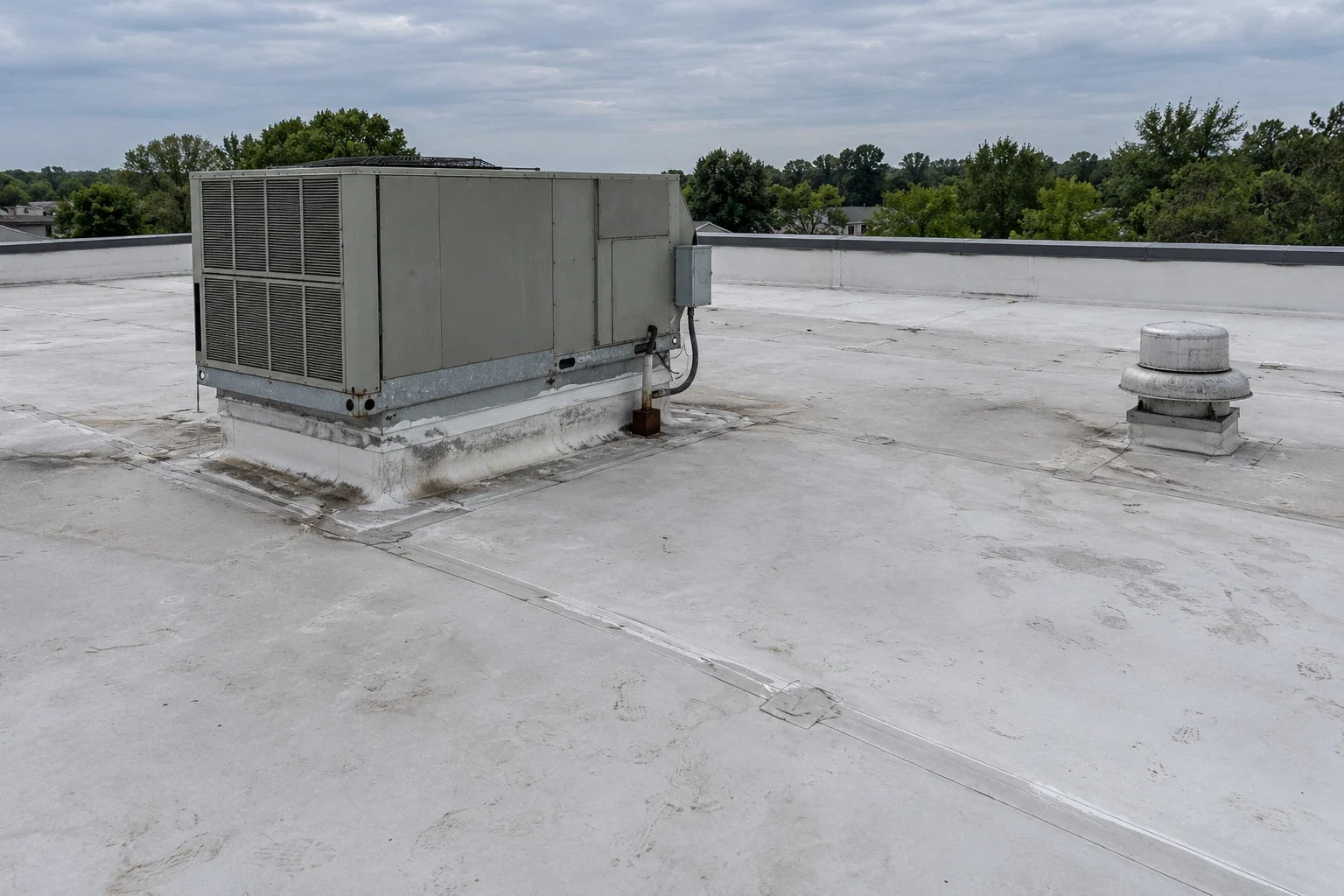
We inspect each curb corner, boot and drain for cracked sealant, gaps and lifting. Where a prefabricated corner or boot fits, we use it. Where details must be built on site, we build them with care and record them. A rooftop equipment curb repair often means lifting the unit's flashing, renewing the base and resealing, and we coordinate with the mechanical contractor so the unit is not disturbed more than needed.
Phase Work Around Operations
Buildings in Sherman and Denison keep working while roofs are replaced. Plants in Progress Park, with tenants such as Tyson Foods, Sunny Delight and Kaiser Aluminum, hospitals, Sherman ISD buildings and Austin College all have schedules that cannot stop. We divide the roof into sections and complete one at a time. Each section is made watertight before the crew moves on.
We coordinate noise windows, material routes and rooftop access with the building contact, and we confirm equipment shutdowns where needed. A occupied building reroofing plan states the sequence in writing. Tenants know which area is open and when. The same method applies to roofs in Denison and in the smaller towns around Sherman.
Weather planning is part of the sequence. A single-ply sheet needs dry surfaces for adhesive and weld work, and it needs reasonable temperatures. We read the forecast, keep a rain plan and avoid leaving a roof open overnight in the spring storm season. If a front is coming, the crew closes the section with a temporary tie-in and returns when conditions allow.
Specify to the Local Requirements
Wind uplift, insulation and fire details follow from what the local building department requires, and that office is asked before a new or recovered roof is priced.
The scope lists the membrane, attachment pattern, insulation, edge metal and flashing details. Other single-ply makers, including Carlisle SynTec, offer comparable assemblies, and the same questions about attachment and edges apply. The owner can compare options on one sheet.
Commercial Roofing Questions
What attachment methods do single-ply roofs use?
Fully adhered, mechanically attached and ballasted. We identify yours by probing the roof.
Why are edges checked first?
Wind uplift is strongest there. Loose edge metal gives wind a grip.
Can I recover a wet roof?
No. A recover traps the water. Wet sections must be cut out first.
Does a recover need a permit?
Often. The local authority decides. We confirm before pricing.
How long does a section take?
It depends on area and details. The scope gives the order and expected duration for each section.
Send the Address and the Roof Papers
Send the building address, any leak history and the roof papers you have. We will walk the roof with you and explain what the readings show.
Related Roofing Work
Wind Damage Roof Repair
Wind damage roof repair in Sherman, TX: edge metal, fastener, membrane and flashing checks after storms, with moisture scans and written repair scopes.
Roof Recover and Overlay Systems
Recover a sound commercial roof in Sherman, TX with a new membrane over dry insulation, after core samples and a moisture scan show the old roof can stay.
Holcim Elevate Roofing Systems
Holcim Elevate roofing in Sherman, TX, including roofs under the former Firestone Building Products name: inspection, rubber and single-ply repair, replacement.
Rooftop Equipment Curbs and Supports
Rooftop unit curbs, equipment rails and pipe supports for Sherman, TX commercial roofs: load paths, curb flashing, vibration, walkway wear and timing.