
Roofing for Healthcare Systems in Sherman, TX
Roofing for healthcare systems in Sherman, TX: leak control over clinical space, infection-control planning, rooftop equipment and storm-ready roof records.
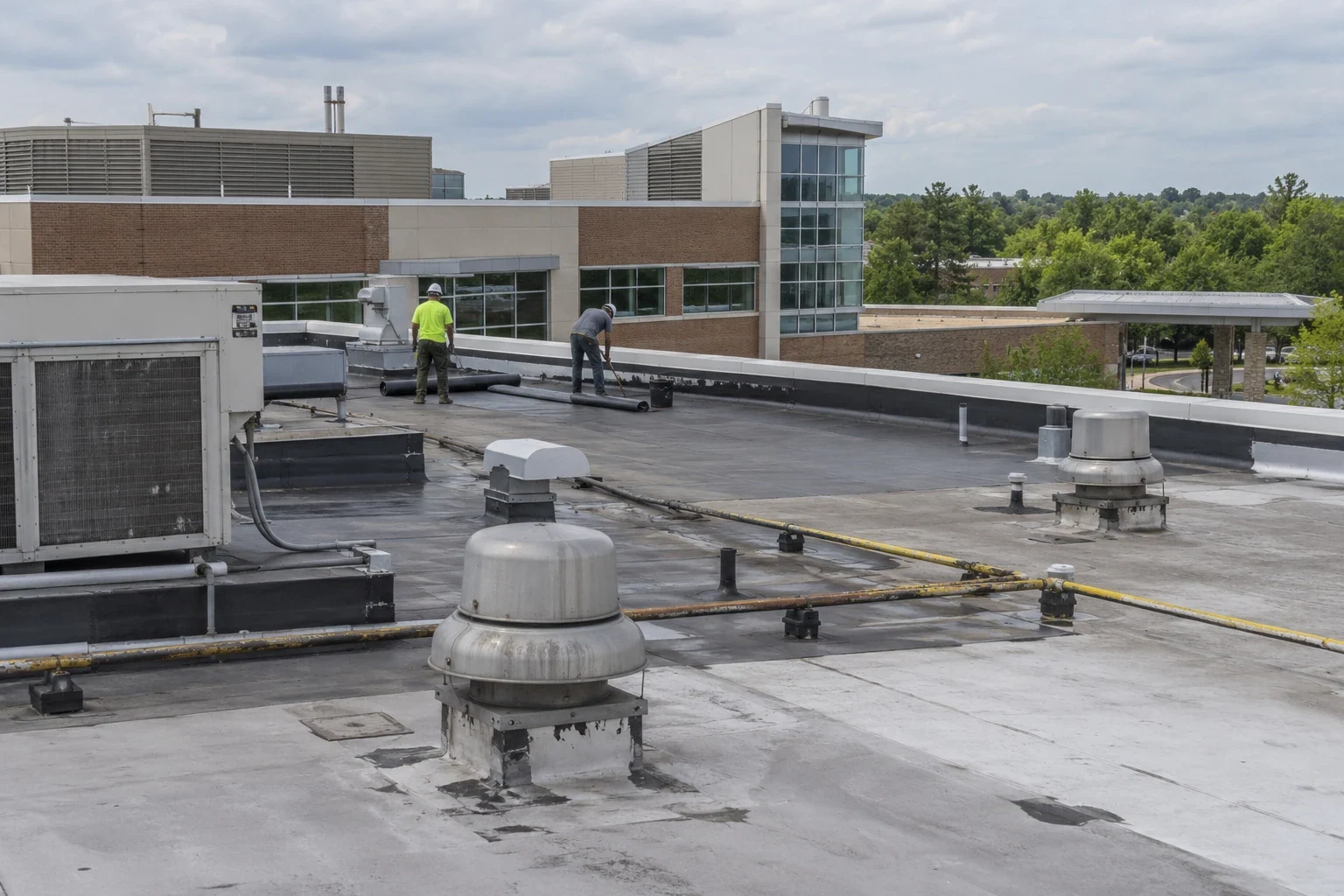
A hospital roof is crowded. Air handlers, exhaust stacks, generators, medical gas lines and communications gear all stand on it or pass through it. Each one needs a curb or a support, and each curb has a flashing that must stay tight. Below the roof sit patient rooms, surgical suites and pharmacies. Water from one failed flashing can reach a ceiling that has to stay clean and dry.
In Sherman, TX a hospital roof has seen 113 F and -3 F on record. That movement works at every curb and pipe boot. A healthcare system has no slack for a surprise leak, so we find the weak points first. We map the penetrations, test the flashings, scan for moisture and plan repairs around clinical rules.
Map Every Penetration Before the First Repair
Healthcare roofs collect penetrations over time. Each renovation adds a unit, a line or a fan. Old curbs stay behind, capped but still flashed. New lines are routed through the nearest opening. The roof drawing, if one exists, rarely matches the roof.
We walk the roof and build a current map. Each curb, pipe, stack and conduit gets a number, a photograph and a condition note. Rusted or loose supports go on the repair list. Where a line crosses the membrane without a boot, we correct it. That map becomes the working document for facilities staff, the roofer and any engineer. It also shows which equipment sits over which department, so a leak report can be traced fast.
Generators and fuel lines need special care. A diesel line that crosses the membrane can leak onto it, and fuel softens many roofing materials. We check every fuel and oil line for staining, make sure the pipe supports sit on pads and recommend a chemical-resistant sheet near any point where a spill is possible. Medical gas lines and condensate drains get the same treatment. A drip from a condensate line, repeated daily, wears through membrane in a way a one-time spill does not.
Control Dust, Odor and Noise Near Patient Areas
Roof work near a clinical space needs an infection-control plan. Tear-off creates dust. Hot asphalt and some adhesives create odor. Fresh-air intakes on the roof can pull both into the building. We locate every intake before work starts and agree on how to protect or shut them off during certain steps. Cold-applied or heat-welded systems often suit these buildings better than open-flame methods.
Noise matters too. Imaging suites, operating rooms and patient rooms all need quiet at certain hours. We schedule loud steps with the facility team, section off work zones and keep debris chutes away from entrances. Occupied building reroofing on a medical campus works best with a daily check-in, a clear route for crews and a named contact on the hospital side.
Pre-work meetings save time. Infection-control staff, facilities, the mechanical contractor and our foreman walk the roof together and mark intakes, exhaust points and the planned work zones. The marks go on a sketch that stays on site. Each morning, the foreman confirms what is open, what is closed and who to call if the plan changes. The sketch gets updated as zones move.
Find Wet Insulation Before It Reaches the Ceiling
Water in a roof assembly travels along the deck and drops at an unrelated spot. By the time a ceiling tile stains, the insulation above it may be wet across a wide area. Wet insulation is also a mold risk in a place where that risk has a higher cost. An infrared moisture survey maps wet areas from the roof side, and cores confirm the depth and the extent.
We repeat the survey on a schedule. Comparing maps year to year shows whether a wet patch is growing or dry. A patch that holds steady can wait for a planned repair. A patch that grows needs action before the next heavy rain. This timing helps facility teams decide what to fix now and what to schedule for a quiet season.
Hospital roofs often include several levels, with a tower, a wing and a lower podium. Water from the upper roof sheds onto the lower one, which doubles the load on the lower drains. We check those transfers and the splash pads below them. A drain that works fine in light rain may overflow when the upper roof dumps a sudden downpour onto the same outlet.
Plan for Sherman and Denison Hospitals and Clinics
Sherman has three hospitals, among them Carrus Hospital with 650 employees, and Denison employers include Texoma Medical Center. Each building has its own roof history, and the name on the door does not tell us what is on top. A healthcare system with sites in both cities faces the same weather and may find a different mix of ages and roof types.
Tornado season across North and Central Texas peaks in April and May. The Sherman tornado of May 15, 1896 killed 73 people, and an EF1 came down along Rockport Road southwest of town in June 2025. A storm plan for a hospital roof includes securing loose equipment, checking edge metal each spring and keeping a contact list for after-hours calls. The same approach applies to a medical office building in Denison.
Winter adds its own load. Sleet and freezing rain in December 2013 left ice 4 to 5 inches thick over Sherman and Denison. Ice backs up drains and loads the structure. Facility teams should know which drains serve which roofs and who clears them in a freeze.
An EF1 in April 2016 damaged homes and the high school at Howe, on Sherman's southern edge, and Sherwood Shores on the Red River took an EF2 in March 2022. After a storm like either one, an insurance restoration adjuster will want dated photographs of each roof section. A system that has them on file moves through the claim faster.
Keep Roof Records Where Facilities Can Find Them
Accreditation reviews, insurers and lenders all ask about the building envelope. A file with photographs, repair dates and moisture maps answers them quickly. Our roof asset management file stays with the facility team, not in a vendor's inbox. It lists each roof section, its system type, its age if known and its current grade.
A system owned by a public body also deals with public agencies, which follow their own procurement and documentation rules. Storm and wind work follows the same record logic. After a tornado, the photographs of a tornado-damaged roof support claims and show which areas need priority repair.
Commercial Roofing Questions
How do you avoid disrupting patient care during roof work?
We plan with the facility team. Intakes are located, noisy steps are scheduled, work zones are sectioned off and a named contact on each side stays in touch daily.
Which roof systems suit a hospital?
Single-ply systems such as TPO, PVC and KEE are common because they can be welded without open flame. Modified bitumen can also be applied cold. The choice depends on the deck, the equipment and the plan.
Why survey for moisture on a schedule?
One survey shows where water is today. A second shows whether it is spreading. The comparison tells facilities staff how urgent a repair is.
Can rooftop equipment work happen during roof repair?
Yes, with coordination. We schedule around the mechanical contractor so curbs are not disturbed twice, and we flash each curb after the unit is set.
What records do you hand over after a repair?
Photographs, a penetration map with the repairs marked, moisture readings and the next survey date.
Send the Campus Addresses and Leak Reports
List the buildings, the departments below the stained ceilings and the dates of recent repairs. We will walk the roofs with your facilities team and explain what the readings show.
Related Roofing Work
Occupied Building Reroofing
Reroofing Sherman, TX hospitals, schools, plants and offices while they stay open, with sectioned tear-off, dust and noise control and daily closure.
Infrared Moisture Survey
Infrared and core-cut moisture surveys for commercial roofs in Sherman, TX, mapping wet insulation so repair and replacement dollars go where water sits.
Hospital Roofing
Hospital and healthcare campus roofing in Sherman, TX: infection-control planning, layered moisture scans and phased repairs that keep patient areas dry.
Medical Office Roofing
Medical office and clinic roofing in Sherman, TX: dust and noise control, moisture scans and phased repairs that keep exam rooms and imaging suites running.