
Roof Asset Management in Sherman, TX
Roof asset management for Sherman, TX portfolios: section ratings, repair logs, storm records and condition trends that show which roofs need money next.
A roof does not decline in a straight line. It holds for years, then speeds up. Seams relax, sealants dry, and insulation takes on a little water. Each change makes the next one easier. By the time a stain shows on a ceiling, the roof has often been losing ground for a long time. Asset management is the habit of watching that curve before the stain. We rate each roof section, log what happens to it, and put the trend where the owner can read it. In Sherman, TX the curve is steep, because recorded temperatures run from 113 F down to -3 F.
The goal is simple. Know what you own, know its condition, and know when it will need money.
Count Every Roof Section
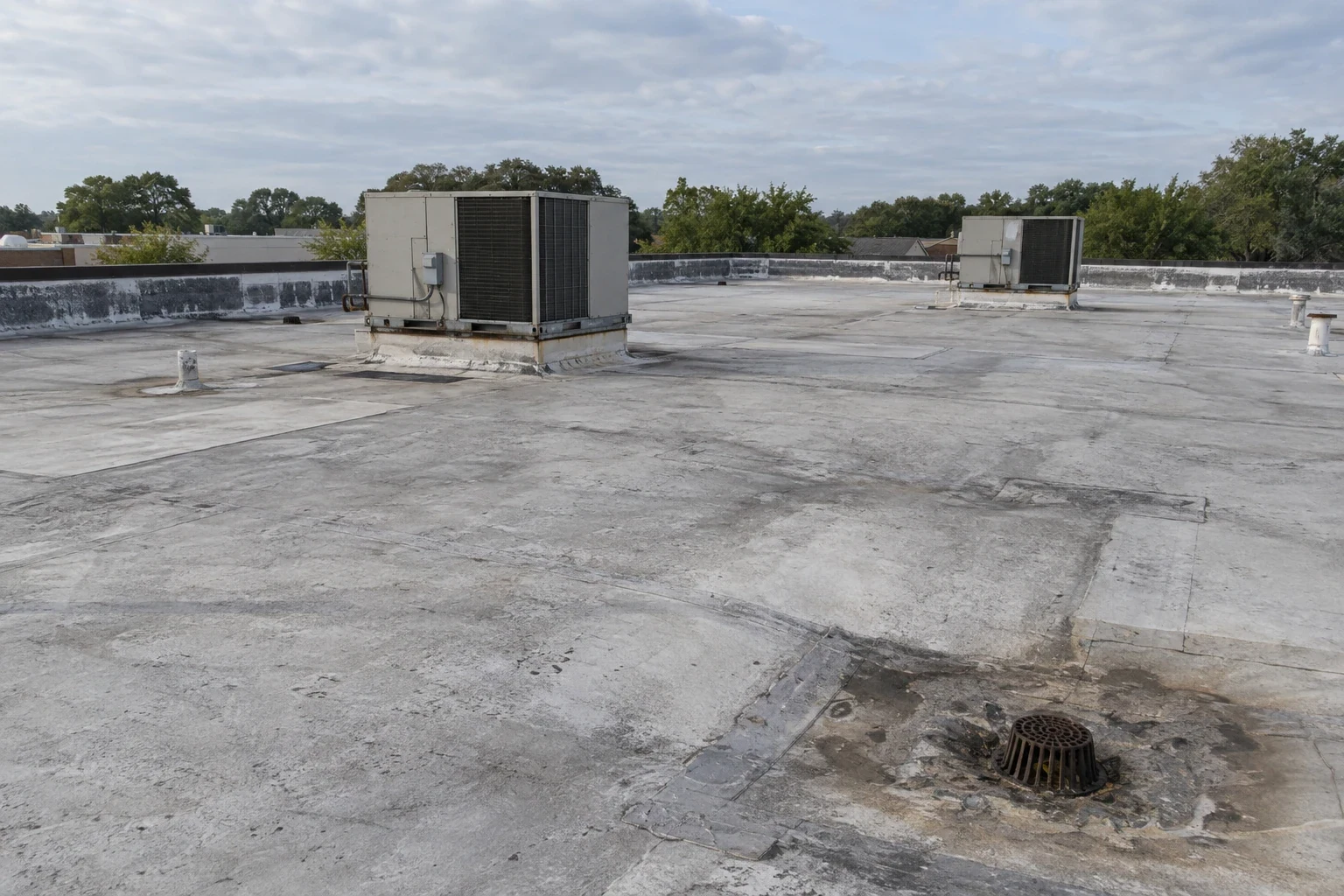
The first step is an inventory. A building is rarely one roof. Additions, mechanical wells and canopies create separate sections, each with its own age and system. We walk the property and draw each section on a plan. We record the membrane type, the approximate area, the number of drains, and the equipment on top.
This sounds basic. It prevents real mistakes. An owner who thinks a building has one roof may have four, and two of them may be past their service life. Once the sections are listed, each one can be rated and tracked on its own. The plan then becomes the backbone of the file, and every later photo and repair note refers back to a numbered section.
Rate Condition the Same Way Each Time
Ratings only help when they are consistent. We score every section on the same scale, using the same checks. We probe seams. We inspect flashings at walls and curbs. We look at drains and ponding. We note fasteners that have backed out. Where the surface raises a question, we take a core sample or run a moisture scan to see what lies beneath.
A commercial roof inspection produces the raw findings. The rating turns them into a number the owner can compare across sections and across years. A section that drops one step in a year is a different problem from one that has held steady for five. The comparison only works if the method does not change.
Log Every Repair and Every Leak
A repair is information. It marks where the roof failed and what was done. We record the date, the location, the cause and the material used. We tie each entry to the numbered section on the plan. Over time the log shows patterns. Three repairs at the same curb point to a flashing problem. Repeated patches along one seam point to a bigger issue.
Leak history matters just as much. When an owner reports a stain, we add the date and the room to the file. If the same room returns, the file shows it. Without the log, each leak looks new. With it, the owner can see when repair spending on a section begins to rival the cost of a new roof. That comparison sits at the heart of the replacement decision, which capital planning then turns into a budget.
Record Weather That Touched the Roof
Storms leave marks that outlast the storm. Hail bruises the membrane. Wind lifts edges. Ice and snow load the deck and the drains. We keep a short record of the events that reached each property, with dates, so later damage can be separated from ordinary wear. Grayson County has logged half-dollar hail northwest of Denison in June 2025, an EF1 southwest of Sherman that same day, and a sheet of ice four to five inches deep over the Sherman and Denison area in December 2013.
These entries do two jobs. They help an insurer see that damage followed an event. They also help the owner decide whether a section that took a hard storm needs an earlier look. A hail damage review after a major event adds its own findings to the same file.
Dates matter as much as the descriptions. A note that says only 'hail' tells a future reader little. A note that gives the day, the reported stone size and the roof sections we walked afterward gives them something to check against a claim, a warranty file or a sale disclosure. We keep each entry to a few lines and attach the photos taken at the time.
Match Each Rating to an Action
A rating means little without a response. We tie each score to a default action. A healthy section gets a routine look and a clean drain. A section with early wear gets targeted repairs at seams and flashings. A section with wet insulation gets a scope that includes cutting out the wet material. A section near the end of its life gets a replacement date on the books.
The action list is short and ranked. Owners with limited budgets can see which sections to fund first and which can wait a season. If the budget is fixed, the file shows the cheapest way to hold the whole portfolio steady. If the budget is flexible, it shows where one larger project would remove several small recurring costs. The ranking changes as ratings change, so the list is rebuilt after every inspection.
Read the Trend, Not the Snapshot
One inspection tells you the condition today. Two inspections tell you the direction. Three tell you the speed. We re-inspect on a set schedule, often before and after the hottest and coldest months, and compare each section with its prior rating. The photos are taken from the same positions each time, so a change is easy to see.
The trend answers practical questions. How many years remain on the membrane? Will a coating extend it? Is a recover possible, or is the insulation too wet? A section with a slow slope can sit on a preventive maintenance plan. A section falling fast needs a decision now. The trend also protects the owner from surprise spending, because the date of a likely replacement is visible years ahead.
Hand Over a File That Others Can Use
The record has to outlive any one person. Property managers change. Buildings sell. Lenders ask for roof condition. We deliver the file in a form that a new reader can follow: the plan, the section list, the ratings, the photos, the repair log and the weather events. Nothing depends on memory.
For a single building the file is short. For a group of buildings it grows into a multi-site roof program, with the same method across every property. The format stays the same whether the building is a plant in Progress Park, a clinic or a school. That sameness is what lets an owner compare a roof in Sherman with one in Denison on equal terms.
Commercial Roofing Questions
How many roofs does a portfolio need before this pays off?
One is enough. A single building with several roof sections benefits from a rating and a log. The value grows as buildings are added.
Do you need access to old roof records?
They help, but we do not need them. We start from what the roof shows today. Old drawings and warranty papers get added to the file as they turn up.
How often should ratings be updated?
Once a year at minimum, and after any major storm. An owner can pick a date before summer and one after winter.
What does the owner receive?
A section plan, a rating for each section, photos, a repair log and a short list of what to do next, ranked by urgency.
Does a rating replace an inspection?
No. The rating comes out of the inspection. It organizes the findings so they can be compared over time.
Send the Address and the Roof History
Send the building address and any leak history. We will walk the roof with you and explain what the readings show.
Related Roofing Work
Commercial Roof Inspection
Hands-on commercial roof inspections in Sherman, TX, with photographed findings, moisture checks and a ranked list of repairs and budget timing for owners.
Roof Capital Planning
Roof capital planning in Sherman, TX: replacement timing, repair-versus-replace math, phasing and code checks that turn roof condition into a budget line.
Hail Damage Roof Repair
Hail damage roof repair in Sherman, TX: find bruises, fractured membranes and dented metal with moisture scans and core samples, then repair and document.
Preventive Roof Maintenance
Scheduled commercial roof maintenance in Sherman, TX: drain clearing, seam and flashing checks, moisture scans and dated records that catch failures early.