Roof Insulation and Cover Board in Sherman, TX
Insulation, tapered systems and cover board for Sherman, TX commercial roofs: thermal value, compressive strength, vapor control and hail protection.
Insulation does two jobs. It slows heat flow through the roof. It also supports the membrane. The second job gets less attention than the first. A membrane is thin. It sits on the insulation like skin on a mattress. If the insulation is soft, wet or crushed, the membrane flexes, fatigues and tears. If a hailstone strikes a soft surface, the stone dents it and the layer under it breaks.
So in Sherman, TX the insulation and the board over it are structural choices. They set how the roof handles heat, hail, foot traffic and water vapor. They also set slope. We make them in a fixed order: deck, vapor control, insulation, cover board, membrane.
Compare the Insulation Materials by What They Do
Polyisocyanurate, or polyiso, is common. It has a high R-value per inch and a stiff foil face. It loses some value in cold. Expanded polystyrene is lighter and cheaper. It resists moisture better than many boards. Extruded polystyrene has higher compressive strength. Mineral wool resists fire and sound.
Each has limits. Polyiso that has been wet loses its value and can swell. Polystyrene can shrink or melt near heat if unprotected. Mineral wool absorbs water unless coated. The choice depends on the roof system, the fire rating and the budget.
R-value is the number everyone asks about. Compressive strength is the number that decides if the board survives foot traffic. Both matter, and we list both on the proposal. Thickness comes from the R-value target, the code and the height available at walls and curbs. Two layers with staggered joints beat one thick layer, because joints in the lower layer are covered by the upper one. Heat then has no straight path through a gap.
Add a Cover Board Where the Roof Takes Abuse
A cover board is a thin, hard layer over the insulation. It spreads loads. It protects the board from hail and foot traffic. It adds fire resistance. It gives the membrane a smooth, firm base.
Common types are gypsum-based boards, high-density polyiso, fiber boards and cement boards. Each has strengths. Gypsum boards resist fire. High-density polyiso is light and tough. Cement boards resist impact.
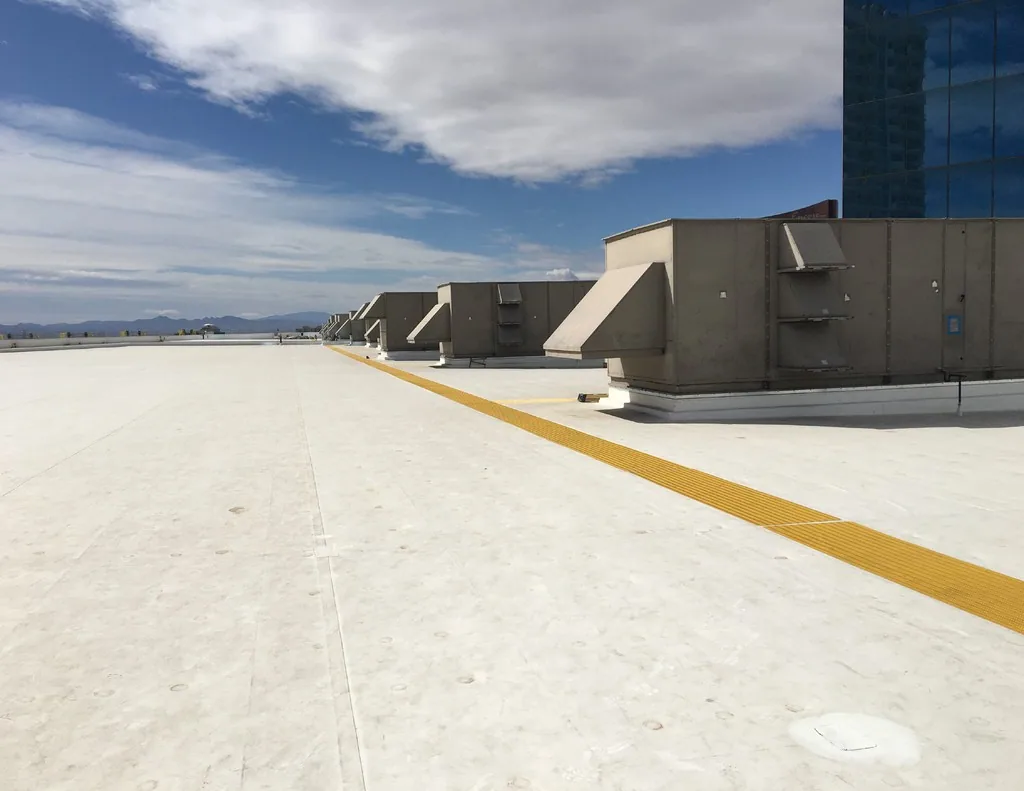
Sherman roofs have a reason to use them. Hail the size of a dime and a penny was reported around Sadler and Luella in April 2014. A half-dollar hailstone was reported northwest of Denison in June 2025. A cover board turns the soft layer into a hard one, and hail marks the membrane less. A hail damage roof repair starts by finding the bruises that a soft base lets through. Foot traffic is the quiet damage. Technicians cross the same path to rooftop units. Soft insulation under a membrane compresses along that path. The compression forms a trough that holds water. A cover board resists it. We mark the path on the plan and add a walkway pad on top.
Control Vapor Before It Reaches a Cold Surface
Warm air holds moisture. When it meets a cold surface, the moisture condenses. The temperature where that happens is the dew point. In a roof, condensation can form inside the insulation or under the deck. Wet insulation loses value fast.
The building's use matters. A cleanroom holds tight humidity control. A cold storage building holds cold air. A pool room holds warm moist air. Each pushes vapor toward the roof in a different direction. Sherman now has a 300 mm wafer fab in production, with about 1.3 million square feet of cleanroom space listed for the site, and that kind of building shows how much interior conditions drive roof design.
A vapor retarder goes on the warm side of the insulation. Its position depends on the climate and the use. We check the interior conditions, set the layer and verify the dew point does not fall inside the assembly. If the interior is dry and conditioned in the normal range, a vapor retarder may not be needed. We do not add layers for their own sake. Every layer has a job, and the proposal names it.
Build Slope Into the Insulation
Many flat roofs drain poorly because the deck is flat. Tapered insulation fixes that. Boards are cut in wedges and laid to slope water toward drains. Crickets divert water around curbs.
A tapered plan is drawn on a layout. Each board has a number and a thickness. The crew lays them in order. Mistakes are costly, so the layout is checked against the drain locations first.
Added height affects details. Flashings at walls and curbs must rise to match. Edge metal must be reset. Drain bodies are lowered or sumps built. These changes are in the scope from the start. A tapered system is also how a drain and scupper fix gets slope across a wide roof. Where the deck itself slopes, the plan uses the slope and adds less taper. Where the deck is flat, the taper does all the work. The slope target is a fraction of an inch per foot, set by the design and checked on the layout.
Fasten to the Deck for Wind, Not for Convenience
Insulation is held by adhesive or by fasteners. Either way, the pattern must resist uplift. More fasteners go at corners and edges, where uplift is highest. Fewer go in the field.
Fasteners must reach the deck. A screw that bottoms in soft board holds nothing. Deck type matters too. Steel decks take screws. Concrete takes special fasteners. Wood decks take other types.
We run pull tests on a sample. We record the numbers. If the deck is rusted or the test fails, the deck is repaired first. A roof is only as strong as what it is fastened to. Adhesives are used where fastening would pierce a sensitive deck or where the maker calls for them. Adhesive sets only in the right weather, so the crew checks temperature and humidity before each pour. Cold, damp boards do not bond.
Test the Insulation That Is Already There
On a recover or partial replacement, the existing insulation is the question. Is it dry? Is it firm? Does it still have thickness? Cores and a moisture scan answer these. Wet or crushed board comes out.
A roof recover adds a layer over what is there. The old insulation must carry the new load. We test compressive strength by pressing a core. Soft board fails the test. A cover board over sound insulation is often the cheapest upgrade that adds hail resistance. Tapered insulation added over an older roof also adds load. We confirm the deck capacity against the new weight and against snow. A roof that carries extra board needs margin for heavy snow, like the nine to eleven inches that fell in isolated spots across the county in early 2025.
Match the Package to the Building
A distribution building of the kind the North Texas Logistics Park serves wants low cost and high wind resistance. A hospital wants fire resistance and quiet. A plant with process humidity wants vapor control. A manufacturing plant roof may need a cover board that resists exhaust.
Commercial Roofing Questions
What is R-value?
It measures resistance to heat flow. Higher is better. It is one number among several.
Is a cover board required?
Some membranes and warranties require one. Others do not. It adds hail and traffic resistance.
Can wet insulation be dried in place?
Rarely. It usually has to come out. A membrane laid over damp board traps the moisture.
Does thicker insulation always help?
Up to a point. Code, budget and flashing height set the limit.
How do I know the insulation is failing?
A moisture scan and core samples show it. Soft spots underfoot are a warning.
Send the Address and the Roof Age
Send the building address and the age of the roof. We will take cores, run the scan and explain what the insulation is doing.
Related Roofing Work
Hail Damage Roof Repair
Hail damage roof repair in Sherman, TX: find bruises, fractured membranes and dented metal with moisture scans and core samples, then repair and document.
Edge Metal, Coping and Gutters
Edge metal, coping, gutter and downspout repair for commercial roofs in Sherman, TX: cleat fastening, joint sealing, thermal movement and wind uplift.
Roof Drains and Scuppers
Drain, scupper and ponding correction for commercial roofs in Sherman, TX: sump repair, overflow sizing, crickets and tapered insulation that clear water.
Roof Recover and Overlay Systems
Recover a sound commercial roof in Sherman, TX with a new membrane over dry insulation, after core samples and a moisture scan show the old roof can stay.