
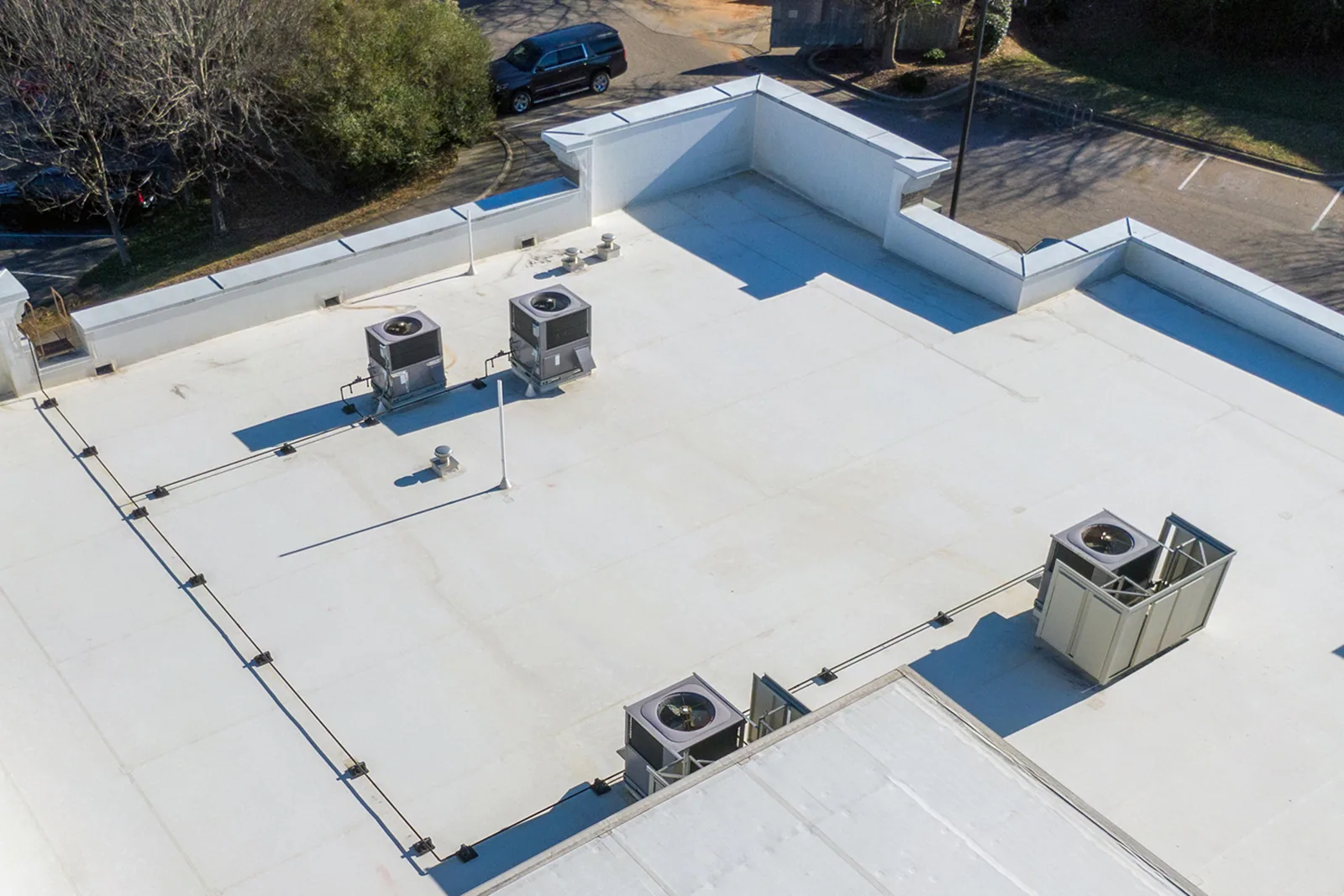
Membrane Puncture Repair in Sherman, TX
Membrane puncture repair in Sherman, TX: find cuts, tears and impact bruises from foot traffic and debris, check the insulation below and patch to match.
A roof membrane is a thin sheet over a soft layer. The sheet resists water. The layer beneath it is insulation, and insulation is not hard. When something heavy lands on the sheet, or a boot grinds on it, the sheet presses into the soft layer. The surface may look fine. The material underneath may be crushed. That crush is called an impact bruise.
A puncture is the sharper version. A dropped tool, a ladder foot or a piece of debris cuts through. Water follows the cut into the insulation. Sherman, TX averages 44.3 inches of precipitation a year, and a small hole soaks a large area over time. We find every hole and every bruise before we choose a patch.
Identify what broke the sheet
Punctures come from four sources. Foot traffic is the most common. Technicians walk to rooftop units, and their boots carry grit that scuffs and cuts. Dropped tools and materials are second. Storm debris is third. Hail is fourth, and hail bruises can crack the sheet without a visible hole.
The source matters because it points to a pattern. Cuts in a line show a service path. Cuts near a unit show maintenance work. Scattered round marks show hail. Random tears near an edge show wind-blown debris. We map every mark on the roof plan. A map turns a list of holes into a story, and the story tells us how to prevent the next one.
Scan below the surface
A hole in the sheet is only the top of the problem. Water that enters travels through the insulation and soaks it. Wet insulation loses thermal value. It also adds weight and can corrode the deck.
We run a moisture scan around every puncture. The scan shows how far the water has spread. Then we cut a core sample where readings are high. A core reveals the layers and the condition of each one. A dry core means a simple patch. A wet core means the insulation is cut out. For a large roof, an infrared moisture survey finds the wet zones across the whole surface in one pass, and it often reveals leaks from punctures that nobody noticed.
A scan on the day of repair is not enough on its own. After a week, we recheck the moisture reading in the area. A reading that drops confirms the repair worked. A reading that stays high means water is still entering, or the insulation was not fully dried. The check costs little, and it prevents a repair from failing quietly.
Patch to match the sheet
The patch has to bond to the sheet beneath it. On a thermoplastic roof, such as TPO, the patch is a piece of the same material, hot-air welded around the edges. On cured rubber, the patch is adhered or taped. On modified bitumen, the patch is a heated or cold-applied piece of compatible material.
We prepare the surface first. The area around the hole is cleaned and the edges of the cut are trimmed. The patch extends well beyond the hole in every direction, so the weld sits on sound material. Corners are rounded, since a square corner peels. After the patch cools, we probe its edge with a blunt tool and check for gaps. A bad patch is worse than none, because it hides the problem.
Near a lap, the repair changes. A puncture within a few inches of a weld can pull the seam open as the patch cools and shrinks. We probe the neighboring lap before and after, and a seam that has opened is welded in the same visit. Patches on a curved or sloped surface are cut to follow it, and each one is numbered on the plan so it can be rechecked.
Fix the soft layer too
If the insulation under a puncture is wet or crushed, the patch alone will not hold. A patch over a soft spot sinks, and the sinking pulls on the weld. We cut out the damaged insulation, install new boards and then patch the membrane over them.
Where foot traffic is heavy, a cover board adds a firm layer between the insulation and the sheet. It spreads load and resists crushing. It is a small addition to a repair, and it protects the new patch from the same damage. We recommend it along service paths and around equipment. A firm layer under the sheet also stops a stone or a dropped tool from crushing the insulation, so the sheet has support when it takes an impact. On a roof with a history of punctures, we price the board as an option beside the patch work.
Add the weather load
Heat softens a membrane, and a sheet on a 113 F day scuffs more easily than a cool one. Hail adds direct impact. The June 8, 2025 storm produced a half-dollar hail report near Denison, and an EF1 came down southwest of Sherman the same day. Debris from a storm like that can cut a roof far from where it started. We check for hail damage on the same walk as any puncture repair, since the two often overlap.
Cold makes a sheet stiff and brittle. A tool dropped on a cold roof in January can crack a membrane that would only dent in July. We note the season of each puncture when we can learn it, since it helps explain the cause.
Protect the paths
Most punctures are avoidable. Service paths to rooftop units should have walkway pads, which are thick, wide strips of protective material welded or adhered to the roof. They spread a boot's load and catch grit. Equipment curbs and supports should have clear working room, so a technician does not need to kneel on the bare sheet. Our work on rooftop equipment curbs includes this planning.
A plant with process exhaust and frequent service, such as the food and metal plants at Progress Park, sees more traffic than most roofs. A manufacturing plant roof benefits from marked paths, a sign at the roof hatch and a short rule sheet for service contractors.
Schools, hospitals and campuses have their own traffic. Hospitals and a college campus such as Austin College, in Sherman since 1876, see maintenance crews, window washers and antenna installers on their roofs. Each visit is a chance to cut the sheet. We recommend a roof access log, so the owner knows who went up and when. If a new puncture appears, the log narrows the search.
Expect this on site
On arrival the crew walks and scans first, and then marks every puncture and bruise, photographs them and covers open holes with temporary seals. Repair follows in sections. Tenants below are told when work happens, and access is arranged in advance. Across Sherman and the nearby towns, the owner receives the same package: a roof plan with every repair marked, photos before and after, and notes on paths to protect.
Commercial Roofing Questions
Can a small puncture wait?
No. Water enters through any hole and soaks the insulation. A temporary seal is the minimum.
How do you find a puncture that is hard to see?
A moisture scan finds the wet zone, and a close inspection of that zone finds the opening.
Is a patch permanent?
A patch that is welded or adhered correctly on dry insulation lasts as long as the sheet around it.
What is an impact bruise?
It is crushed insulation under an intact sheet. The sheet may crack later, so we check it.
How do I reduce punctures?
Add walkway pads along service paths, keep tools off the roof and brief service contractors.
Send the address and leak history
Send the building address and any past leak history. We will walk the roof, run the moisture scan and explain what the readings show.
Related Roofing Work
Infrared Moisture Survey
Infrared and core-cut moisture surveys for commercial roofs in Sherman, TX, mapping wet insulation so repair and replacement dollars go where water sits.
TPO Roofing
TPO single-ply roofing in Sherman, TX: how the welded membrane moves, where it fails, how we test seams, and how repairs and replacements are built.
Seam Failure Repair
Seam failure repair in Sherman, TX: probe, weld, tape and re-seal split membrane laps, then scan for the wet insulation that open seams leave behind.
Roof Insulation and Cover Board
Insulation, tapered systems and cover board for Sherman, TX commercial roofs: thermal value, compressive strength, vapor control and hail protection.