
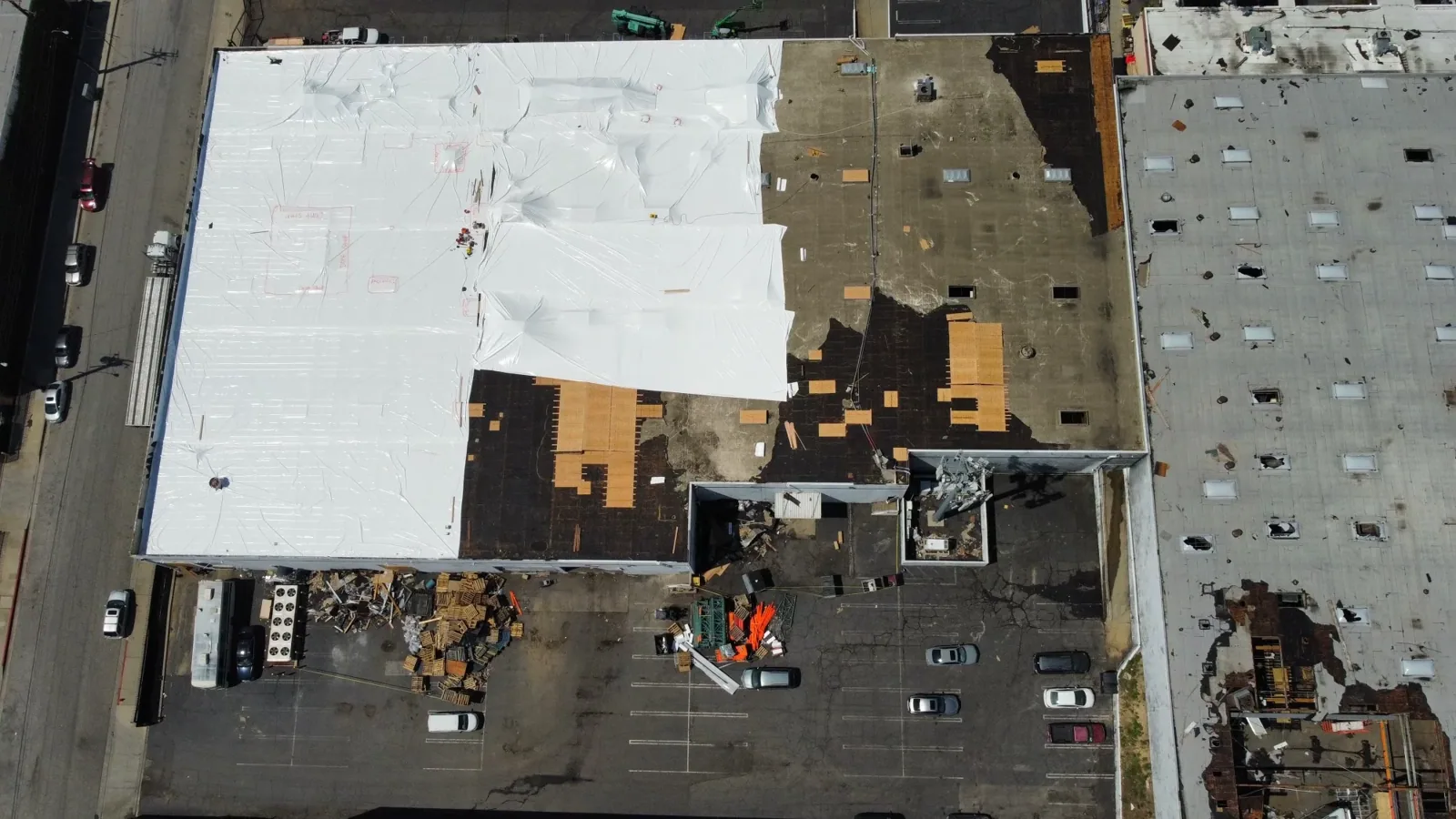
Fire Damage Roof Repair in Sherman, TX
Fire damage roof repair in Sherman, TX: assess deck strength, melted membrane, wet insulation and smoke contamination, then rebuild the roof section by section.
Fire attacks a roof from two directions. Heat from below softens the deck and chars what sits on it. Heat from above melts the membrane and ignites the insulation. Water from the fire department then soaks everything that did not burn. A roof that looks intact from the ground can be weakened in every layer.
Steel deck is the first concern. Steel loses strength when it gets hot, and it can sag or warp without any visible flame on the roof. Insulation boards can melt, shrink or burn at different temperatures. The membrane may be scorched, blistered or gone. In Sherman, TX, we start every fire repair with a safety check of the structure. No one walks the roof until the deck is judged safe to hold weight.
Clear the roof for safe access
The first visit is not a repair visit. It is a safety visit. We confirm with the owner and the authorities that the building is open to inspection. Then we view the roof from below, looking at the underside of the deck for sag, rust, charring or distortion. If a structural engineer is involved, we work from the engineer's limits.
On the roof, we walk the safest path first and test the deck with care. Soft spots, holes and warped panels are marked and avoided. Temporary protection goes on openings, so rain does not add to the damage. The photo set taken at this stage documents the loss as it stands, before cleanup. That record supports the claim and sets the scope.
Occupants and neighbors matter at this stage too. Falling debris, hot spots that flare up and fumes from burned material are all hazards, so we set a controlled zone below the work and keep unauthorized people out. The crew carries the right protective gear, and any area that smells of burned material is ventilated before work begins.
Measure what the heat did
Fire damage is uneven. One bay may be destroyed while the next shows only smoke. We map the roof into zones and rate each one. A zone is total loss, partial loss or smoke only. Total loss means the deck and insulation must be replaced. Partial loss means the membrane and some insulation come out but the deck stays. Smoke only means cleaning and inspection.
Moisture scans are part of the assessment. Water from firefighting runs through damaged areas and soaks the insulation. The scan shows how far it spread. Core samples confirm what the layers look like. An infrared moisture survey maps the whole roof quickly, which helps when the damage is large and access is limited.
Water damage from suppression often exceeds the fire damage itself. A roof can hold a large volume of water in its insulation, and the added weight stays on the deck until the boards are removed. Water also finds its way through the old punctures and cuts that firefighters make to vent the roof. Those vent cuts are mapped and repaired as part of the same scope.
Document for the carrier
A fire claim is large and detailed. The carrier will want proof of cause, extent and cost. We supply dated photos, zone maps, moisture readings, core samples and a written scope. Each item ties to a location on the roof plan, so the adjuster can follow the damage without guessing.
We separate fire damage from older problems. A roof with existing leaks or worn seams will show those in the same photos. Being clear about what was already there protects the owner, since the carrier pays for fire loss and not for wear. The insurance claim assistance we provide follows this record and stays factual about what each zone needs.
Rebuild from the deck up
The rebuild follows the layers. First comes the deck. Damaged panels are replaced or repaired, and the structure is checked against the engineer's report. Next comes the insulation. Burned and wet boards are removed, and new boards go in dry. A cover board may be added to protect the new insulation. Last comes the membrane, welded or adhered to match the surrounding roof.
Flashings at walls, curbs and penetrations are usually damaged too. Heat shrinks them and smoke stains them. We replace them where needed and tie them into the new sheet. Smoke odor can stay in insulation, so odor-affected boards are removed when the scope requires it. The work proceeds in sections, and each section is closed in before the crew moves on.
Seams in the new sheet are probed as soon as they cool, and tie-ins to the old sheet get extra attention. The line where new membrane meets old is the likeliest place for a later seam failure, so each tie-in is photographed and logged. A final moisture scan confirms the roof is dry before the section is signed off.
Plan around the weather
Sherman's weather adds pressure to a fire repair. An open roof needs a seal before the next rain, and the area records about 44.3 inches of precipitation a year. Spring storms are the main risk, because tornadoes in North Texas bunch up in April and May, as the June 2025 EF1 southwest of Sherman reminded the county. A roof with a hole in it during storm season is exposed to wind as well as rain.
Heat matters during the rebuild. Records reach 113 F, and a hot deck affects adhesives, coatings and the crew. Work shifts to cooler hours when needed. In winter, the record low of -3 F limits adhesive work, and the crew uses methods that suit the temperature.
Wind is the quiet threat to a half-rebuilt roof. New insulation and loose membrane lift easily until they are fastened or adhered, and a gust can strip a section overnight. We secure each day's work before leaving, ballast loose edges and tie down materials. The wind damage checks used after storms apply here as well.
Match the repair to the building
Fire repair differs by building. A food plant at Progress Park, a semiconductor facility, a hospital and a retail center each need different handling. Food and clean-process sites may need controlled clean methods and strict control of debris. Hospitals need infection control during the work. Retail centers need staged access so shops can reopen.
A manufacturing plant roof often has exhaust ducts and process piping that run through it, and heat travels along them. We trace every penetration for damage. For work across Progress Park and the rest of the city, the owner gets a zone map, a scope, a schedule and a closeout photo set.
A site near US 75 or in Denison that keeps production going around the clock often cannot stop for the whole job. We phase the work so unaffected bays stay in use, and a fire watch is kept on any hot work. Access routes for trucks, lifts and dumpsters are set before the first day.
Commercial Roofing Questions
Can a fire-damaged roof be repaired, or must it be replaced?
Both happen. Zones with sound decks and limited damage are repaired. Zones with burned or warped decks are replaced.
How soon should the roof be covered?
As soon as the structure is safe to access. Temporary protection stops rain from adding to the loss.
What about smoke damage on the roof?
Smoke stains and odor settle into membranes and insulation. We clean what can be cleaned and replace what cannot.
Who judges whether the deck is safe?
A structural engineer does, when there is doubt. We work within the limits the engineer sets.
Do you work with the insurance adjuster?
We provide documentation and walk the roof with the adjuster if the owner asks.
Send the address and damage history
Send the building address and any past leak history. We will walk the roof once it is safe, map the zones and explain what the readings show.
Related Roofing Work
Infrared Moisture Survey
Infrared and core-cut moisture surveys for commercial roofs in Sherman, TX, mapping wet insulation so repair and replacement dollars go where water sits.
Membrane Puncture Repair
Membrane puncture repair in Sherman, TX: find cuts, tears and impact bruises from foot traffic and debris, check the insulation below and patch to match.
Roof Insurance Claim Assistance
Documentation and coordination for commercial roof insurance claims in Sherman, TX: dated photos, moisture maps, test squares, scope lines and adjuster visits.
Roof Insulation and Cover Board
Insulation, tapered systems and cover board for Sherman, TX commercial roofs: thermal value, compressive strength, vapor control and hail protection.