
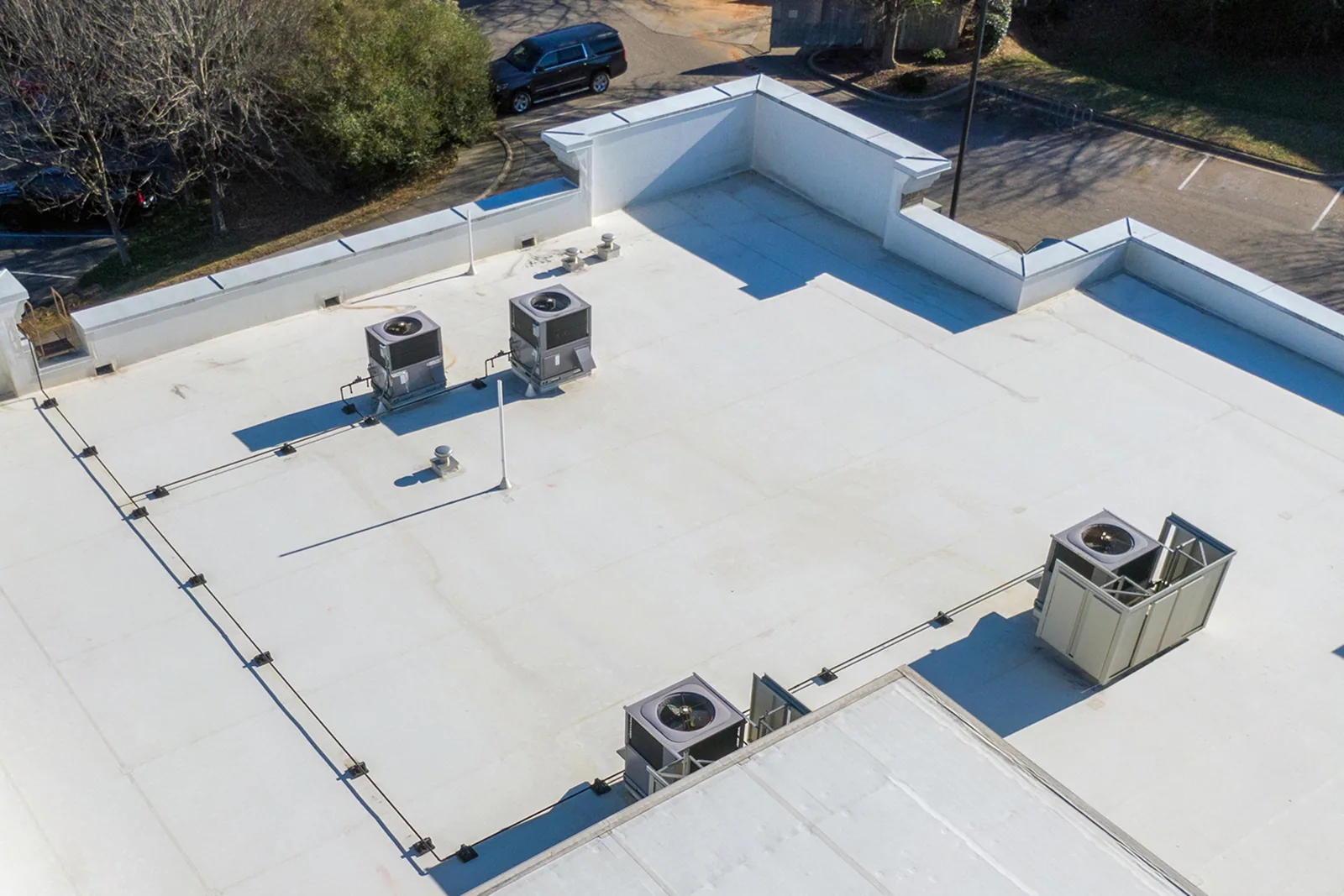
Restaurant Roofing in Sherman, TX
Restaurant roofing in Sherman, TX: grease-resistant membranes, exhaust fan flashing and repairs scheduled so the kitchen and dining room stay open.
Grease is a slow poison for a roof. Kitchen exhaust throws a fine film of oil onto the membrane. Sun bakes it. Rain softens it. The film attacks many single-ply sheets and loosens their seams. A restaurant roof can look fine from the parking lot and be failing at the exhaust fan.
So the first stop on a restaurant roof is the kitchen exhaust. We look at the fan, the curb, the grease trap and the membrane around them. We probe the nearby seams with a tool. We take a core if the surface feels soft. The findings tell the owner how far the damage has traveled, and whether a repair or a section replacement is the right answer.
In Sherman, TX the heat adds to the problem. A record high of 113 F bakes the oil faster, and a record low of -3 F stiffens the membrane. Those swings crack a weakened surface.
Stop Grease Before It Spreads
A grease trap on each exhaust fan catches most of the oil. When it is full, oil runs onto the roof. When it is missing, oil runs everywhere. A cleaning schedule matters as much as the trap.
We check each trap and note its condition. Where grease has already reached the roof, we recommend a wash with a suitable cleaner. We then look at the membrane. Some sheets resist grease better than others. A PVC membrane is designed to resist oils and fats, which makes it a common choice for restaurant roofs. Other membranes can work if the trap stays clean and the roof is washed often.
The fan itself needs flashing that sheds water and grease away from the curb. Cracked sealant or split pitch pans let oil under the membrane. We reseal them and log the date.
Washing deserves a note of its own. A low-pressure wash with a cleaner made for the membrane lifts the film without driving water under seams. High pressure does the opposite. We wash from the field toward the drains, and we check the drain bowls afterward for grease buildup. A clogged drain full of grease holds water against the membrane for days.
Count the Openings
A restaurant roof has more openings than most. There are exhaust fans, make-up air units, plumbing vents, gas lines and walk-in cooler condensers. Each opening has flashing, and each flashing is a place for water to get in.
The number of openings multiplies the risk. A roof with twelve penetrations has twelve chances to leak. We inspect each one. We record the flashing type, the sealant state and any signs of past repair. The record becomes a checklist for later visits.
Roof access for service techs adds traffic. People walk across the membrane to reach units. We mark walk paths and add pads where wear shows. Good penetration flashing work often removes more risk than anything else on a small roof. Condenser coils for walk-in coolers also deserve a look, because their lines pass through the membrane and carry condensation that drips onto the surface below.
Plan for Storms and Freezes
Tornado season in North Texas crests in April and May. Along the Red River, Sherwood Shores took heavy damage from an EF2 on March 21, 2022, and in April 2016 an EF1 in Howe, south of Sherman, hit homes and the high school.
Small restaurant buildings often have light roofs and low parapets, so wind can lift an edge fast. We check the perimeter metal and fasteners every spring. After any storm we check again and compare the photographs.
Hail leaves bruises that do not leak at once. They crush insulation and weaken the membrane. A moisture scan reveals them. Early repair is far cheaper than a roof full of wet insulation.
Winter matters as well. The March 2008 snow band, up to 6 inches over Grayson County, is the kind of load that blocks small drains, and meltwater finds seams. A pre-winter check of drains keeps a dining room dry.
Handle Older Buildings with Care
Denison grew from a Katy railroad depot in 1872, and brick storefronts with flat roofs fill its downtown and rail-side blocks. A restaurant in a building like that may share a wall or a parapet with a neighbor, and a shared wall is a leak path.
We inspect the parapet cap, the flashing at the wall and the drain behind the parapet. Brick can crack, and mortar can wash out. We repair the joints before we touch the membrane. A new roof against a weak wall will fail at the junction.
A newer restaurant along US 75 or US 82 may be a pad building with a single flat or low-slope roof. They are simpler to inspect but still have their own problem spots. We treat them with the same sequence: walk, scan, core and record. A Denison restaurant and a Sherman pad site may need very different repairs.
Work Around the Service Hours
A restaurant cannot close for a week. Roof work must fit around meals. We start early, before the lunch prep begins. We finish by midday on hot days, which helps the crew and the membrane.
Fumes and noise matter in a dining room. We locate air intakes before using any adhesive. We schedule the loudest steps away from peak seating. We keep ladders and equipment away from the entrance.
Kitchen protection comes first. Ceiling tiles over cooking lines are covered. Food prep areas stay clear. We also keep fire safety in mind. Torch work on a roof near a kitchen exhaust is a risk, so we prefer welded or adhered systems that do not use an open flame. This also applies to a hotel kitchen or banquet room.
Match the Repair to the Finding
Surface grease damage with a sound substrate can take a section replacement. A roof with wet insulation across a large area needs full replacement. A roof that is only dry and worn can take a coating, but the grease source must be fixed first or the coating will fail.
A coating restoration works best when the surface is clean and the insulation is dry. We test both. We list the cost drivers in the scope: roof area, access, number of penetrations, insulation thickness and edge metal.
Restaurants in a strip share one roof with their neighbors. The shopping center pattern applies, and the repair must be coordinated with the landlord and the other tenants. A grease leak above one suite can stain the ceiling of the next. Our record shows where the oil came from and where the water went.
After the work, the owner receives a short care schedule. It lists the dates for trap cleaning, roof washing and a follow-up scan. Food service runs on routine, and a roof can run on routine too.
Commercial Roofing Questions
Does grease really damage a roof?
Yes. Oil softens many membranes and loosens seam adhesives. Over time it eats through the surface near the fan.
Which roof is best for a restaurant?
A grease-resistant membrane, such as PVC, is a strong match. Any membrane can work with a clean trap and regular washing.
Can the restaurant stay open during roof work?
Usually yes. We work early and avoid peak meals. Kitchen areas are protected before we start.
How do I know if the fan curb is leaking?
Look for stains on the ceiling below and soft membrane near the curb. A moisture scan confirms it.
What should be done after a hailstorm?
Schedule a scan within days. Hail bruises insulation without splitting the surface, and the damage shows only under a scan.
Send the Restaurant Address and Leak History
Tell us where you see stains, where the exhaust fans sit and when the roof was last worked on. We will walk the roof with you and explain what the readings show.
Related Roofing Work
PVC Roofing
PVC single-ply roofing in Sherman, TX: how the welded membrane resists fats and chemicals, where it fails, and how we test, repair and replace it.
Skylight and Penetration Flashing
Skylight, curb and penetration flashing repair for commercial roofs in Sherman, TX: pipe boots, vent stacks, dome seals and curb details that stop leaks.
Denison
Commercial roofing in Denison, TX: parapet and flashing repair on older brick flat roofs, plus moisture scans and recovers for plants, clinics and schools.
Sherman
Commercial roofing in Sherman, TX for fabs, food plants, hospitals and the college: moisture scans, seam repair, recovers and storm checks on flat roofs.