
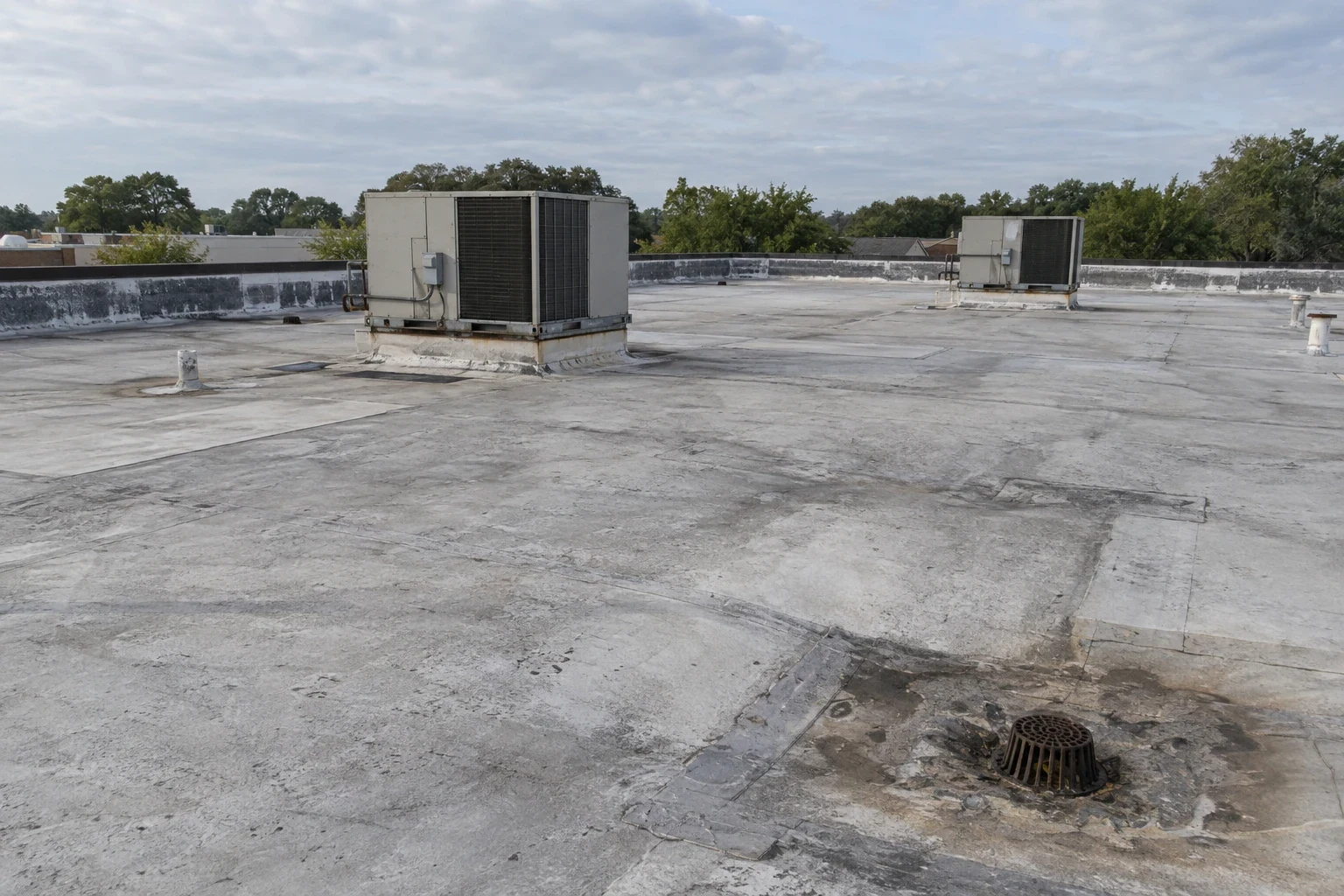
Grocery Store Roofing in Sherman, TX
Grocery store roofing in Sherman, TX: refrigeration load, dew point and vapor control, plus repairs staged so the store stays stocked and open.
A grocery roof sits between two climates. Below it is cold air from coolers and freezers. Above it is Texas sun. Warm, moist air tries to move toward the cold side. When it meets a cold surface it condenses. That point is the dew point, and where it falls inside the roof assembly matters a great deal. If it lands in the insulation, the insulation gets wet and stays wet.
This is why a grocery roof can fail without a visible leak. The ceiling tile stays dry for a long time. Meanwhile the insulation loses its value and the deck starts to rust. We look for it with a moisture scan and core samples, and we read the vapor retarder as carefully as the membrane. The owner then knows what the roof is doing before a customer sees a drip.
Count the Roof's Mechanical Load
Grocery roofs carry heavy equipment. There are condensers, make-up air units, exhaust fans and sometimes a large rack of piping. Each item has a curb, a line set or a drain. Each is a place for water to enter.
Refrigeration lines pass through the roof in bundles. Their insulation can crack in the sun, and the sealant around them can open. Condensate lines can drip onto the membrane. We check each penetration by hand. We record its flashing, its sealant and its drain path.
Technicians service this equipment on a regular schedule. They walk on the membrane and set down tools. A walk path with protective pads keeps their traffic off the field of the roof. We recommend one wherever a path is worn through the surface. Curbs and equipment supports deserve the same attention as the membrane.
Drainage is the other half. Grocery roofs shed a lot of water from a large area, and a clogged drain turns the roof into a pond within one heavy storm. We clear every drain bowl, check strainers and test the overflow scuppers. Ponding adds weight to the deck. It also speeds up membrane wear. A drain log gives the manager a record of what was found at each visit.
Respect the Heat and the Cold
Sherman reaches a record high of 113 F and a record low of -3 F. Between those marks, a roof moves. Seams stretch. Flashings pull. Fasteners back out. A grocery roof feels this in a particular way, because heat from inside and outside both push on the same assembly.
A reflective membrane helps with the outside load. A TPO roof sheds sunlight and welds at the seams. An EPDM roof has a long record on flat commercial buildings and handles cold well. Either system works when the substrate is dry and the details are sound.
Winter loads matter too. A thaw matters most after storms like the December 2013 sleet, when ice 4 to 5 inches thick sat on Sherman and Denison, or the January 2025 snow that hit 9 to 11 inches in isolated pockets. Drains must be clear before the cold, and the roof should be walked after a thaw. A thaw lifts ice from the edges and exposes any seam it has pulled apart. A short repair that week avoids a long repair in spring.
Plan for Storms Before the Doors Open
Tornado season here centers on April and May. The fresh reference is the June 8, 2025 storm, with EF1 winds southwest of Sherman and half-dollar stones northwest of Denison. Dime hail north of Sadler on April 3, 2014 is the older one.
A storm that hits a grocery store roof can cost a day of sales. So we plan for it. We walk the roof each spring. We log edge metal, seams, drains and curbs. After a storm, we repeat the walk and compare. The comparison shows what changed, and it supports a claim.
Hail bruises insulation without always tearing the surface. A moisture scan after any hail report finds them. Early repairs cost far less than a wet-insulation replacement later.
Wind is the other half of the spring problem. A gust can lift a loose edge metal strip, and the strip then tears the membrane beneath it. We check every coping joint and every perimeter fastener. Where metal has worked loose, we re-secure it and seal the joint. This small fix is one of the cheapest forms of protection a grocery roof can have. It is also one of the easiest to forget between storm seasons.
A written storm plan helps the staff. It lists who calls us, who opens the roof hatch and where the shutoff for rooftop equipment sits. When the first hour matters, the plan saves minutes.
Look at the Food Economy Around Sherman
Food runs deep in this region. Tyson Foods, with about 1,765 employees, is Sherman's largest employer. Sunny Delight Beverage is a tenant in Progress Park. Ruiz Foods is a Denison employer. In Anna, Brookshire's is among the largest employers at about 100 jobs.
Those names show how much of the local economy handles food. Food handling often means cold product, but the roofs differ from plant to plant. We start every job with a walk, a scan and a core. The record then drives the advice.
Grocery stores follow population growth. Anna's 2020 count of 16,896 residents had more than doubled by the 2025 estimate, and a store opened in a town growing that fast has a young roof, and young roofs still need an early inspection. Roofs in Anna and Progress Park each get their own walk.
Keep Shelves Stocked During Repairs
A grocery store runs on deliveries and cold storage. A roofing crew must not interrupt either. We schedule around truck arrivals. We stage material away from the dock. We keep sidewalks and entries clear.
Roof sections open one at a time. Each one is dried in before the crew leaves. A leak during work is the worst outcome, so we keep a watch on the forecast and a crew on standby to cover any open area.
Noise and dust get managed too. Fumes from adhesives can enter air intakes. We locate the intakes first and plan around them. A written plan goes to the store manager before the first day. The same approach carries to a restaurant, where kitchen exhaust and food safety add similar limits. Larger stores in a plaza may share a roof with a neighbor, and the big-box retail pattern applies there.
When the job ends, the owner receives photographs, material records and a care schedule. The care schedule names the dates for drain cleaning, curb checks and the next moisture scan. A manager who follows it sees problems while they are small.
Commercial Roofing Questions
Why does a grocery roof get wet insulation without leaking?
Moist air condenses inside the roof assembly where it meets a cold surface. The insulation absorbs the water slowly. A moisture scan finds it before a stain does.
Can a vapor retarder be repaired?
Sometimes. Small breaks can be patched during a section repair. A badly damaged retarder usually means replacing that section of the assembly.
How do you protect refrigerated stock during roof work?
We keep roof sections small and dry them in daily. Interior cover goes up where needed. We also avoid blocking dock access and air intakes.
Is a white roof better for a grocery store?
A reflective surface cuts heat gain from above. It does not fix a wet assembly or a vapor problem. We check the whole system first.
How often should a grocery roof be inspected?
Twice a year is a good pace, once before spring storms and once after winter. More often is wise after hail or ice.
Send the Store Address and Leak History
Tell us where you have seen stains, when the roof was last worked on and how your refrigeration equipment sits on the roof. We will walk it with you and explain what the readings show.
Related Roofing Work
Rooftop Equipment Curbs and Supports
Rooftop unit curbs, equipment rails and pipe supports for Sherman, TX commercial roofs: load paths, curb flashing, vibration, walkway wear and timing.
TPO Roofing
TPO single-ply roofing in Sherman, TX: how the welded membrane moves, where it fails, how we test seams, and how repairs and replacements are built.
EPDM Roofing
EPDM rubber roofing in Sherman, TX: how the sheet stretches and shrinks, where splices and flashings fail, and how we test, repair, ballast and replace it.
Anna
Commercial roofing in Anna, TX: baseline scans on new roofs, refrigeration-aware grocery roof checks, school and clinic scheduling, and storm-ready repairs.