
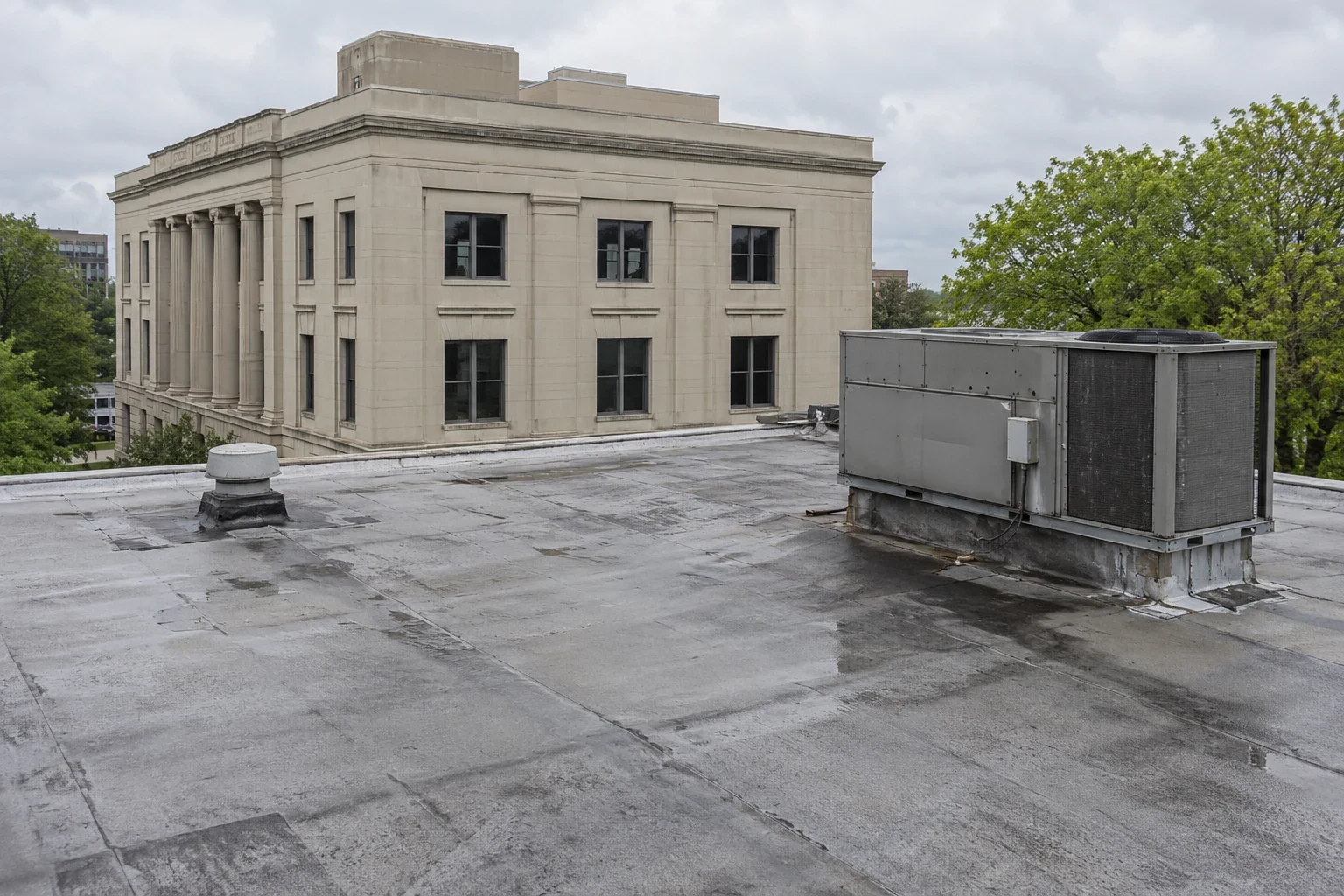
Government Building Roofing in Sherman, TX
Government and municipal roofing in Sherman, TX: documented scopes for public procurement, code-aware reroofing and records that stand up to audit.
A public building roof has two jobs. It keeps the rain out, and it keeps a paper trail. Public money pays for it, so every decision may be read later by a council, an auditor or a citizen. A roof with no record becomes a hard decision to defend.
So we build the file as we build the roof. Each inspection produces photographs, a moisture map and a written condition rating. Each repair produces a dated scope and a materials list. In Sherman, TX the thermometer has recorded 113 F and -3 F, and that range wears seams and flashings on every public roof. A documented condition record shows the council why a repair is needed now and why another can wait.
Clear the Permit and the Inspector
A public reroof passes through the building department before it passes through the roof. The permit office decides what drawings it wants, whether an engineer's seal is needed and when inspections are called. We ask those questions in the first week, not the last, because the answers set the schedule.
A scope written without that conversation gets rejected at review, and the delay costs money. We list the assembly, the fastening pattern and the fire rating in plain terms so the reviewer finds the compliance on the first page. The permit and inspection records stay in the project file for later reference.
Inspections follow the permit. We meet the inspector on site, show the assembly and answer questions about fastening and flashing. Passing the first time saves days. A failed inspection means a hold, and holds are costly when a council expects the work done before the school year or before a new fiscal year begins.
Look at the County Seat and Its Neighbors
Sherman is the Grayson County seat, and the City of Sherman is among the area's larger employers at 606 people. Sherman ISD, at about 1,137 people, is a public employer of a different type. Their buildings include offices, maintenance shops, community spaces and storage.
Each building has a roof of its own. A courthouse annex does not look like a fleet shop. A library does not look like a fire station. Each job starts with a walk, a scan and a core, and the findings go to the building's owner in writing before anyone prices a repair.
Neighboring towns bring more buildings. Denison, Howe and Van Alstyne each run municipal buildings of their own. A shared record format lets a county or a council compare them without translation. Fiscal years differ from one entity to another, so we mark the budget deadline for each building next to its recommendation. A roof that needs money before a deadline gets flagged in time.
Write Scopes a Purchasing Office Can Use
Public bids need clear scopes. Vague scopes produce uneven bids and change orders. A good scope lists the roof area, the existing system, the tear-off depth, the insulation, the membrane, the flashings and the warranty terms.
We also list cost drivers: access, number of penetrations, edge metal and phasing. A purchasing officer can then compare bids on equal terms. Allowances for unknowns, such as wet insulation found during tear-off, are written in advance with unit prices.
Our condition reports are written for this use. They can be attached to a bid package, a budget request or a grant application. A capital plan turns the reports into a multi-year schedule that a council can approve in stages.
Prepare for Storms and Outages
Public buildings often must stay open in a storm. Police stations, fire stations and emergency operations centers cannot close. A leaking roof can cut off power, damage equipment or close a bay.
Most tornadoes in North Texas arrive in April and May. The county's recent record includes an EF1 southwest of Sherman on June 8, 2025, hail with half-dollar stones northwest of Denison that day, and an EF2 at Sherwood Shores in March 2022. We plan roof checks before spring so those buildings enter storm season with a clean record. The checks cover the details a storm tests first: edge metal, coping, rooftop unit hold-downs and drain strainers. The facility manager receives a written list of what was checked, what was fixed and what is still open, so the roof's state is known before the first warning of the season.
Winter matters too. Ice from the December 2013 sleet stood 4 to 5 inches deep across Sherman and Denison, and snow in January 2025 topped out at 9 to 11 inches in isolated places. Ice blocks drains and loads roofs. We clear drains in autumn and check them after any freeze.
Reroof Without Closing the Doors
Many public offices serve citizens daily. A reroof must not close the counter. We phase the work by section, protect entrances and keep walkways clear. Noisy steps land during low-traffic hours. Dust and fumes are kept away from air intakes. Public work carries one more scheduling layer. Council meetings, election days and court sessions fix the quiet hours, so the phase plan lists those dates beside the roof sections and keeps lifts and noisy steps away from them.
Security matters in some buildings. We coordinate with facility staff on access, escort rules and tool control. Our crews wear identification and follow site rules. An occupied building reroofing plan lists each rule in writing, so every worker knows the limits.
Closeout gives the owner complete records: photographs, materials, test results and a maintenance schedule. The next facility manager then inherits a roof with a history, not a mystery.
Pick the Right System for Public Use
Public owners want long life and low upkeep. A TPO membrane is a common low-slope choice and has welded seams. A standing seam metal roof suits sloped roofs and lasts a long time with little care. Either way, the substrate and the drainage drive the choice as much as the surface does. Warranty terms belong in the file as well, so a future manager can see what was promised and by whom.
The same approach works for a school building or a college facility, which also answer to public records rules.
Maintenance yards and fleet shops often have simple low-slope or metal roofs with many penetrations for exhaust and heating. Those penetrations matter more than the field. We seal each one, record it and set a recheck date. A leak over a parts room or a vehicle bay is an operations problem, not only a roof problem.
Solar-ready and cool-roof requirements sometimes appear in public projects. We note any such requirement in the scope early so the design includes the right insulation, curbs and reflectivity from the start.
Commercial Roofing Questions
Who approves a public reroof before work starts?
The city or county building department. We ask in the first week what drawings and inspections it requires, so the schedule reflects them.
Can a public building stay open during a reroof?
Yes, in most cases. We phase the work and protect entrances. Security rules go into the written plan.
What records do you provide for an audit?
Photographs, moisture maps, written ratings, scopes, material lists and permit documents. Everything is dated and organized by roof section.
How do you handle unknown conditions in a bid?
We write unit prices for wet insulation or deck repairs found during tear-off. The bid then has a clear path for changes.
When should a public roof be inspected?
Once a year at minimum. Add a scan after hail, after ice and before the budget cycle.
Send the Building Address and Leak History
Tell us which buildings have had leaks, what your permit office requires and when your budget cycle opens. We will walk the roof with you and explain what the readings show.
Related Roofing Work
Denison
Commercial roofing in Denison, TX: parapet and flashing repair on older brick flat roofs, plus moisture scans and recovers for plants, clinics and schools.
Howe
Commercial roofing in Howe, TX: wind uplift checks, post-tornado inspections and moisture scans for school, light industrial and highway retail roofs.
Van Alstyne
Commercial roofing in Van Alstyne, TX: baseline scans for new buildings, seam and flashing repair for retail strips and older stock, and storm upkeep.
Roof Condition Reports
Written roof condition reports with photos for Sherman, TX buildings: probed seams, moisture readings, core samples and a ranked list of what to fix first.