
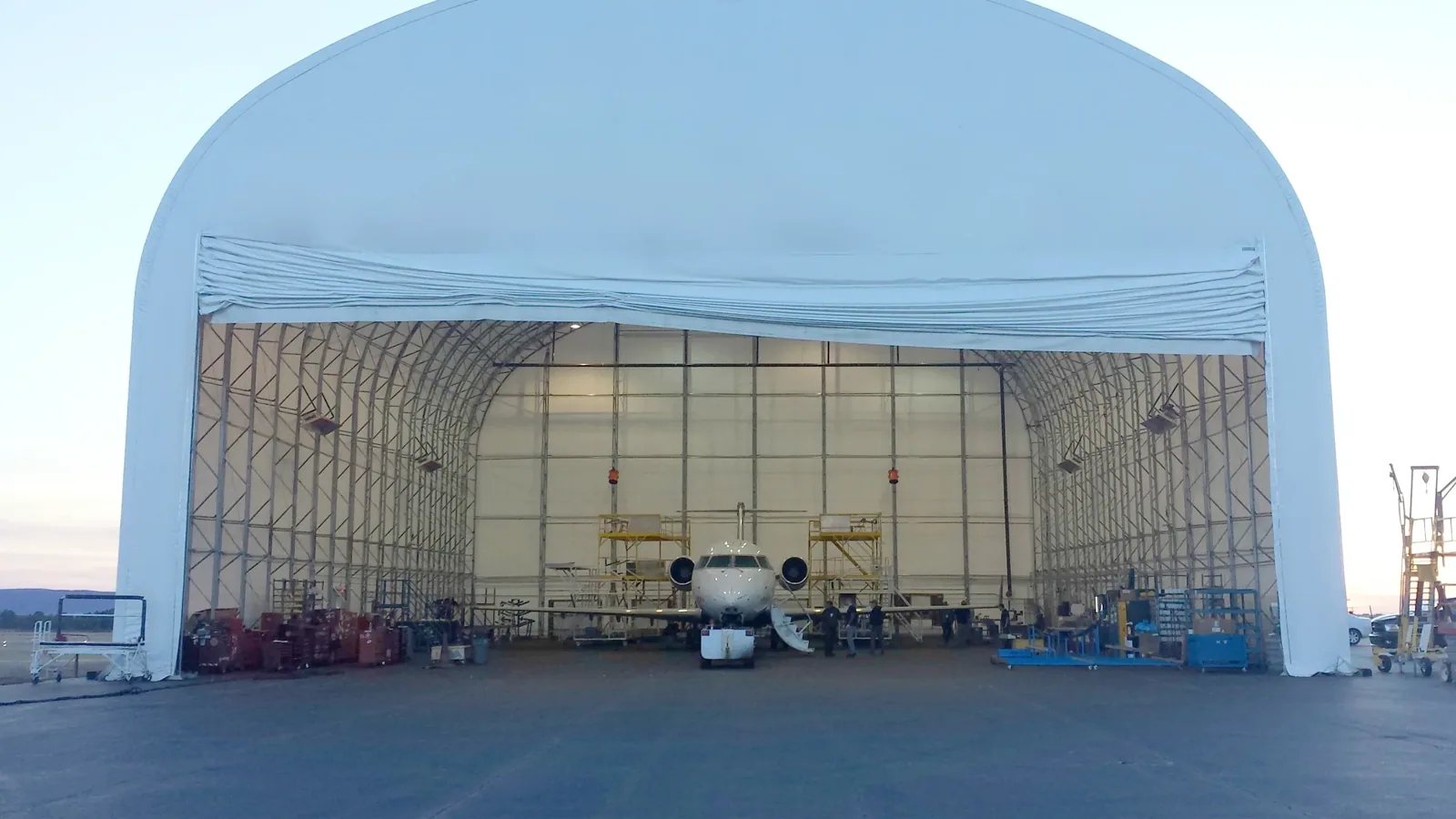
Aircraft Hangar Roofing in Sherman, TX
Aircraft hangar roofing in Sherman, TX: long-span metal roofs, uplift at the door wall, tornado and hail exposure, and repairs planned around parked aircraft.
A hangar is one big room with a lid. There are no interior columns to break the span. The roof carries its load across a wide clear opening on trusses or rigid frames. On one side the wall is mostly door. When that door is open in a gust, wind pushes into the building and lifts the roof from below. Pressure builds under the panels while suction pulls from above. That double load is what separates a hangar from a warehouse of the same size.
In Sherman, TX the roof also faces a record 113 F and a record low of -3 F. Long metal panels on a long span move a great deal between those two numbers. We look for the places where that movement and that wind have worked on the same joint.
Read the Span Before the Surface
The structure sets the rules. A long-span frame flexes under snow, wind and its own weight. The roof deck rides on that frame, so it flexes too. Panel laps open a little, and clips shift a little. Over years the sealant loses its grip. We inspect the structural connections, the purlin spacing and the clip condition along with the surface of the roof.
Hangar roofs are usually metal, either standing seam or a through-fastened panel. Some are low-slope membrane over a deck. The material decides the failure mode. A through-fastened panel leaks at the screw. A standing seam roof leaks at the seam end, the clip penetration or the flashing at a skylight or vent. A membrane roof leaks at the lap, the drain or the wall base. Each gets its own checklist before any work begins.
Condensation is the other quiet problem. A large metal roof over a heated or cooled space reaches the dew point on cool mornings, and water beads on the underside of the panel. It drips like a leak but leaves no hole. We check the insulation, the vapor retarder and the ventilation before cutting into a roof that may not be leaking at all.
Brace for Uplift at the Door Wall
The door wall takes the hardest load. Wind enters through the opening, fills the building and lifts the roof edge nearest the door. Eave trim peels first. Then the first few panels. Once a panel gives, the pressure gets inside the next one.
Spring is the tornado season in North and Central Texas. Grayson County has had an EF1 on Rockport Road southwest of Sherman in June 2025 and an EF2 at Sherwood Shores in March 2022. Storms like those are why a long-span building needs a tight edge. We check every eave screw, ridge fastener and rake clip. Where trim has loosened, we add fasteners at a closer spacing and renew the sealant. A wind-damaged roof gets the edge repaired before anything else, since an open edge invites the next gust.
Check Panels for Hail Dents and Cracked Coatings
Hail leaves a roof pattern. Stones at half-dollar size turned up northwest of Denison in June 2025, and hail north of Sadler on April 3, 2014 was dime-size. Large flat panels show dents easily. A few dents at the field are cosmetic. Dents at a seam, a rib or a clip can break the coating on the steel. Once the coating breaks, rust starts there.
A drone survey maps the dent pattern across a wide roof in a short time, without putting weight on thin panels. We then walk the suspect areas by hand, mark them and measure. If the loss is covered, the same photographs and counts go to the adjuster. The same pass finds loose skylight frames and ridge vents, which wide roofs often have.
Decide Between Repair, Coating and Retrofit
A hangar roof is costly to open. Every hour a panel is off is an hour water might reach an aircraft below. So we choose the least invasive fix that will hold. Reseal and re-fasten when the steel is sound. Coat when the panels are flat and the coating has chalked. Retrofit when the steel is rusted through or the clips have failed. A metal roof retrofit adds a new panel system over the old one without stripping the building, which keeps interior disruption low. Wind sets the pace on a job like this. Panels cannot be lifted by crane when gusts rise, and an open bay over a hangar floor should never wait overnight, so each day's work ends with the bay closed. The old roof stays in place as a base, so the work can move along the building one bay at a time while the floor below stays covered and dry.
Cost depends on the span, the access, the panel gauge, the number of penetrations and the height of the lift. Hangar eaves are high, and lift time is a real part of the price. We list those drivers in the scope so the owner sees why a quote moves.
Where new work is planned, a standing seam system with concealed clips and floating panels suits the long runs. It removes the screw holes that wear on a through-fastened roof. The details at the eave and the door header still need careful flashing.
Plan Work Around Aircraft and Airfield Rules
Roof work at an airfield brings its own rules. Lifts and cranes have height limits. Access near taxiways and ramps needs coordination with the airport manager. Debris control matters near moving aircraft and engines, and a loose fastener on a ramp is a hazard to every wheel and propeller that crosses it.
Inside the hangar, we tarp and screen work areas and keep fuel, tools and torches away from aircraft. We agree on a day-by-day plan with the owner so the aircraft are moved or covered before a panel comes off. Work runs in sections, so part of the floor stays usable. Owners of related buildings, such as a warehouse or a government building on the same field, can combine the survey and planning. Our crews also work across Sherman and the surrounding towns, so mobilizing for a second building on the same trip is simple.
Commercial Roofing Questions
Why do hangar roofs lose panels in storms?
An open door lets wind inside, and the roof is pushed up from below while suction pulls from above. Edge trim and the first panels fail first. Tight fastening at the eave and rake is the main defense, along with a door seal that stays in good repair.
Can the roof be repaired with aircraft inside?
Often, if the work is staged. We tarp, screen and protect the area below, and we agree with the owner on which aircraft move before panels come off.
Is a coating a good choice for a metal hangar roof?
It works on flat, sound panels with chalked or faded paint. It does not fix rusted-through steel or failed clips. We cut a sample and check the thickness first, then look at the purlins beneath for rust that a coating would hide.
What does a drone survey show on a long-span roof?
It maps hail dents, stains, loose trim and standing water without foot traffic on thin panels. We still walk any area the images flag, then mark and measure it.
Does a hangar roof need separate flashing at the door header?
Yes. The header is a long horizontal joint where roof, wall and door meet. It needs its own flashing and a drainage path that sheds water away from the door track. If that water pools at the threshold, it also freezes there in winter, which damages the seal and the track.
Send the Hangar Address and Roof History
Tell us about the roof type, any leaks and the last storm that passed. We will walk the roof with you and explain what the panels, clips and seams show.
Related Roofing Work
Wind Damage Roof Repair
Wind damage roof repair in Sherman, TX: edge metal, fastener, membrane and flashing checks after storms, with moisture scans and written repair scopes.
Drone Roof Inspection
Drone roof inspections for large and hard-to-reach commercial buildings in Sherman, TX, with high-resolution imagery, thermal capture and a mapped report.
Metal Roof Retrofit
Retrofitting and restoring exposed-fastener metal roofs in Sherman, TX: why screws back out, how panels leak, and how we re-fasten, reseal, coat or cover them.
Standing Seam Metal Roofing
Standing seam metal roofing in Sherman, TX: how clips and seams let panels float, where they fail in wind and hail, and how we inspect and repair them.