
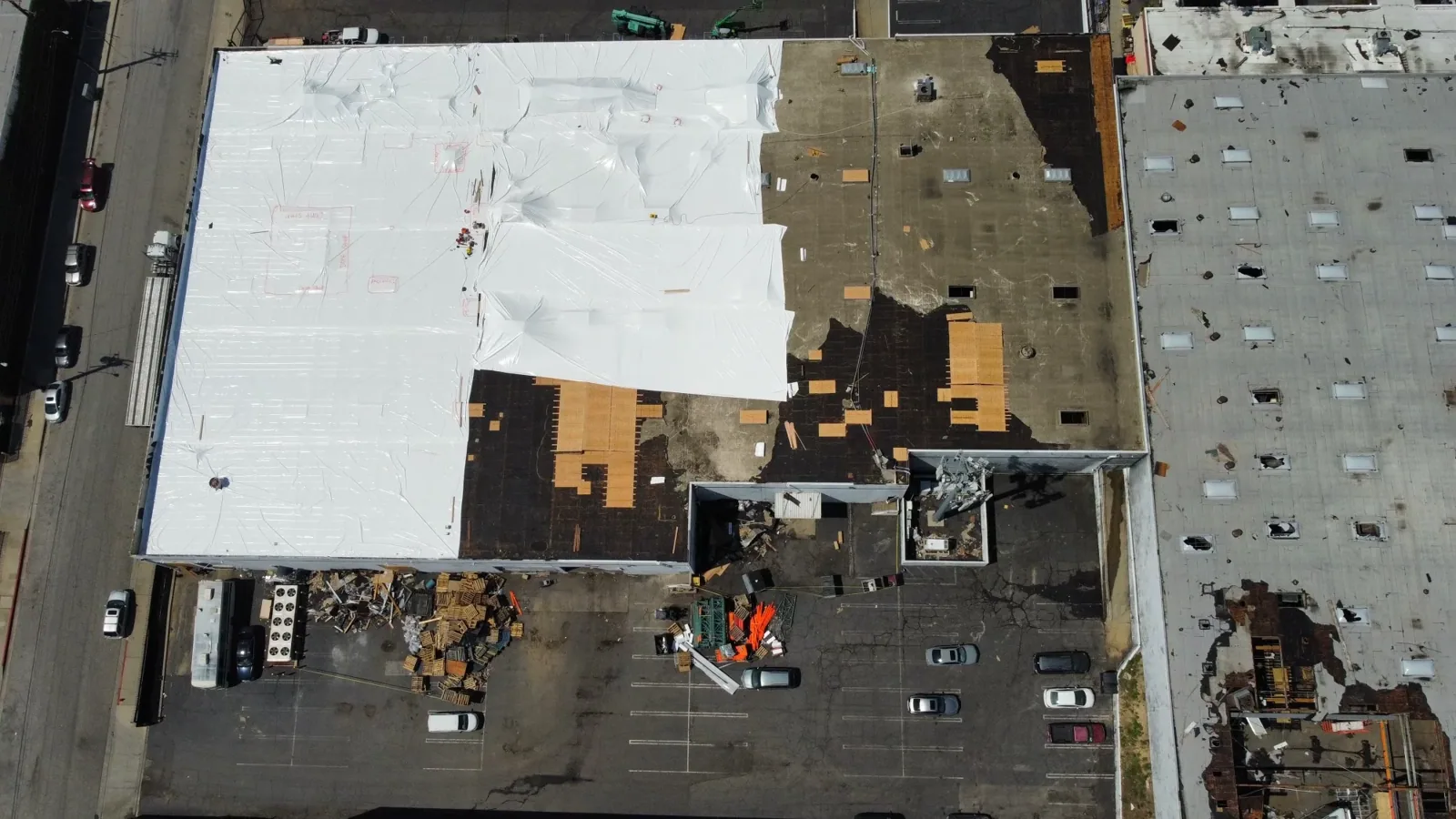
Heat and UV Roof Damage Repair in Sherman, TX
Repair of heat and UV degradation on commercial roofs in Sherman, TX: chalking, crazing, shrinkage, seam creep and coating restoration with dated records.
Sunlight breaks roofing down at the molecular level. Ultraviolet energy attacks the polymer chains in a membrane or coating. The surface loses plasticizer. It turns chalky. It stiffens. Tiny cracks appear and spread. The sheet that once stretched with the building now resists every movement. The damage starts at the top and works down.
Heat makes it worse. In Sherman, TX the record high is 113 F. A dark roof surface runs well above the air temperature on a day like that. Then the night cools it, and the cycle repeats. Over years the sheet shrinks, the seams pull and the flashings creep away from the wall. We find this damage early with a hands-on walk and repair it before water enters.
Spot the Signs of Sun Damage
Chalking comes first. Run a hand across a white membrane and a powder comes off. A glossy surface goes dull. Colors fade. Next comes crazing, a fine web of cracks on the surface. Then alligatoring on built-up and asphalt surfaces, where the top layer splits into a pattern of small blocks.
Shrinkage shows at the edges. The sheet pulls back from a curb or a wall. A flashing lifts. Seams open at the laps. Granules wear off a cap sheet and leave the base bare. We photograph each sign and mark it on the roof plan. Early signs call for monitoring. Later signs call for repair.
Metal roofs show it differently. Paint chalks. Fasteners back out as the panel expands and contracts. Sealant at laps hardens and splits. Rust starts at cut edges and exposed screws. The panel itself may stay sound for a long time. The details around it go first. We tighten, reseal and replace, and we log each fastener count. When the damage looks like flashing failure, we treat the flashing as the cause.
Track Thermal Movement at Every Detail
Sherman's record high is 113 F and its record low is -3 F, a span of 116 degrees, and every degree moves the roof. A long run of membrane grows and shrinks. A metal edge piece moves more than the sheet beside it. A pipe through the deck moves less. The joints between these parts take the difference.
Fasteners back out in this cycle. Sealant splits. A lap seam peels at the edge. We test each detail. We press on seams. We pull gently on flashing. We tap edge metal and listen. We check expansion joints for tears. Where movement has outrun the material, we add relief. A cut in a long flashing or a new expansion joint gives the roof room to move.
Seam creep is the slow cousin of seam failure. The lap does not open at once. It slides a little each season. A weld that held for years starts to peel from one end. We measure the lap width at several points and compare it to the original. A lap that has lost half its width goes on the repair list. A lap that has lost most of it goes to the top.
Test Below the Surface
Heat drives water vapor. Warm air carries moisture upward. It meets a cooler layer and turns to liquid at the dew point. Insulation can hold that water for years. A blister on the surface is often a pocket of trapped vapor. A soft spot underfoot is often wet board.
We run a moisture scan after sunset. We cut a few core samples. We measure the thickness of the membrane and look at the state of the adhesive. A sheet that has lost a large share of its thickness cannot be saved by patching. A sheet that is sound under a weathered surface may take a coating. An infrared moisture survey tells us which case we have.
Records give the test meaning. A dated set of photographs, moisture readings and thickness measurements lets us compare this year to last. A sheet that lost a little in a year is aging normally. A sheet that lost a lot is failing early. We keep the results in the roof file, so the next manager sees the trend.
Choose Between Patch, Coat and Replace
The choice follows the test results. A roof with sound insulation and a membrane of useful thickness can be cleaned, repaired and coated. A silicone coating or an acrylic coating restores the UV barrier and adds a reflective surface. The coating must bond to a clean, dry substrate, so we test adhesion first.
A roof with wide wet insulation or a membrane worn thin needs more. We cut out wet sections and replace them. Where the damage spreads, we price a recover or a full replacement. Roof coating restoration can extend life, but it cannot fix a wet assembly. We put the options and the trade-offs in front of the owner.
Schedule Repairs for Safe Heat
Heat limits the work. Adhesives set fast on a hot deck. Welded seams need a cool, clean sheet. Crews tire quickly on a dark roof in July. We start early. We shade materials. We stop when the surface is unsafe. Spring and fall give better working hours.
Rain limits it too. Sherman averages roughly 79 days of precipitation a year, about 44 inches in all. A coating cannot cure in the rain. A patch needs a dry surface. We watch the forecast and keep the roof closed each night. Spring storms add risk, because North Texas tornadoes crowd into April and May. We tie down loose material at the end of every shift.
Buildings in different settings need different plans. A distribution building in North Texas Logistics Park sits on the Oklahoma border with two access points off US 75, so deliveries shape the crew's day. A plant in Progress Park may carry rooftop exhaust that adds heat to one part of the roof. A hospital has its own limits for noise and dust. We read the setting before we write the schedule.
Planning ahead saves cost. A roof that gets a coating before the membrane fails lasts longer than one patched after leaks start. A roof that gets a yearly check shows trouble early. The owner can set a budget in advance, not in a hurry. Our roof condition reports give the numbers that support that plan.
Commercial Roofing Questions
How fast does UV wear out a membrane?
The rate depends on the material, the color and the exposure. A white sheet reflects more light than a dark one. A thick sheet lasts longer than a thin one. We measure the remaining thickness and judge from the facts, not the age.
Can a coating fix a weathered roof?
Often, yes, if the insulation is dry and the membrane is sound. The coating adds a new surface layer. It does not fix leaks or wet board. We test first, then recommend.
What does heat do to the seams?
Heat expands the sheet. Cold shrinks it. Over many cycles the laps peel or open. We probe every seam on a walk and re-weld or re-tape the weak ones before water enters.
Should we choose a lighter-colored roof?
A reflective surface lowers roof temperature and slows heat aging. It may also reduce cooling load. We check the code and the building use before we recommend it.
How often should we check for sun damage?
Check once a year and after major storms. A walk in spring finds winter damage. A walk in fall finds summer damage. Keep dated photographs so changes show over time.
Send the address and any leak history
Share the building address, the roof type and any past leaks. We will walk the roof, run the readings and explain what they show.
Related Roofing Work
Flashing Failure Repair
Flashing failure repair in Sherman, TX: find open terminations, cracked sealant and torn base flashing at walls, curbs and penetrations, then rebuild them.
Seam Failure Repair
Seam failure repair in Sherman, TX: probe, weld, tape and re-seal split membrane laps, then scan for the wet insulation that open seams leave behind.
Infrared Moisture Survey
Infrared and core-cut moisture surveys for commercial roofs in Sherman, TX, mapping wet insulation so repair and replacement dollars go where water sits.
Silicone Roof Coatings
Silicone roof coatings in Sherman, TX: how the liquid membrane cures, why it tolerates ponding, where it fails, and how we test, prepare and apply it.