
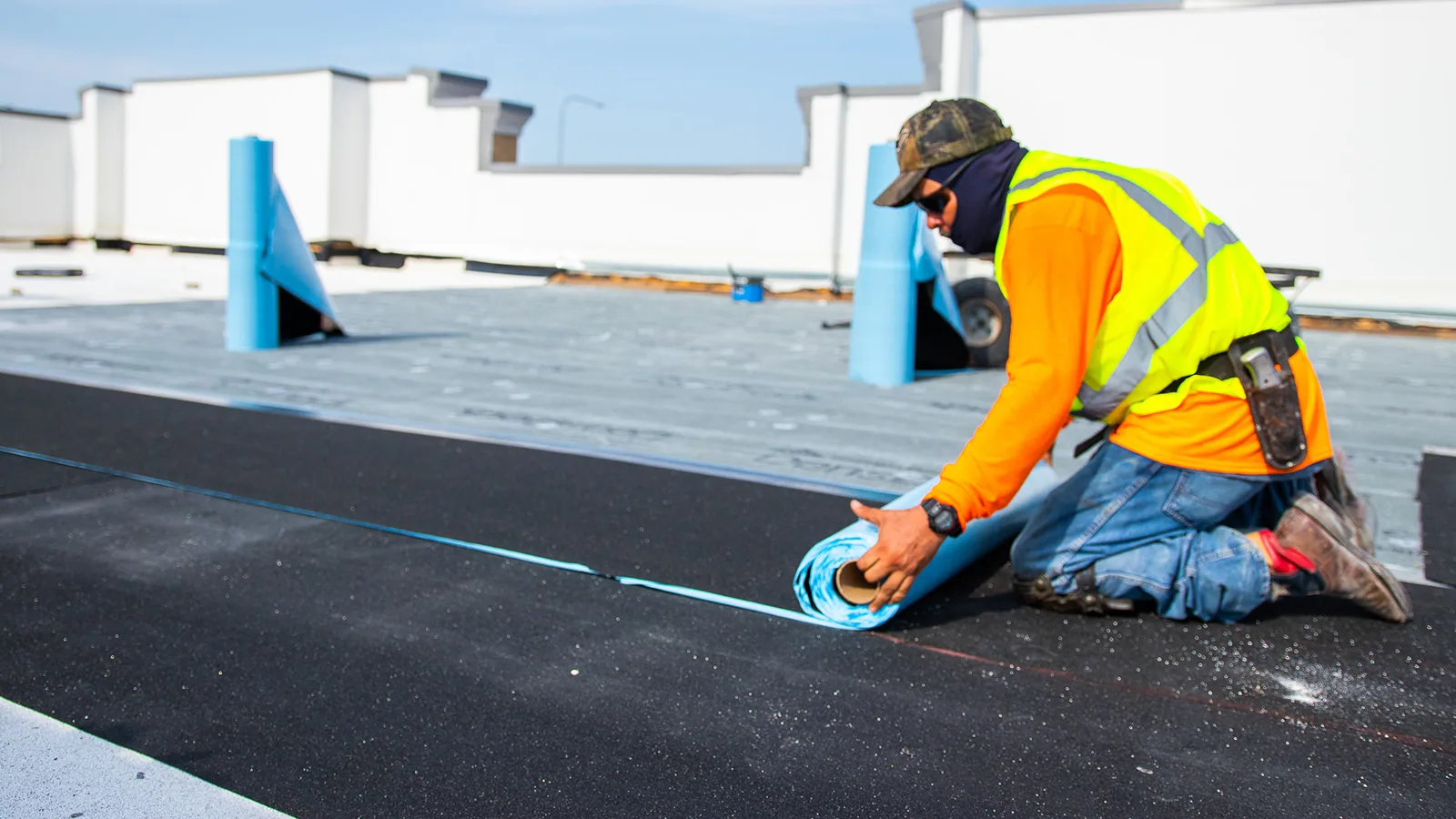
Modified Bitumen Roofing in Sherman, TX
SBS and APP modified bitumen roofing in Sherman, TX: how layered asphalt sheets move, where laps and flashings fail, and how we test, repair and replace them.
Modified bitumen is asphalt with a polymer added. The polymer turns brittle asphalt into something that stretches. It is laid in layers, usually a base sheet and a cap sheet. Each layer adds protection. Each layer also hides what is happening below. Sherman has seen 113 F and -3 F, and an asphalt sheet changes with every degree. Hot days soften it. Cold days stiffen it. Over years, the surface wears and the laps tire. We read those signs first.
Then we test. Then we match the repair to the damage. The steps below follow that order.
A bitumen roof is not outdated technology. It is proven technology. Layered roofs have a long record on flat roofs. Modern sheets add polymer and reinforcement, and they hold up well when drainage is right and laps are tight. Their weak points are known, and a careful inspection finds them early.
Know What Modified Bitumen Is Made Of
Two polymers are common. SBS is a rubber-like additive. It makes the sheet stretch and recover. APP is a plastic additive. It makes the sheet firm and heat tolerant. SBS sheets are often mopped in hot asphalt or applied with cold adhesive or self-adhered. APP sheets are usually torch-applied. A reinforcing mat of polyester or fiberglass sits inside each sheet. The mat resists tearing.
The cap sheet has a granule surface. Granules shield the asphalt from sun. They also give color and reflect some heat. As granules wear off, the asphalt is exposed. UV then hardens and cracks it. A bare spot is a warning. It means the layer below is open to the sun.
Watch for How Modified Bitumen Fails
Laps open first. A lap is where two sheets overlap. Thermal movement pulls on it. If the bond was weak, a fishmouth forms. That is a curl at the edge of the lap. Water gets in. Blisters form where moisture or air is trapped between layers. A blister can break and leave a hole. Splits can run through a sheet along an old joint in the deck or insulation.
Granule loss exposes asphalt. Flashings fail where the sheet turns up a wall. Cold weather makes the sheet stiff and prone to cracking, and Sherman's record low is -3 F. Ponding wears the surface and softens the edges. Foot traffic crushes granules and thins the cap. We look at all of these and photograph each one.
Torch-applied work adds a safety question. Open flame near insulation can start a hidden fire, sometimes hours after the crew leaves. Crews follow hot work permits and keep a fire watch after the torch is off, for as long as the permit and the insurer require. We plan around that. For some buildings, a cold-applied or self-adhered method is the better choice.
Test Laps, Blisters and Moisture
We lift a lap edge gently with a blade. A bonded lap resists. An open lap lifts easily. We press blisters. Some are small and dry. Some are broken. An infrared scan and a handheld meter map the moisture. A core sample confirms it. A core shows the number of layers, their thickness and whether the insulation is wet.
We also cut a test square in the gravel or granule surface where needed. The square shows the felts or the cap beneath. It tells us whether plies are still bonded. The result goes in the report with a photograph and a note on the patch.
Flashings get the same treatment. We check the height of each turn-up, the condition of the termination and the sealant above it. A flashing that is too low lets water splash behind it. A termination that has pulled away is an open door. We measure the height, photograph the condition and list the fix. Walls with masonry above the flashing also get a look at the mortar and the coping.
Drains are part of the same walk. A drain with a loose collar, a cracked strainer or debris packed in the basket will hold water around a bitumen sheet. We clear it, flush it and photograph the water level before and after.
Count Hail and Cold Into the Plan
Hail bruises asphalt sheets. North of Sadler the April 2014 stones were dime-size, and near Luella they were penny-size. Northwest of Denison, a June 8, 2025 report put the stones at 1.25 inches. Larger hail crushes granules and cracks the mat. A bruise may not leak at first. It becomes a weak spot. We press suspect areas, look for fractures and check the insulation below.
Cold matters too. A sleet and freezing rain event in December 2013 laid ice 4 to 5 inches thick across the Sherman and Denison area. A sheet that is stiff in cold can crack under load or foot traffic. We avoid walking brittle sheet on very cold days, and we schedule inspections for milder weather when we can.
Build the Repair Step by Step
Clean the area. Cut out the damaged sheet. Dry the insulation or replace it. Bond a patch of compatible material. Seal the edges. Embed granules on the cap. For laps, re-bond with adhesive or heat as the system allows. For blisters, cut, dry and patch. For flashings, rebuild with new membrane and a proper termination. Probe the result and photograph it.
When many repairs have stacked up, a coating may seal the surface for a time. When the base is dry but the surface is spent, a recover may follow. When moisture has spread, a replacement is the scope. Price follows area, penetrations, insulation replaced and access.
Match Modified Bitumen to Sherman Buildings
Layered roofs are common on older commercial buildings and on roofs with many penetrations. In Denison, with older brick and flat-roof buildings downtown and by the rail line, an inspection may turn up a layered roof. In Sherman, Austin College has been in town since 1876, and a campus roof gets the same test as any other. A hospital roof adds infection control and noise limits to the plan. We plan the method to fit the building. A hospital or an occupied building may rule out torch work and odors. A warehouse may allow it. An old school may have wood or lightweight deck that does not tolerate heat. The deck type goes in the scope with the method, and the reason for the method is written beside it.
An industrial owner in Sherman, including a tenant at Progress Park, may choose a layered system where a heavy, familiar assembly is wanted. Access for kettles, torches and material hoists is planned in advance, and the haul route is drawn once.
Ask What the Record Shows
The owner gets the file. Photographs. Lap checks. Blister maps. Moisture maps. The materials list. The next visit dates. Owners comparing systems can weigh built-up roofing, a related layered system, against TPO roofing, a welded single-ply alternative.
Commercial Roofing Questions
What is the difference between SBS and APP?
SBS adds rubber for stretch. APP adds plastic for firmness and heat tolerance. Both are modified asphalt, and a roof may carry one or the other, so the sheet is identified before a repair is chosen.
Is torch-applied work safe?
With permits, trained crews and a fire watch, yes. Some buildings call for cold-applied methods instead.
What causes blisters?
Trapped air or moisture between layers. Heat expands it and lifts the sheet, which is why blisters often appear after a hot spell.
How many layers does a roof have?
Cores show it. Many have two or three, and older roofs may have more.
When is a recover better than a replacement?
When the deck and insulation are dry and the surface is spent. Moisture readings decide.
Send the Address and the Leak History
Send the building address and any leak history. We will walk the roof with you and explain what the readings show about the laps, the blisters and the insulation.
Related Roofing Work
Roof Coating Restoration
Commercial roof coating restoration in Sherman, TX: moisture scans, adhesion tests, seam prep and thickness checks that extend the life of a sound roof.
Roof Recover and Overlay Systems
Recover a sound commercial roof in Sherman, TX with a new membrane over dry insulation, after core samples and a moisture scan show the old roof can stay.
Commercial Roof Replacement
Full tear-off and replacement of low-slope and metal commercial roofs in Sherman, TX, planned around moisture findings, heat cycling and North Texas hail.
Denison
Commercial roofing in Denison, TX: parapet and flashing repair on older brick flat roofs, plus moisture scans and recovers for plants, clinics and schools.