
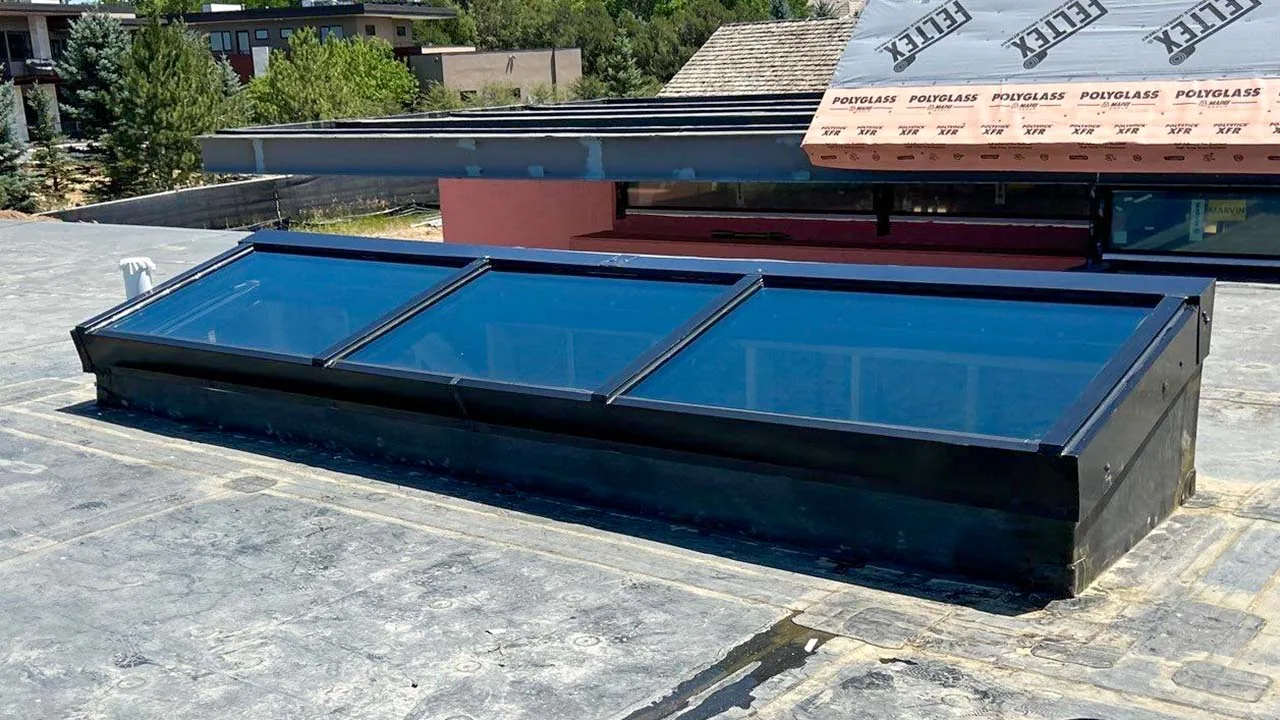
Skylight and Penetration Flashing in Sherman, TX
Skylight, curb and penetration flashing repair for commercial roofs in Sherman, TX: pipe boots, vent stacks, dome seals and curb details that stop leaks.
Flashing joins two things that move differently. A pipe stands still while the roof flexes. A curb is steel or wood while the membrane is rubber or plastic. Heat and cold change their sizes at different rates. The seam between them opens and closes. Sealant stretches until it tears. Metal bends until it cracks.
Most commercial leaks start at such a joint. A skylight, a vent, a conduit, a drain or a unit curb is a hole in the roof. The flashing is the repair that keeps it closed. In Sherman, TX, where roofs see 113 F in summer and snow in winter, that repair works hard. We start by counting the openings and ranking them by risk.
Count Every Opening Before You Judge the Roof
A roof with many openings has many chances to leak. The first task is a count. We list each skylight, vent, stack, conduit, support leg, antenna mast and unit curb. Each one gets a number on the plan.
We record the type of flashing at each. A pipe may have a rubber boot, a pitch pan, a clamp collar or a welded sleeve. A skylight may sit on a curb with metal cap flashing. A conduit may pass through a pitch pocket. Each type fails in its own way.
The count tells the owner something. A roof with sixty penetrations needs sixty good seals. One bad seal can wet the insulation across a wide area. The inventory shows where risk concentrates. Along US 75 and US 82, buildings of all ages share the same weather. A roof added to in several phases usually has openings from each phase, and the flashing styles differ. Mixed styles mean mixed failure times.
Inspect Skylights as Glazing, Frame and Curb
A skylight has three parts. The dome or glazing admits light. The frame holds it. The curb raises it off the roof. Each can fail.
Domes yellow, craze and crack in sun. Gaskets harden. Frames corrode at the corners. Curbs rot or rust, and the flashing at their base separates. Condensation on the glass can drip and look like a leak. We tell the difference by timing and by where water appears.
Hail can crack a dome. Grayson County has logged dime-size, penny-size and half-dollar hail reports in 2014 and 2025. We check domes for star cracks and loose clips. Where a hospital roof, a college building or a school roof has skylights over an atrium or a corridor, the leak risk is high because the space below is occupied.
When a skylight is past repair, we replace the unit and the curb flashing together. New glazing on an old curb often fails again. Safety comes first on skylights. A dome can hold a person's weight until it does not. Crews cover domes with screens or planks before they cross them. The same rule applies to old fiberglass panels, which become brittle with age.
Replace Boots and Collars Before They Crack
Rubber boots on pipes age fast in sun. They harden, crack and split at the collar. A split boot lets water follow the pipe into the building. The fix is quick when caught early. A new boot or a clamp collar and sealant takes minutes.
Pitch pans on older roofs hold a pourable sealer. The sealer shrinks and cracks. Water enters the gap. We refill or replace pans. Where possible, we swap them for boots or welded sleeves.
Vent stacks and conduits get the same check. We look at the base flashing, the counterflashing and the sealant. A loose clamp or a lifted flange shows as a gap. We re-seat, re-seal or replace. Some pipes carry heat. A flue or exhaust stack gets hot enough to degrade rubber. Those need metal collars with high-temperature sealant. We check the temperature rating of every sealant and boot against the pipe it serves. Conduits that enter through a curb are sealed inside and out. Cable bundles need a split boot or a sealed pocket. Mixed cable runs are the hardest to seal, and we plan extra time for them.
Plan for Heat Now and Snow Later
Summer heat bakes sealants. The surface hardens and cracks. By autumn, many joints are open. Winter then lets water in. Ice forces water into small gaps. Freeze expands them.
Snow adds its own problem. Snow drifts against curbs and walls. Meltwater pools there. A January 2025 storm piled up to eleven inches in isolated county spots. Drifts against a skylight curb can pile higher than the flashing. Water then runs under it.
So curb flashing is set high enough, and the upslope side gets a cricket or a diverter. The detail sends water around the curb, not into it. Sealants have a service range. Some stay flexible only above a set temperature. Others soften in heat and sag. We choose products rated for the range Sherman produces, from a record -3 F up through the summer extremes.
Rebuild the Flashing in the Right Order
A proper flashing job follows a set order. Clean and dry the surface. Remove failed material back to sound membrane. Install new base flashing and lap it onto the field. Fasten the termination. Install counterflashing or cap flashing. Seal and test.
Compatibility matters. The flashing material must bond to the roof membrane. A flashing failure repair that mixes incompatible products fails fast. We use materials approved for the roof type and check the maker's detail.
Every repaired opening is photographed. A before and after pair goes in the file with the plan number and the date. Plants in Progress Park and buildings in Denison receive the same record. For skylights, the curb is rebuilt to the height the code and the maker require. The base flashing climbs the curb. The cap flashing laps over it and is fastened above the base. Sealant is a back-up, not the main seal.
Group Small Repairs Into One Visit
Flashing repairs are cheap in the field and costly in lost time. So we group them. A roof with a dozen aged boots gets one visit that replaces them all. Owners save a mobilization and avoid a second leak.
For roofs under new construction or upgrade, we check each opening before the membrane goes on. A rooftop equipment curb is flashed once and flashed well.
If leaks keep returning at one place, the cause may be elsewhere. We use a commercial roof leak repair trace to find it. The file lists every opening by number, with the date of its last repair. Next year's visit checks the list. A boot replaced this year is checked again next year, and a boot with no record gets a closer look. A flat price works for a count of like items, such as boots. It does not work for unknown conditions under a curb. We price the known items and set a unit rate for the unknown ones, so no one argues later.
Commercial Roofing Questions
How long does a pipe boot last?
A few years to over a decade, depending on material and sun. Check at each visit.
Can a leaking skylight be resealed?
Sometimes. If the dome and gasket are sound, a new seal works. If not, replace the unit.
Why does a leak return after sealing?
The cause may be a movement or a second entry point. Trace the water before sealing again.
Is flashing a roofing or a sheet metal job?
Both. Metal parts and membrane parts must work together.
Do skylights add risk on a hospital roof?
They can, because the space below is occupied. Schedule inspections and keep records.
Send the Address and the Leak Locations
Send the building address and the places where water has shown. We will count the openings, test the seals and explain what the readings show.
Related Roofing Work
Hospital Roofing
Hospital and healthcare campus roofing in Sherman, TX: infection-control planning, layered moisture scans and phased repairs that keep patient areas dry.
School Roofing
School roofing in Sherman, TX: moisture scans, seam repair and phased replacement planned around classes, with storm and freeze damage found early.
Flashing Failure Repair
Flashing failure repair in Sherman, TX: find open terminations, cracked sealant and torn base flashing at walls, curbs and penetrations, then rebuild them.
Progress Park
Commercial roofing in Progress Park, Sherman, TX: scans, seam repair and recovers for food, beverage and metals plants, with baseline surveys for new buildings.