
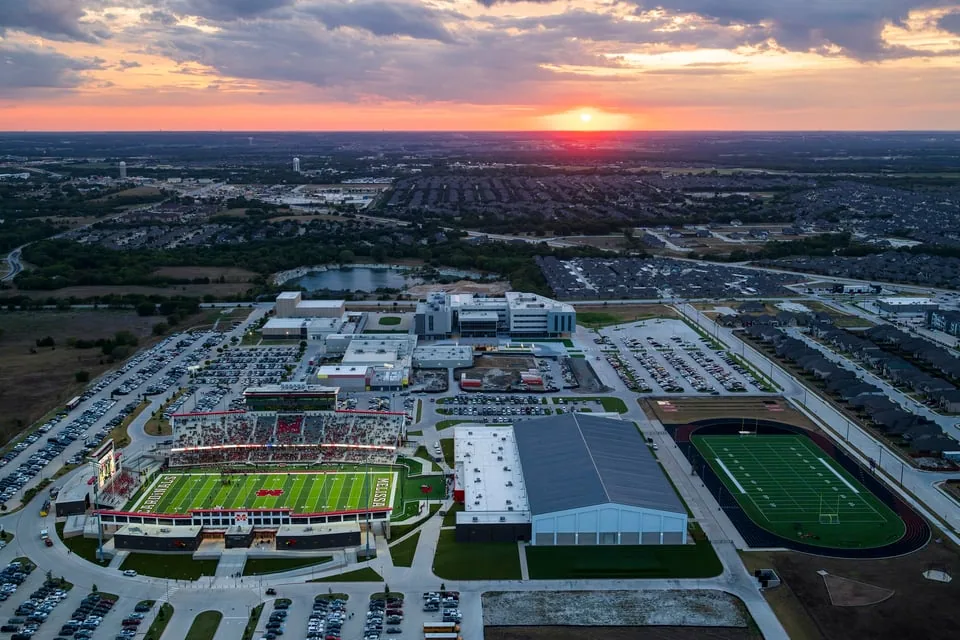
Commercial Roofing in Melissa, TX
Commercial roofing in Melissa, TX, where US 75, SH 5 and SH 121 meet: moisture scans, core samples, storm repairs and replacements for growing commercial roofs.
Insulation settles, fasteners seat and seams cure, and then the whole roof begins to move with the heat. In Melissa, TX, that early movement matters because the city has grown fast, and many commercial roofs are young enough that small installation flaws are still the main risk. We look for those flaws first.
Melissa sits in Collin County, where US 75, State Highway 5 and State Highway 121 meet. The city grew from 4,695 people in 2010 to 13,901 in 2020. Growth like that puts new retail, service and light industrial roofs on a short clock. Owners want to know early whether a roof is sound or hiding a defect.
Read the Young Roof
A young roof fails in a few predictable ways. Seams are welded in cold or damp conditions and never fully bond. Fasteners are driven off-line and miss the deck flute. Flashing is cut short at a wall. Drains are set a little high and leave a pond. None of these show up in the first year. All of them show up by year five.
We start with a moisture scan across the whole roof. It shows where insulation holds water. Then we take a few core samples at the flagged spots. A core shows the layers, the attachment and the state of the deck. The report lists each defect with a photograph and a location. Warranty claims depend on that record, so we keep it clean. A roof warranty management file starts here. At year five the baseline photographs and moisture map are what show that a defect was there from the start, rather than caused later by a tenant or a storm.
Dew point matters in a young roof too. Warm, wet air from the building rises to the underside of a cold deck. It condenses. The insulation takes on water that no leak caused. A scan cannot tell condensation from a leak, so we read the pattern. Wet spots that follow ductwork or a vapor path point to condensation. Wet spots at a seam point to a leak. Each calls for a different fix.
Plan Around Heavy Users
Redden Concrete, Beam Concrete Construction and Buc-ee's are among Melissa's largest employers, with 428, 315 and 313 workers, and a city with employers like those lives with trucks, deliveries and US 75 traffic. A roof job near that traffic needs a clear staging plan.
We ask for the loading points, the fire lanes and the busiest hours. We place the lift and the dumpster outside those zones. Debris nets go up over walkways. Noisy tear-off moves to the quiet hours. An occupied building reroofing plan puts every one of those choices in writing before the crew arrives.
Two buildings side by side can carry different membranes, and their repairs do not match. A thermoplastic seam is welded with heat. A rubber seam is taped or glued. Mixing the two causes failures. We identify each membrane before any crew touches it, and we tie repairs only into material that accepts them. An owner with a second building in Anna gets that same check there.
Weigh the Tornado Record
An F4 tornado struck Melissa on April 13, 1921, and killed 13 people. That history is why wind rating, edge metal and deck attachment get a close look here. Tornadoes peak in April and May across North and Central Texas, which is why edge and fastener work is finished before spring.
Wind lifts a roof at its perimeter first. Low pressure forms at corners and edges. If the edge metal is loose or the membrane is poorly attached there, the lift starts. We pull-test fasteners, check edge metal at every joint and measure the nailer or cleat. A tornado damage roof repair follows a different path: tarp, document, then scope. Photographs come before any repair, because an insurer needs the raw damage.
After a storm, speed matters less than order. First, make the area safe. Second, photograph every visible defect from the ground and the roof. Third, cover openings. Fourth, scope the permanent repair. Owners who skip the photographs lose the record that shows storm damage separate from old wear. We keep the photo set with the date and weather.
Account for Heat and Hail
Up US 75 to the north, Sherman has logged 113 F and minus 3 F, and Collin County roofs ride the same range. Membrane expands in heat and shrinks in cold. Seams carry that load every day. Over years, laps open, flashing pulls away and sealant cracks. Heat cycling is the slow cause of many leaks.
Hail is the fast cause. A June 2025 report from northwest of Denison measured half-dollar stones. Hail leaves impact bruises that do not leak at once. The membrane is cracked underneath. Water enters later. A hail damage roof repair starts with a moisture scan, because bruises hide in a roof that looks sound from the edge.
Heat also drives roof equipment. Units on curbs push warm exhaust against membrane near them. Sealant at the curb flange dries and splits. We check every curb for height, flashing and gasket wear. A split sealant joint beside a rooftop unit is a common first leak. The repair is small if found early. It is large once water reaches the deck.
Decide Repair or Replace
We compare three numbers. The first is the area of wet insulation. The second is the number of repairs already on the roof. The third is the age of the membrane. A small wet area and a young membrane means repair. A large wet area or repeat repairs means replace. We show both costs side by side.
Permit rules enter the cost. We check what the city requires before pricing a commercial roof replacement, because insulation and attachment rules change the scope.
Owners with buildings in both Melissa and Celina can run one scope format across both. Each roof gets its own file. A summary ranks them by condition. The ranking sets the order of work and the year each roof reaches the capital line.
Commercial Roofing Questions
How soon can a new roof show defects?
Often within two to five years. Poor seams and misplaced fasteners fail slowly, and a stain is the last sign. A moisture scan finds wet insulation long before that. We scan, log the result and compare it with the next scan a year later.
Do I need a core sample?
Yes, at the spots the scan flags. The core confirms what the scan suggests. It shows layers, attachment and deck condition. We patch each core and log its location so the test does not leave a new leak.
What happens after a hail storm?
We scan the roof and photograph the damage. Bruises hide under intact surfaces, so a roof can look fine and still leak later. The record supports an insurance claim and separates storm damage from age.
Can you work near truck traffic?
Yes. We stage away from loading points and fire lanes. Debris nets protect walkways. The plan is written before work begins, and the site contact approves it.
Does the 1921 tornado change the repair?
It raises the priority of edge metal and deck attachment. We test both on every walk. Spring is the best time to finish that work, before the peak tornado months of April and May.
Send us your Melissa building address
Send the building address and any past leak history. We will walk the roof and explain what the readings show.
Related Roofing Work
Roof Warranty Management
Roof warranty management in Sherman, TX: keeping records, repairs and storm documentation in order so a manufacturer or installer warranty stays usable.
Occupied Building Reroofing
Reroofing Sherman, TX hospitals, schools, plants and offices while they stay open, with sectioned tear-off, dust and noise control and daily closure.
Anna
Commercial roofing in Anna, TX: baseline scans on new roofs, refrigeration-aware grocery roof checks, school and clinic scheduling, and storm-ready repairs.
Tornado Damage Roof Repair
Tornado damage roof repair in Sherman, TX: emergency dry-in, structural review, debris impact checks and phased rebuilds for commercial and institutional roofs.