
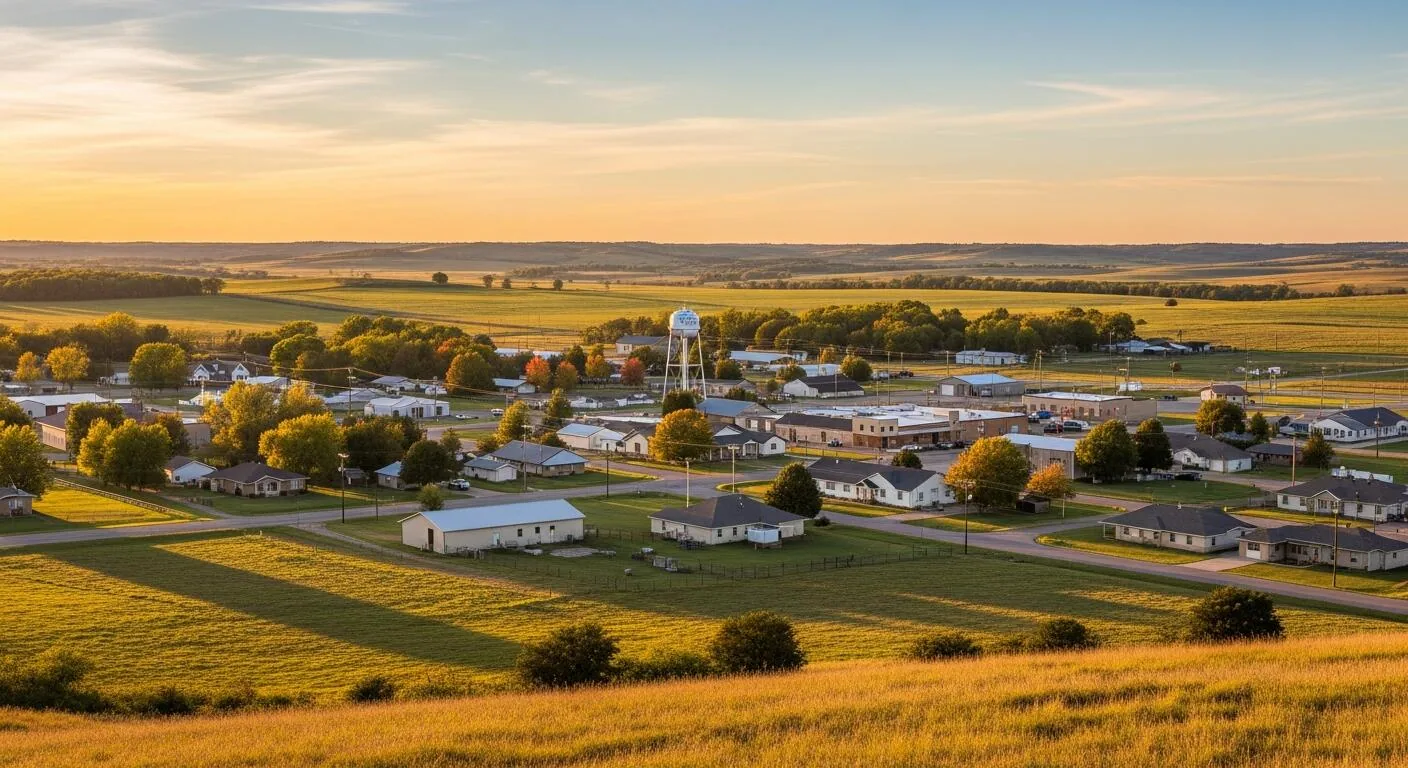
Commercial Roofing in Calera, OK
Commercial roofing in Calera, OK along US 69/75: roof condition reports for retail and municipal property, moisture scans, storm repairs and replacement scopes.
Retail roofs carry equipment. Rooftop units, exhaust fans, signs and conduit all stand on a membrane that was laid to shed water, not to bear traffic. Each one is a penetration, and each one moves. In Calera, OK, we count those penetrations first, because on a retail roof they cause more leaks than the field of the membrane does.
Calera sits on US 69/75, which is described as the second busiest north-south route in Oklahoma, with the Union Pacific Railroad on the east side. The town had 2,916 residents in 2020, up from 2,164 in 2010, with growth tied to nearby Choctaw Casinos and Resorts. The town also recruits businesses and owns retail properties, so some of the roofs here belong to a public owner.
Count the Penetrations
We walk the roof and list every object that pierces or sits on it. Each gets a condition note. A rooftop unit on a curb has flashing at its base and sealant at its seams. An exhaust fan has a cap, a curb and a gasket. A conduit has a support and a boot. Signs have posts with seals. Each is a possible leak.
Most fail slowly. Rubber boots crack in sun. Sealant dries and splits. Clamps loosen as equipment vibrates. Gaskets flatten. We replace what has failed and tighten what has loosened. A rooftop equipment curb and support repair raises low flashing, resets the unit and reseals the base. The report lists every item with a photograph, so the owner sees what the roof carries and what it needs.
Signs deserve a closer look. A pole sign or a wall sign mounted through the roof edge puts fasteners through the membrane. Wind rocks the sign. The rocking works the seal loose, and water follows the fastener into the wall. We check the base plate, the sealant and the flashing collar. Where a sign is no longer used, we recommend removal and a full patch. Fewer openings mean fewer leaks.
Drains on retail roofs clog with trash from the parking lot and wind-borne litter. A clogged drain floods the low corner. We clear and flush each drain, check the ring and the sump and mark any that look cracked. Overflow drains and scuppers are checked for clear openings. A roof with a blocked overflow has no safety net.
Serve a Public Owner
When a town owns retail property, the roof belongs to the public. That changes the paperwork. A public owner needs comparable line items and records an auditor can follow, and a plan that fits a budget cycle. Every line of the scope carries a quantity, a unit and a price, so a council member can follow it.
We also help a public owner plan across several roofs. A roof asset management program lists each roof, its condition, its warranty status and its expected replacement year. A public agency can then budget over several years instead of reacting to leaks. The program also holds the records that show how funds were spent.
Public buildings face a particular risk: deferred work. A budget cycle can push a repair off a year. A small leak grows. The insulation gets wet. The final cost doubles. The ranked list in a roof asset program shows what waiting costs. Each item has a price today and a likely price if delayed one year. A council can then decide with numbers, not hunches.
We keep the program current. After each visit, the file gains photographs, scan results and the repair log. Condition scores change. The replacement year moves. If a roof ages faster than planned, the file shows it before the leak does. That is the point of keeping records.
Plan Beside US 69/75 and the Rail Line
Roof work beside a busy highway needs a delivery plan. Trucks must pull in and out without blocking the road. A lift needs a firm, level pad. Debris needs a marked drop point. We confirm these with the owner before the first load.
A rail line on the east side adds noise and vibration to the area. Roof equipment near it may shake more. We check clamps and supports for loosening and tighten them. Noise also affects scheduling: we avoid work that needs close communication during the busiest hours. For an occupied retail building, an occupied building reroofing plan works bay by bay, so one tenant is never left without cover.
Traffic around a retail property matters. Customers need clear entries and safe paths. We use barriers and spotters where trucks cross a drive. Overhead protection goes over doors when debris could fall. A magnet sweep clears the lot at the end of each day. Sharp debris on a parking surface is a cost to the owner and a risk to customers, so we treat the sweep as part of the work.
Count the Weather Load
Sherman, to the south, has logged 113 F and minus 3 F, and a roof in Calera lives through a similar range. Heat cycling works seams and flashings every day. Ice from the December 2013 sleet reached 4 to 5 inches around Sherman and Denison, and snow along the Red River passed 6 inches in January 2025.
Spring brings the storms, and the weather systems that build tornadoes in April and May across North and Central Texas cross into Oklahoma. A June 2025 report from northwest of Denison gave half-dollar stones. After any hail report in the region, we scan nearby roofs for bruises. A hail damage roof repair starts with photographs and a moisture map.
After a storm, we follow a set order. Make the area safe. Photograph the damage from the ground and the roof. Cover openings. Scope the permanent repair. The photographs support an insurance claim, whether the carrier is in Oklahoma or Texas. A town that owns property also needs the record for its own file and for its insurer.
Price the Work
The price on a Calera roof comes from four readings: wet insulation, deck condition, penetration count and access. A scan that comes back dry with isolated defects leads to a repair. Wide wet areas and patches that keep returning lead to replacement. The cores are the evidence, and both prices go into the proposal side by side, with a unit rate for any hidden damage found once the sheet comes off.
Oklahoma rules for permits and code govern here, not Texas rules, so we confirm them at the address and state the basis in the scope before a commercial roof replacement is priced. An owner with buildings in Colbert or Achille gets the scope in one layout for every building, with a ranked summary on top.
Material lead time and weather set the schedule. Membrane and insulation can take weeks, and rain stops adhesive work. The order follows approval, the crew is booked when dates are firm, and a temporary dry-in holds the roof until then.
Commercial Roofing Questions
Why do retail roofs leak at equipment?
Every unit is a penetration with flashing and sealant. Heat, sun and vibration wear those parts. We replace failed boots and sealant, reset loose units and raise low flashing.
What does a public owner need from a roofer?
It needs a clear scope, comparable line items and auditable records. We write the scope so a board member can read it, with a quantity, unit and price on each line.
Can you plan across several town-owned roofs?
Yes. A roof asset program lists condition, warranty and expected replacement year for each roof. The town can then budget over several years and see the cost of waiting.
Does rail noise affect roof work?
It affects scheduling and equipment checks. We tighten supports that vibrate and avoid close-communication work at the busiest hours.
What records do I keep?
You keep dated photographs, a penetration list, a moisture map, the scope sheet and the invoice. They show the roof before and after, and an auditor can follow them.
Send us your Calera building address
Send the building address and any past leak history. We will walk the roof and explain what the readings show.
Related Roofing Work
Rooftop Equipment Curbs and Supports
Rooftop unit curbs, equipment rails and pipe supports for Sherman, TX commercial roofs: load paths, curb flashing, vibration, walkway wear and timing.
Roof Asset Management
Roof asset management for Sherman, TX portfolios: section ratings, repair logs, storm records and condition trends that show which roofs need money next.
Roofing for Cities, Counties and Public Agencies
Roofing for cities, counties and agencies in Sherman, TX: written scopes for bidding, essential-building leak control, storm records and long-range plans.
Occupied Building Reroofing
Reroofing Sherman, TX hospitals, schools, plants and offices while they stay open, with sectioned tear-off, dust and noise control and daily closure.