
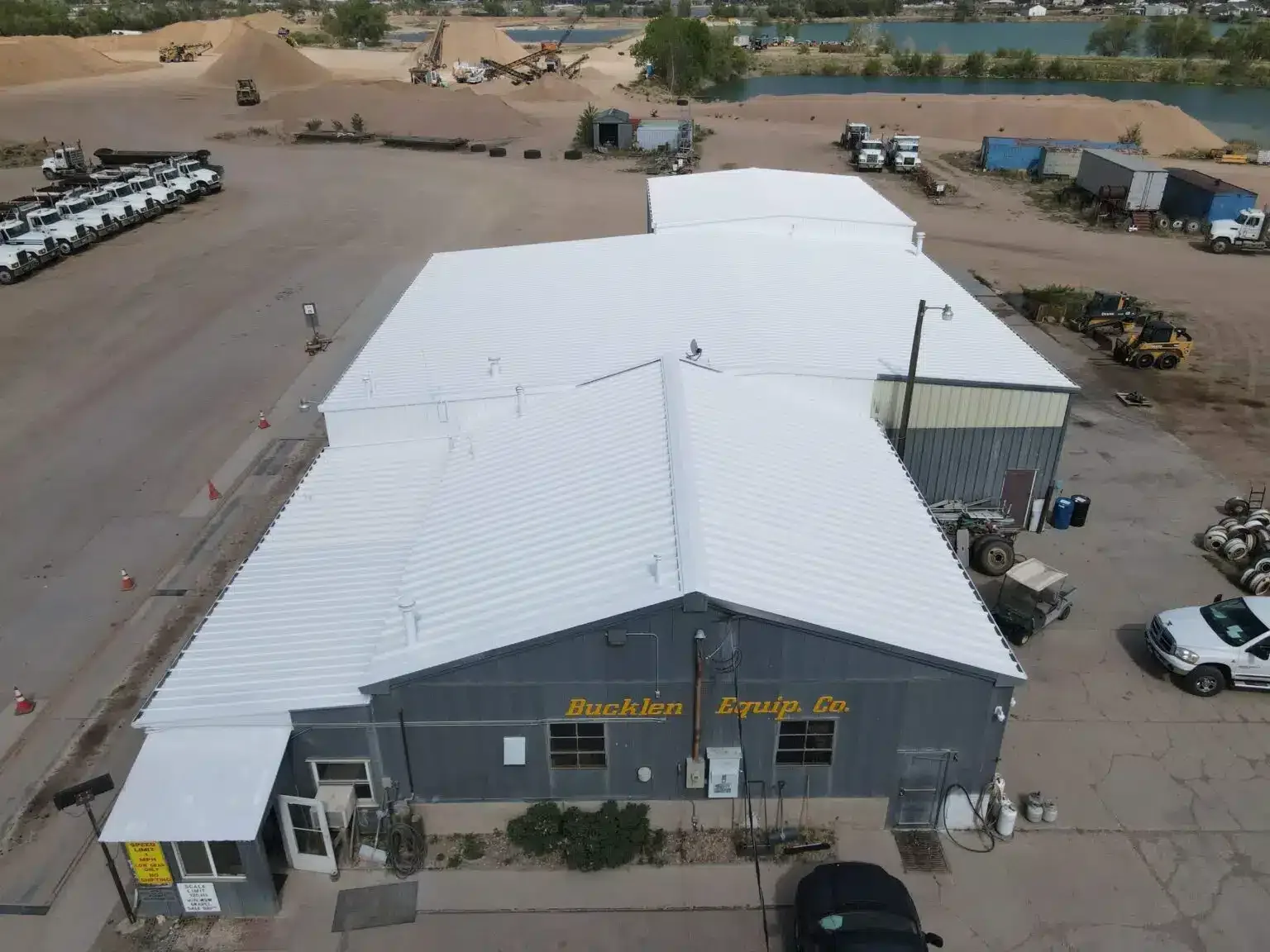
Spray Polyurethane Foam Roofing in Sherman, TX
Spray polyurethane foam (SPF) roofing in Sherman, TX: how sprayed foam insulates and seals, where it fails, and how we test, coat, repair and replace SPF roofs.
Spray foam is a liquid that becomes a solid on the roof. Two components meet at the spray gun. They react. They expand to many times their volume. They harden into a rigid, closed-cell insulation that bonds to the deck. There are no seams. The roof is one continuous layer. That is its strength. Its weakness is that foam alone does not survive the sun. Ultraviolet light breaks it down. A protective coating on top is not optional. It is part of the system.
Records of 113 F and -3 F put real strain on that coating, and hail adds to it. We start with the coating. Then we test the foam beneath. Then we match the repair to the damage.
An SPF roof looks like a pale, slightly textured surface. Under the coating, the foam has a density, a thickness and a bond. Each affects how it handles foot traffic, hail and water. We measure each one.
Application conditions matter. Foam must be sprayed on a dry deck, in the right temperature range, with low wind. Wind carries overspray onto cars and buildings. Moisture in the deck can ruin adhesion. A roof that was sprayed in poor conditions may show poor bond, pinholes or soft zones. We look for signs: blistering, uneven texture, cracked lifts. They tell us how the roof was built and what to expect from it.
Know What SPF Is Made Of
The foam is polyurethane. It is sprayed in passes, called lifts. Each lift is about an inch thick. Several lifts build the thickness. The foam is closed-cell, which means the tiny cells are sealed. Closed cells resist water absorption and give high insulation value per inch. The foam follows the shape of the deck, filling gaps and covering penetrations without joints.
The coating on top may be silicone, acrylic or polyurethane. It seals the foam from UV and water. Granules may be added to the coating for wear and fire resistance. The system relies on both layers. If the coating fails, the foam begins to degrade. If the foam is wet, the coating cannot fix it.
Surface texture varies. A smooth surface sheds water. A rough or orange-peel surface holds dirt. A heavy texture, sometimes called popcorn, is hard to coat well. We note the texture because it affects coating coverage and the amount of material a recoat will need.
Watch for How SPF Fails
The coating wears. It chalks, thins and cracks. Foot traffic wears it faster along routes. Hail pits it and punches through to the foam. Ponding softens some coatings and lets water pass. Birds peck at foam. Blisters form where moisture is trapped. Cracks open at foam joints or where the substrate moves.
Once the coating opens, the foam soaks water. Wet foam loses insulation value. It can freeze and break. It grows heavier. The deck may rust below. We look for all of these. We test the foam by pressing, by cutting small cores and by measuring thickness.
Penetrations are the other checkpoint. Pipes, vents and curbs are sealed with coating, with mesh, or with a flashing sheet. The sealant at the base ages. A pipe that moves in wind can crack the seal. We check each base and press gently to feel for movement. Curbs for rooftop units get a close look, because units vibrate and shift.
Test the Coating and the Foam
We walk the roof and look for thin coating, cracks, blisters and punctures. We press the foam with a thumb. Good foam resists. Wet foam feels soft or spongy. We cut small cores. They show thickness, density and the condition of the bond. An infrared scan and a meter map the moisture. We check the coating thickness at several points with a gauge.
Drains and edges get a close look. Foam is sprayed to slope in many cases, and ponding is less common. But low spots still form. We note any ponds and any place where the foam meets a wall or curb. Terminations are sealed with coating or sheet flashing. We check them for cracks.
Count Hail, Wind and Ice Into the Plan
Hail is a documented stress here. Stones the size of a half dollar were reported northwest of Denison on June 8, 2025, the same day an EF1 touched down southwest of Sherman. North of Sadler, the April 2014 hail was dime-size. Hail can punch through coating and dent the foam. Each hit is a possible leak. We walk the roof after any hail event, mark each impact and repair it. A cluster of hits may call for a recoat.
Spring brings tornado season. April and May are the peak months across North Texas. Sherwood Shores was hit by an EF2 on March 21, 2022. Wind can carry stone, tools and debris onto a roof and gouge foam. After any wind event we walk the roof looking for gouges and punctures, and we repair them the same day if we can.
Wind and ice matter less to foam than to membranes, because foam is bonded across its whole surface. But debris can tear it, and ice in drains can still flood a low spot. In December 2013 sleet left 4 to 5 inches of ice across Sherman and Denison. After such an event we clear drains and check for cracks.
Build the Repair Step by Step
Clean the surface. Cut out wet or damaged foam. Spray new foam to match the thickness. Trim it flush. Prime where needed. Apply new coating to the repair and overlap onto sound coating. Add granules if the system uses them. Probe and photograph the result. For widespread coating wear, recoat the whole roof after cleaning. A coating cycle every so many years keeps the foam protected.
When moisture has spread, the wet foam must go. A coating restoration over wet foam fails. A replacement removes wet foam and installs new. The scan shows which case applies. Price follows area, thickness, penetrations and access.
Compare options. A coating restoration costs less and extends life if the foam is sound. A recover can add a new system over dry foam. A replacement resets everything. Each path has a place. The moisture scan and the cores tell us which one applies. The scope lists each with a price per square foot and a range of expected years.
Match SPF to Sherman Buildings
SPF suits roofs with many penetrations or odd shapes, and buildings where insulation value matters. Hospitals, labs and cold-storage buildings come to mind. The city's three hospitals are one place to start the conversation about roofs that insulate and seal. A cold storage roof needs high insulation value and a tight seal. Industrial buildings at Progress Park and in Sherman are other candidates. The decision depends on the deck, the use and the budget.
Ask What the Record Shows
The owner gets the file. Core photographs. Coating thickness readings. Moisture maps. Hail impact maps. The next recoat date. Owners comparing coatings can weigh silicone coatings against acrylic coatings, since each has its own rate of wear on a foam roof.
Commercial Roofing Questions
Why does foam need a coating?
UV breaks foam down. The coating shields it from sun and water.
How thick is the foam?
Cores show it. Typical roofs have one to several inches, depending on the design.
Can wet foam be dried?
Not reliably. Wet foam is usually cut out and replaced.
How often is recoating needed?
It depends on the coating and the exposure. The inspection shows when thin spots appear.
Does SPF handle foot traffic?
Light traffic, yes. Heavy traffic needs walk pads.
Send the Address and the Leak History
Send the building address and any leak history. We will walk the roof with you and explain what the readings show about the coating and the foam.
Related Roofing Work
Roof Coating Restoration
Commercial roof coating restoration in Sherman, TX: moisture scans, adhesion tests, seam prep and thickness checks that extend the life of a sound roof.
Cold Storage Roofing
Cold storage and freezer roofing in Sherman, TX: how vapor drive and ice damage insulation, where these roofs leak, and how we scan, repair and replace them.
Progress Park
Commercial roofing in Progress Park, Sherman, TX: scans, seam repair and recovers for food, beverage and metals plants, with baseline surveys for new buildings.
Sherman
Commercial roofing in Sherman, TX for fabs, food plants, hospitals and the college: moisture scans, seam repair, recovers and storm checks on flat roofs.