
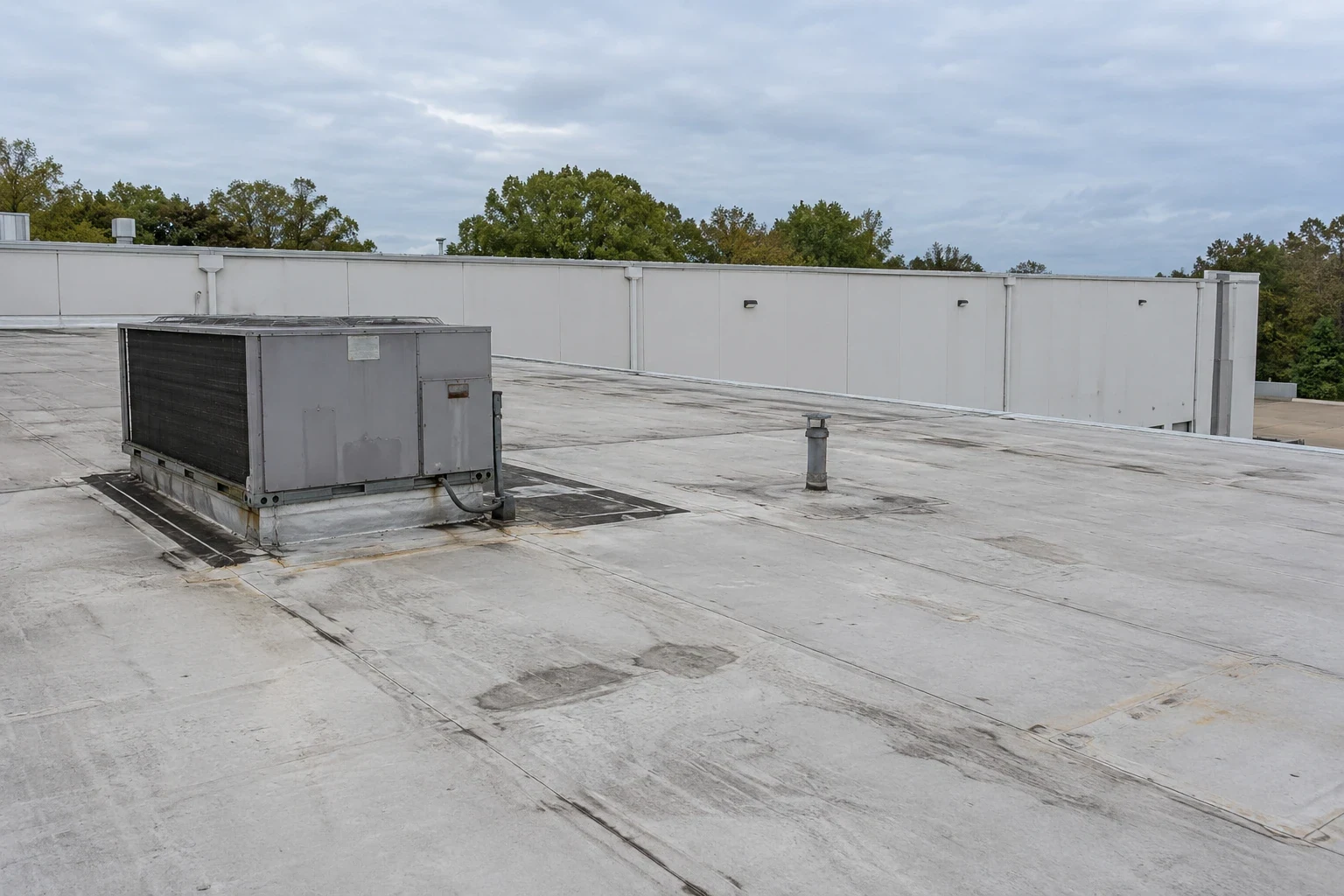
Cold Storage Roofing in Sherman, TX
Cold storage and freezer roofing in Sherman, TX: how vapor drive and ice damage insulation, where these roofs leak, and how we scan, repair and replace them.
A freezer building has a hot roof and a cold floor. The inside may sit well below freezing. The outside, in Sherman, reaches 113 F in summer. Between them lies a roof assembly that must hold back both heat and moisture. Water vapor pushes from the warm side to the cold side. That push is vapor drive. In a freezer, vapor drive runs downward and inward, and it meets the cold insulation and freezes. The ice builds. The insulation fails from within. A roof that looks fine from above can be heavy with ice below.
We start with that mechanism. Then we scan. Then we match the repair to the damage.
Cold storage is a high-stakes use. Product worth more than the building sits below. A failed roof thaws product, breaks seals and shuts down operations. The cost of a leak is far above the cost of the repair, and the priority is to prevent water from ever reaching the insulation.
Know What a Cold Storage Roof Is Made Of
A freezer roof carries a thick insulation package, often several layers of rigid foam. A vapor retarder sits on the warm side, usually near the deck. A membrane sits on top. The deck may be concrete, steel or precast. Penetrations are fewer but critical. Refrigeration lines, conduit and sensors pass through. Each is sealed against vapor. Dock areas have their own seals and canopies.
Some freezers have heat under the slab to prevent frost heave. Some have ventilated roof spaces. Each design has its own failure modes. We ask for drawings where they exist, and we read the roof against them.
The roof-to-wall joint is the most exposed detail. Cold wall panels meet a roof that swings with the sun, and the joint between them has to stay tight in both directions. Dock doors add another set of seals, and the canopy over each door sheds water onto a surface that stays cold. We trace where the vapor retarder meets each wall, each curb and each pipe before we judge the field of the roof.
Watch for How Cold Storage Roofs Fail
Vapor gets in. A hole in the vapor retarder lets moist air reach cold insulation. Frost forms. Ice grows. Insulation boards lose value. The roof assembly swells and the membrane lifts. Meltwater drips. A penetration seal fails and the same thing happens at a smaller scale. Condensation forms on cold surfaces. Surface water finds the same weak points as in any roof, with colder results.
Vapor travels where air travels. A gap at the wall, an unsealed conduit or a cracked pipe boot lets moist air move into the roof. The insulation near the opening gains weight first. Because frost hides inside the assembly, the first outward sign can be a bulge in the membrane or a drip over a rack, and by then the wet area is larger than the sign.
Ponding makes it worse. Water on the membrane warms the sheet and raises the vapor load below. A drain that holds a puddle over a freezer has a second job to do, and we treat it as part of the repair.
Membranes fail as they do on other buildings. Seams open. Flashings crack. Ponding forms. The difference is the consequence. A small leak into freezer insulation freezes and grows. It does not show for months. It becomes a major repair.
Scan for Moisture and Check the Seals
We use infrared and a moisture meter. We take cores in a grid. A core shows insulation layers, any ice or damp, and the state of the vapor retarder. We check every penetration seal. We look at the dock canopies and the interface between the roof and the walls. We check the interior from below with the owner's help: frost on ceilings, ice on pipes, drips on racks.
A freezer roof sheds its cold unevenly, so the thermal picture needs cores to read. We cut extra cores near penetrations, walls and docks, where vapor enters, and reseal each one with vapor-tight material before we leave. The operator's logs help as well: compressor run times, defrost cycles and any frost calls. A rising defrost count under one section can point to moisture before the roof shows it.
The report ranks findings. Wet insulation. Failed seals. Open seams. Each gets a cause and a price. Because product is at risk, the report adds a recommended interim step for each leak.
Count Heat, Hail and Winter Into the Plan
Sherman swings from 113 F to -3 F. The heat drives vapor and loads the cooling system. Hail is documented. Northwest of Denison, a June 8, 2025 report measured the stones at 1.25 inches, and April 2014 brought dime-size stones north of Sadler. Hail bruises membranes and crushes insulation. After hail, we scan for hidden damage.
Winter adds ice and snow. The December 2013 sleet left 4 to 5 inches of ice around Sherman and Denison, and January 2025 snow measured 9 to 11 inches at isolated Grayson County spots. A cold storage roof does not melt snow from below the way a heated building does, so snow can sit and load the deck. We check drains and structure after heavy snow.
Build the Repair Step by Step
Find the entry. Isolate the area. Cut out wet or iced insulation. Restore the vapor retarder first. Install new insulation. Install new membrane. Seal penetrations against vapor. Test the seal. Probe and photograph. Insulation that has taken on ice is removed, not dried. Frozen board looks sound until it thaws, and a new layer laid over it only hides the problem. Work is planned around the cold chain. Product is moved, or the area is closed, or a temporary enclosure is built.
Timing matters. Each opened area stays as small as the hold points allow, and new work is sealed at the end of every shift so no part of the freezer sees outside air overnight. Cold storage operators may allow a short window. Work moves in sections. Interior and exterior crews coordinate. The plan names each step, each hold point and the person who signs off. Price follows area, insulation depth, penetrations, access and the cost of protecting product.
Match Cold Storage to Sherman Industry
Sherman's food processing base includes Tyson, which is the city's largest employer at 1,765 people, and Progress Park includes Tyson, Sunny Delight and Kaiser Aluminum as tenants. A food plant can include cold rooms and freezers, so a Progress Park building with a freezer wing is the kind of case cold storage work covers. A distribution building at North Texas Logistics Park may add cold rooms. A distribution center with a cold section needs both roof types, and the same holds for a freezer wing attached to a warehouse roof or a walk-in freezer behind a grocery store.
Ask What the Record Shows
The owner gets the file. Core logs. Moisture maps. Seal checks. Photographs. The interim plan. The next scan date. A related system for tight insulation work is spray polyurethane foam roofing.
Commercial Roofing Questions
Why does insulation fail in a freezer?
Vapor reaches cold insulation and freezes. Ice grows and the insulation loses value.
Can leaks be found from outside?
Sometimes. A scan and cores find wet or iced insulation that the surface hides.
What matters most in a repair?
Restoring the vapor retarder before new insulation goes down.
Can product stay in during repairs?
Rarely under the work. Product is moved or the area is enclosed.
How often should a cold storage roof be scanned?
Annually is common, plus after any leak or severe storm.
Send the Address and the Leak History
Send the building address and any leak history. We will walk the roof with you and explain what the readings show about the vapor retarder, the insulation and the seals.
Related Roofing Work
Progress Park
Commercial roofing in Progress Park, Sherman, TX: scans, seam repair and recovers for food, beverage and metals plants, with baseline surveys for new buildings.
Commercial Roofing at North Texas Logistics Park near Sherman, TX
Commercial roofing at North Texas Logistics Park near Sherman, TX: ponding control, wide-span roof scans, dock-friendly repairs and storm checks for flat roofs.
Distribution Center Roofing
Distribution and fulfillment center roofing in Sherman, TX: how very large flat roofs drain and leak, and how we inspect and repair them around dock schedules.
Warehouse Roofing
Warehouse roofing in Sherman, TX: how long flat roofs drain and move, where they leak, and how we inspect, repair, coat and replace them in use.