
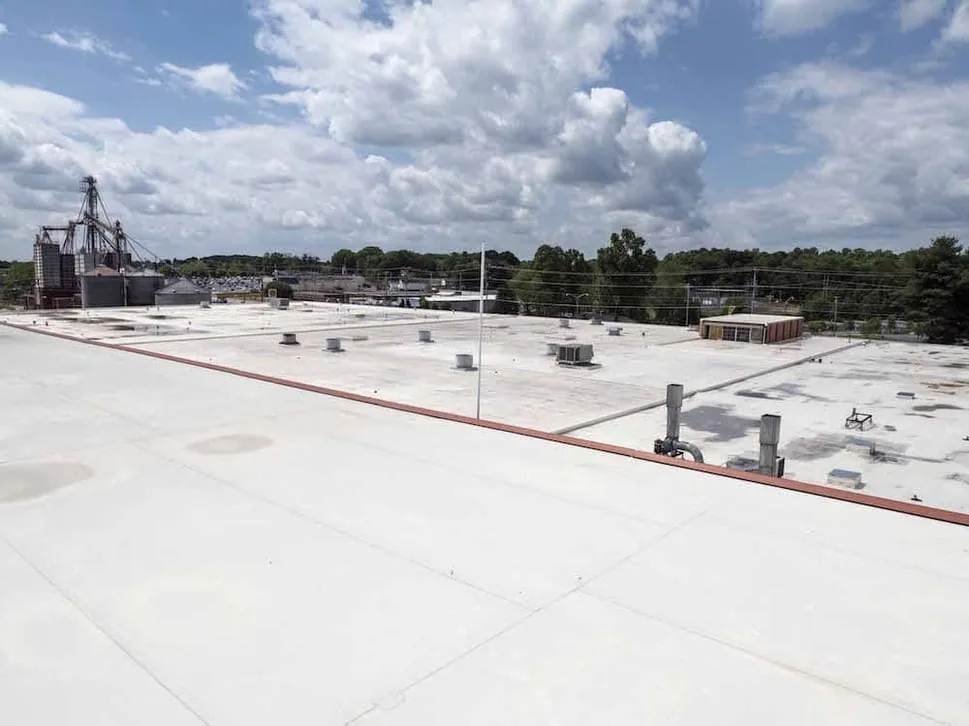
KEE Roofing in Sherman, TX
KEE (PVC-alloy) roofing in Sherman, TX: how the membrane resists oils and heat, where it fails, and how we test, weld and repair it on industrial roofs.
KEE is a blend. It is PVC with a polymer that locks the plasticizer in place. That small change slows the stiffening that ages ordinary PVC. It also helps the sheet resist oils, fats and many chemicals. Sherman's industrial base includes food processing, laser, valve and metal enclosure plants. Exhaust over a plant like that can carry films that other sheets do not like. KEE earns a look when a roof will face that exposure for decades.
We begin with the mechanism, then the test, then the repair. Each step is written down with a photograph and a number, so the owner can see exactly what we saw on the roof and why the plan follows from it.
The mechanism is chemical. Ordinary PVC needs plasticizers to stay soft. Plasticizers are small molecules. They can migrate out of the sheet, especially in heat. As they leave, the sheet stiffens. KEE holds them better. The sheet stays flexible longer. It still ages. It still responds to heat, UV and traffic. But the pace is slower, and the owner sees it in fewer cracks at flashings.
Know What KEE Is Made Of
KEE stands for ketone ethylene ester. The additive is a polymer that bonds with PVC. Plasticizers stay in the sheet longer. The sheet stays flexible. The membrane is reinforced with polyester. It is heat-welded at the laps. Welds fuse the sheet into one, and the strength of a good weld exceeds the strength of the sheet beside it. Colors are usually white or light gray.
The result is a sheet that resists grease, oils, many solvents and bacteria. It is also fire resistant. It costs more than ordinary single-ply. For plants that see grease or chemicals, the added cost may repay itself in fewer repairs.
Thickness and reinforcement vary. A thicker sheet resists punctures and gives more room for repairs. Reinforcement resists tearing and holds fasteners. We read the thickness in a core and record it. When a sheet is thin from age, welds are harder to make, and we say so in the plan.
Watch for How KEE Fails
KEE fails less often, but it fails. Welds open if they were made over dirt or at the wrong temperature. Flashings pull away from walls. Fasteners back out. Punctures happen near units. Ponding holds grease and dirt against the sheet. Heat cycling works at every lap. Sherman's range from -3 F to 113 F means the sheet moves a long way each year.
Surface contamination is a quiet failure. A film of grease and dust can block welding. A repair over a dirty surface will not fuse. Cleaning comes first. We test a weld on scrap to prove the method.
Grease control belongs in the plan. Trays under exhaust fans catch drips. Cleaning dates are set so grease does not build up. Walk pads protect service routes. These steps cost little. They protect the sheet from the most common source of wear on a plant roof, and they keep the warranty file clean if one exists.
Probe, Scan and Core
A probe runs along each seam. Open stretches are marked with paint and numbered on the sketch. A moisture scan follows. We use infrared at dusk and confirm with a meter. We cut core samples. Each core shows the sheet, the insulation and the deck. We check whether the sheet is still flexible. A bend test on a cut edge shows whether it cracks. We note grease on the surface and in drains.
For plants with process equipment, we also log what hangs from the roof. Conduit, gas lines, pipe supports and condensate drains rest on or near the sheet. Where they rub, the sheet wears. Pads or raised supports solve it. We mark each support on the sketch and flag the ones that touch the membrane.
The report lists each finding. It gives a cause. It gives a price, and it adds a note on how the finding relates to the exhaust below it. It ranks items by urgency, so the owner knows what to fix this season and what to plan for later.
Match KEE to Sherman Plants
Progress Park holds food and metals plants with BNSF rail access. Tyson, Sunny Delight and Kaiser Aluminum are among its tenants. Foundation Business Park in Denison fronts State Highway 91 for manufacturing and distribution. Roofs on those plants may see exhaust, steam and oils. A manufacturing plant roof is often a flat roof full of equipment. KEE's chemical resistance helps there. We check what each exhaust carries before we recommend a sheet. A food plant in Progress Park and a metal enclosure plant in Sherman may need different answers, and the exhaust list decides.
Texas Instruments began production at its Sherman wafer fab in December 2025, and the site lists about 1.3 million square feet of cleanroom space. Large technical plants like that share a need for careful roof access and clean work practices, and those habits apply on any plant roof, whatever the system.
Count the Weather Into the Plan
Hail is documented here. Stones about 1.25 inches across were reported northwest of Denison on June 8, 2025, and in April 2014 the stones north of Sadler were dime-size. Hail bruises sheets and crushes insulation. We press suspect spots. We look for soft insulation below. The spring tornado peak in North Texas falls in April and May, and an EF1 touched down southwest of Sherman in June 2025. Wind pulls at edges first, so we test edge attachment and termination bars.
Ice and snow add load. Ice accumulation reached 4 to 5 inches around Sherman and Denison in December 2013, and isolated Grayson County spots held 9 to 11 inches of snow in January 2025. Ice in drains lifts welds. Snow loads the deck. After either, we check drains, low spots and the deck for signs of strain.
Build the Repair Step by Step
Clean the surface with the right cleaner. Run a trial weld on scrap. Weld a patch with rounded corners. Probe the weld. Larger damage gets a cut-out, new insulation and a new sheet. Flashings are rebuilt with prefabricated corners and boots. Edge metal is reset or replaced. If the sheet has stiffened too far to weld, we say so and price a recover or a replacement.
Price follows area, penetrations, insulation replaced and access. A plant roof with many penetrations costs more per square foot than a clear field. A repair that needs a shutdown costs more than one that does not. We list each driver. The owner sees what each line buys.
Ask What the Record Shows
The owner gets photographs, probe results, moisture maps and the next visit dates. Owners weighing sheets can compare PVC roofing with TPO roofing. The right choice depends on exhaust, traffic and budget.
Commercial Roofing Questions
Is KEE the same as PVC?
It is a PVC-based sheet with an added polymer. The additive slows plasticizer loss and improves chemical resistance.
Does KEE cost more?
Usually yes. The scope shows the difference so the owner can weigh it against the repairs it may avoid over the life of the roof.
Can KEE handle kitchen exhaust?
It resists many fats and oils. Grease control at the source still helps.
How is KEE repaired?
By cleaning, a trial weld and a welded patch. The weld is probed afterward, and the result is recorded with the date and the crew lead's initials.
When is KEE the wrong choice?
On roofs with no chemical exposure and a tight budget. Other sheets may serve as well for less.
Send the Address and the Leak History
Send the building address and any leak history. We will walk the roof with you and explain what the readings show about the welds and the surface contamination.
Related Roofing Work
Manufacturing Plant Roofing
Manufacturing plant roofing in Sherman, TX: how process heat, exhaust and equipment load roofs, where plant roofs leak, and how we inspect and repair them.
Progress Park
Commercial roofing in Progress Park, Sherman, TX: scans, seam repair and recovers for food, beverage and metals plants, with baseline surveys for new buildings.
Sherman
Commercial roofing in Sherman, TX for fabs, food plants, hospitals and the college: moisture scans, seam repair, recovers and storm checks on flat roofs.
Roof Recover and Overlay Systems
Recover a sound commercial roof in Sherman, TX with a new membrane over dry insulation, after core samples and a moisture scan show the old roof can stay.