
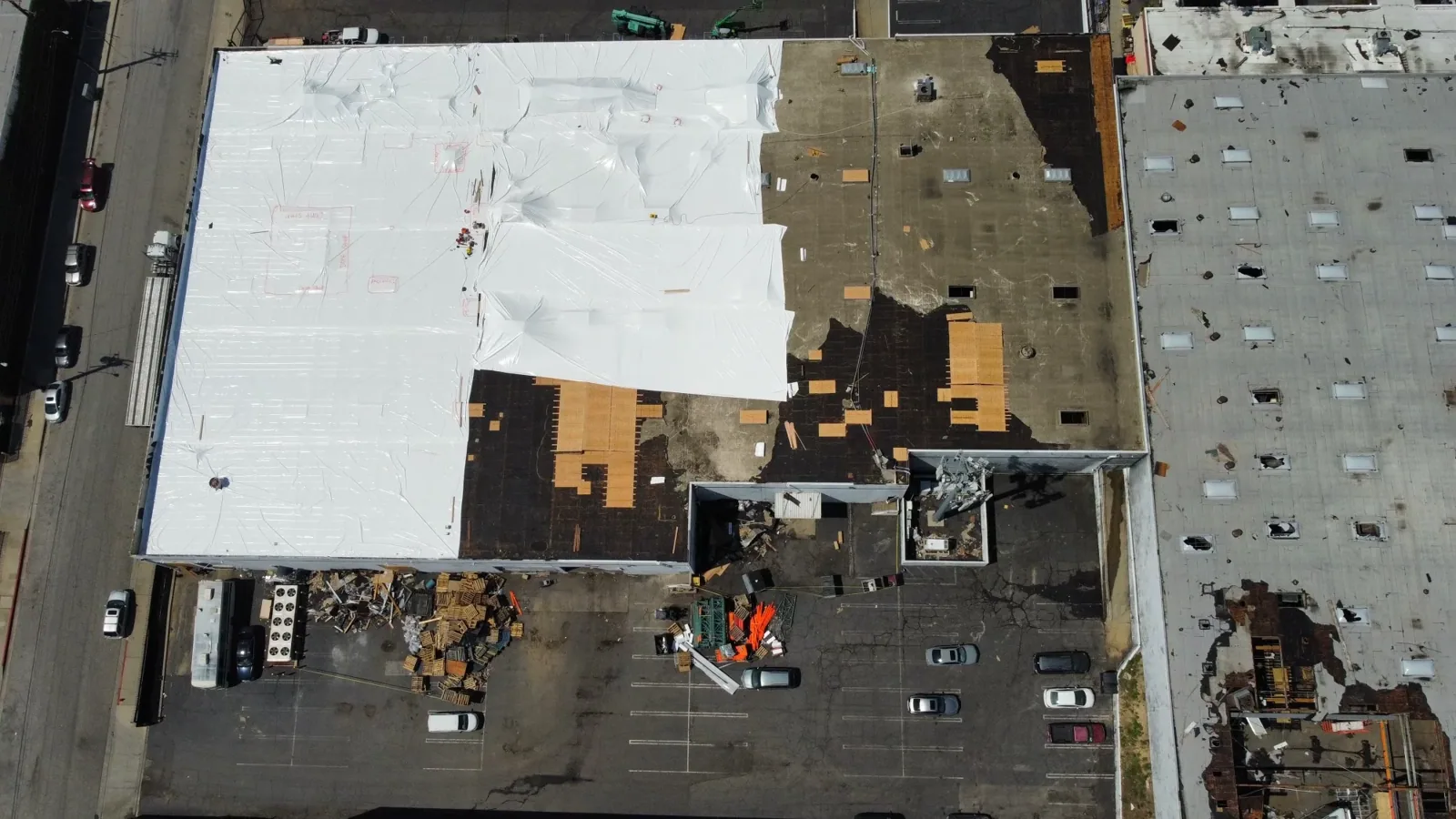
Snow and Ice Roof Damage Repair in Sherman, TX
Repair of snow load and ice damage on commercial roofs in Sherman, TX: drain blockage, frozen seams, ponding, crushed insulation and a documented repair scope.
Ice is heavy and it holds water in place. Frozen water in a drain cannot leave the roof. Meltwater behind it pools. The pool loads the deck. At the edge, the ice locks a gutter and a scupper shut. Water backs up under the sheet. When the sun returns, the whole mass thaws at once and runs to the weakest seam.
Snow and ice arrive rarely in North Texas, so drains are seldom kept with them in mind. The December 2013 sleet is the benchmark: ice built to 4 to 5 inches over Sherman and Denison. January 2025 followed with snow of nine to eleven inches in scattered Grayson and Cooke county locations. We repair the damage those events leave behind, and we explain what we find at each step.
Weigh What the Roof Carried
Snow and ice add dead weight. Wet snow weighs far more than dry snow. Ice weighs more again. A drift builds behind a parapet or against a rooftop unit. The deck below flexes under it. A lightweight steel deck can sag. A sag leaves a low spot that holds water after the thaw.
We check the deck first. We look for deflection between supports. We look for bent purlins, popped fasteners and cracked edges. We measure the low spots with a level. A roof that sagged under the 2013 ice load may still hold ponded water today. A deck that no longer drains needs ponding water repair before any new membrane goes on.
Snow load also reaches past the deck. Wall tops, parapets and rooftop units carry drift pressure. Curbs shift. Flashing pulls away from the wall. Conduit and gas lines on supports can bend. We check each support for movement. We look at the sealant around each foot. A support that moved has opened the membrane beneath it, even when no one sees a stain.
Clear and Test the Drains
Drains are the first failure. A strainer packed with ice blocks flow. A frozen leader pipe cracks. A scupper iced shut turns a roof edge into a dam. Meltwater then rises above the flashing height and enters the wall.
We clear each drain by hand. We check the sump and the pipe. We pour water to test flow. We look for cracks in the pipe where it ran through an unheated space. We inspect scupper boxes for tears and bent metal. A drain that passes the test is logged. A drain that fails is repaired or replaced. Roof drains and scuppers are low-cost parts with high-cost failures.
Gutters and downspouts get the same test on buildings that have them. Ice pulls a gutter off its hangers. A split seam leaks into the wall. Water running down brick or panel stains the face and enters at windows. We reset hangers, reseal seams and reconnect downspouts. Where a downspout ends over a walkway, we route it away so refrozen water does not form a sheet of ice at an entry.
Read the Membrane After a Freeze
Cold stiffens roofing. A sheet that flexed in July turns brittle at 20 F. Foot traffic cracks it. Ice scrapes it. Shovels cut it. Thermal movement works the seams. Sherman has a record low of -3 F, so a hard freeze can strain laps, flashings and fasteners that were already tired from summer heat.
We walk the roof after the thaw. We look for cracks at laps, splits at corners and lifted flashing. We probe the seams with a blunt tool. We check the edge metal for bends. Where ice sat, we look for staining and soft spots. A moisture scan finds water in the insulation. A core sample confirms it. The membrane may look fine while the board beneath it is wet.
Edges deserve a close look. Ice forms first at the perimeter, where heat from the building does not reach. Metal edge pieces bend under its weight. Fasteners pull. The edge then loses its grip on the sheet. When the next wind arrives, the membrane lifts from the corner. We re-fasten the edge, replace bent metal and seal the joints. Edge metal, copings and gutters are small parts that hold the roof together.
Build the Repair in Order
First we dry in any active leak. Then we clear the cause. Then we fix the damage. A seam that opened gets welded or re-taped. A split gets a patch over a clean, dry surface. A crushed section of insulation is cut out and replaced. A bent edge piece is removed and reset. A damaged drain gets a new ring.
Order matters. A patch laid over wet insulation fails. A weld on a cold, damp sheet does not bond. We wait for the surface to dry and warm. In winter that can mean a short delay. We tell the owner what the delay protects. Seam failure repair follows the same rule. The cause comes before the cure.
Temporary measures buy time. A cold-applied patch can seal a split until weather allows a weld. A layer of sheeting can cover an opening for days. We mark each temporary fix on the roof plan and set a date to return. The owner knows what is temporary and when it will be replaced. Nothing stays open because it was forgotten.
Adjust for the Building
A warehouse in North Texas Logistics Park has a different problem than a clinic. A large flat roof gathers a wide drift behind every unit. A plant at Progress Park may have process exhaust that melts snow in patches. A school has covered walkways where ice can hold. A hospital must keep air intakes clear.
We tailor the plan to the use. We ask what runs on the roof and what sits below it. We ask where water cannot go. Then we choose repair methods, schedule and access. The owner gets a list of the items by building and by priority.
Tenants and managers need notice. Work on a shared roof can mean closed doors or limited access. We coordinate with the property manager and post the schedule. Interior damage gets photographed from inside and outside. If water stained a ceiling, we match the stain to the roof area above it. That match shortens the search for the entry point.
Commercial Roofing Questions
Should we remove snow from the roof?
Only when the load is a concern, and only by trained crews. Shovels and blades cut membrane. We leave a layer on the roof and avoid the seams. Clearing drains is usually enough.
How do we tell ice damage from older wear?
Look at the pattern. Ice damage clusters near drains, edges and low spots. Older wear spreads across the field. Dated photographs help. We record both and mark which items fit which cause.
Can a roof leak after the ice is gone?
Yes. Water trapped in insulation seeps out for weeks. A cracked seam opens when the sun warms the sheet. We check again after the thaw and after the first spring rain.
Is ice damage covered by insurance?
Coverage depends on the policy and the cause. We document the roof with photographs, readings and a written scope. The carrier decides coverage. Our record helps it see the facts.
What should we do before the next freeze?
Clear debris from drains and scuppers. Check the flashing at units and walls. Fix open seams. Insulate exposed pipes near the roof. A short visit in fall costs less than a repair in January.
Send the address and any leak history
Share the building address, the roof records and where water showed up after the freeze. We will walk the roof, run the readings and explain what they show.
Related Roofing Work
Ponding Water Roof Repair
Ponding water roof repair in Sherman, TX: find why water stands, check deck and insulation, clear drains, add slope and restore membranes that held water.
Roof Drains and Scuppers
Drain, scupper and ponding correction for commercial roofs in Sherman, TX: sump repair, overflow sizing, crickets and tapered insulation that clear water.
Edge Metal, Coping and Gutters
Edge metal, coping, gutter and downspout repair for commercial roofs in Sherman, TX: cleat fastening, joint sealing, thermal movement and wind uplift.
Seam Failure Repair
Seam failure repair in Sherman, TX: probe, weld, tape and re-seal split membrane laps, then scan for the wet insulation that open seams leave behind.