
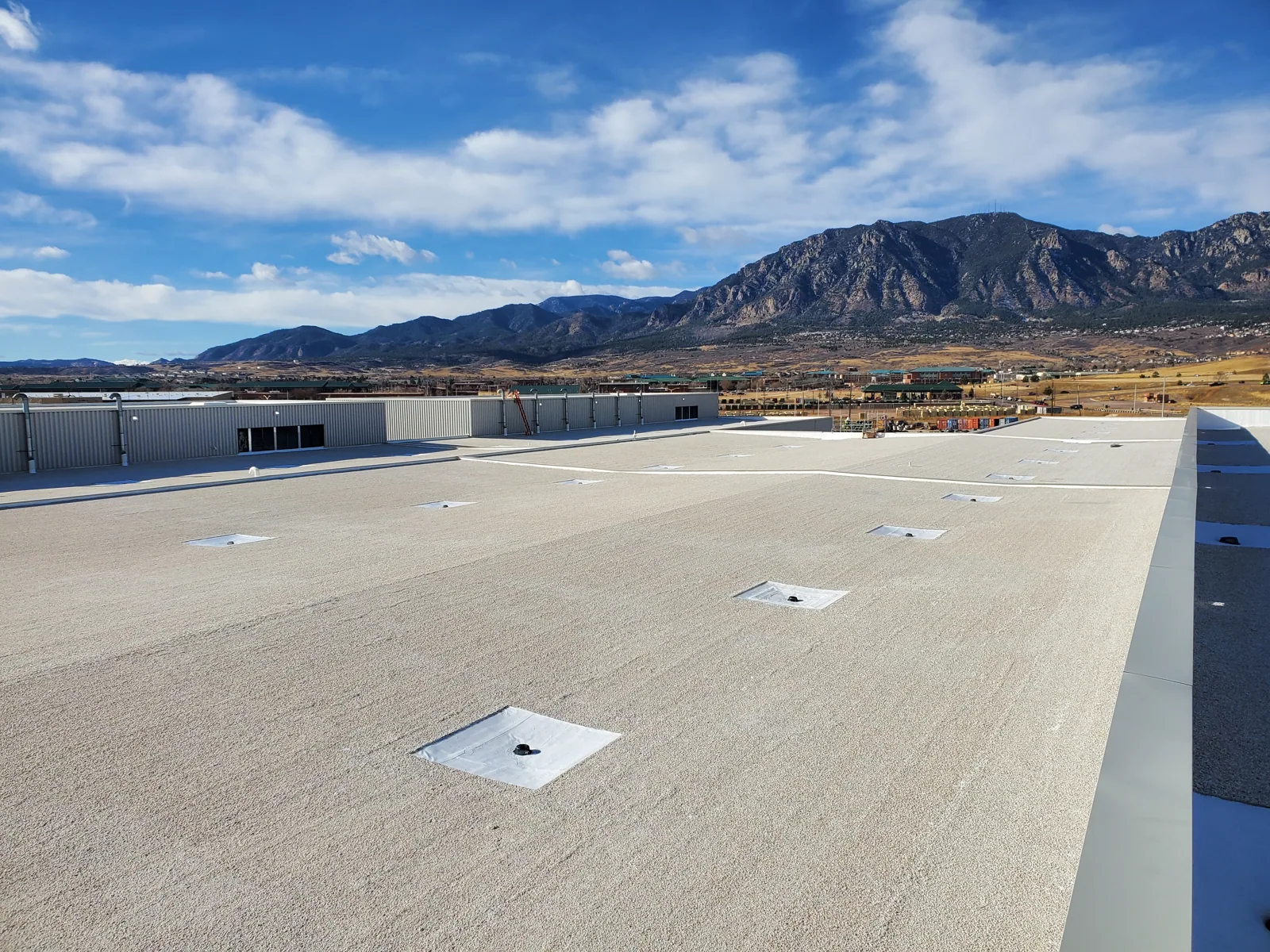
Built-Up Roofing in Sherman, TX
Built-up (BUR) multi-ply roofing in Sherman, TX: how felts and asphalt layer into a membrane, where blisters form, and how we test, repair and replace BUR.
A built-up roof is a stack. Felt. Asphalt. Felt. Asphalt. Usually three or four plies, topped with gravel or a cap sheet. Each ply is thin. Together they make a thick, redundant membrane. If one layer fails, the others still shed water. That redundancy is why built-up roofing has lasted a century on flat roofs. It is also why failures hide. A leak may start many layers down.
Sherman puts a lot of stress on a stack like this, with records of 113 F and -3 F. Every swing moves the layers a little. We start with that movement, then we test, then we match the repair.
The layers do not move together. Insulation shrinks. Felts stretch. The deck flexes with load. At each joint in the insulation, the plies above are pulled. After many cycles, a ridge forms and a split follows. That is why we look at the insulation joints and not only at the surface. A split above a joint is a sign of movement below it, and the sketch records its length and direction.
Many BUR roofs in service are old. That is not a flaw. It is a fact about a long-lived system. An older roof needs a plain read of what is left, and that read starts with a core.
Know What a Built-Up Roof Is Made Of
The plies are reinforced felts, made of fiberglass or polyester. Hot asphalt or cold adhesive glues the plies together. The top surface is either aggregate, a layer of gravel set in asphalt, or a cap sheet with granules. Gravel shields the asphalt from sun and adds weight and fire resistance. It also hides the surface, so inspection takes more work.
Below the plies is insulation, often rigid board, and below that the deck. A vapor layer may sit between. The assembly works as a system. Each part has a job. Moisture in any part harms the others.
Cap sheets and coatings add a surface layer. A cap sheet with granules protects the asphalt from sun. A reflective coating lowers surface temperature. Each layer adds weight and cost. Each must be compatible with what is below. A coating over a roof with blisters will bridge them poorly. A cap sheet over a wet roof will trap the water. We test before we cover.
Watch for How Built-Up Roofs Fail
Blisters are common. They form where air or moisture is trapped between plies. Heat expands them. They can break and leave a hole. Ridges form over insulation joints. Splits run along those ridges. The felts crack as the roof contracts in cold weather. Alligatoring is a pattern of cracks on the surface asphalt. It means the surface is drying out.
Flashings fail where the felts turn up a wall. The asphalt there is often thin and brittle. Pitch pockets around pipes dry and shrink. Gravel scours near drains and edges, leaving bare spots. Bare spots age fast. Ponding adds load and speeds wear. Foot traffic crushes surface and crushes blisters.
Edges deserve a separate look. The roof ends at a gravel stop or a metal edge. Wind pulls there first. If the edge metal is loose, the plies under it lift. Water follows. We check fasteners, joints and sealant on every edge, and we pull a few fasteners to test hold. Weak holds lead to a re-fastening plan that costs far less than lost plies.
Test With a Core and a Scan
The core sample is the main tool. A small plug is cut through the roof. It shows every ply, the insulation and the deck. It shows whether the felts are bonded, whether the asphalt is dry and whether the insulation holds water. We cut several, at different places. We patch each hole the same day.
Drains get their own check. A built-up roof usually has internal drains with clamping rings. If a ring is loose or a strainer is gone, water backs up and spreads. We clear the strainer, check the ring, flush the line and photograph the water level, then note whether the drain body sits above or below the surrounding plies. Scuppers and gutters get the same inspection. A drain that is set high holds a pond by design, and the fix may be as simple as lowering the sump.
A moisture scan comes first. Infrared at dusk and a meter map the wet areas. Cores confirm them. We also pull a test square of gravel where the surface is unclear, to see the cap beneath. The square is photographed, labeled and patched the same day. The report lists plies, thickness, moisture and a likely remaining life.
Count Sherman Weather Into the Plan
Gravel can become a hazard in high wind, and spring is when North Texas sees its tornado peak. The county has had an EF2 at Sherwood Shores in March 2022 and an EF1 southwest of Sherman in June 2025. Loose stone flies. Edge metal and gravel stops get a close look. Hail also bruises. Hail measuring 1.25 inches was reported northwest of Denison on June 8, 2025. We press suspect spots, because a bruise can crack the felts.
Winter loads the roof as well. The Sherman and Denison area took 4 to 5 inches of accumulated ice in December 2013. Snow reached 9 to 11 inches in isolated spots in January 2025. Gravel adds dead load. We check that the deck can carry gravel, snow and ice together.
Build the Repair Step by Step
Remove gravel from the work area. Cut out the damaged plies. Dry the insulation or replace it. Install new plies with staggered laps. Seal flashings with new felts and a proper termination. Replace the gravel. Probe and photograph the result.
For broad wear, a coating may seal the surface. For a dry base with a spent surface, a recover may follow. For wet insulation across the field, replacement is the scope. Price follows area, penetrations, gravel handling and access, and the scope lists each so an owner can compare options. Gravel adds cost because it must be removed, stored and replaced.
Match Built-Up to Sherman Buildings
Built-up roofs appear on older schools, hospitals and commercial buildings. Sherman ISD is among the city's largest employers at 1,137 people, and Sherman has three hospitals: Carrus Hospital, Sherman Medical Center and Heritage Park Surgical Hospital. A school roof adds summer scheduling. A hospital roof adds infection control. Both need a plan that respects the people below, with noise limits, dust control and a daily dry-in. Sherman has both schools and hospitals, and Denison has Denison ISD and Texoma Medical Center. Each roof is read on its own cores, not on the building type.
Ask What the Record Shows
The owner gets the file. Cores. Photographs. Moisture maps. Blister counts. Drain logs. The next visit dates. A related layered roof, modified bitumen, uses polymer-modified sheets in place of felts, and a roof with heavy foot traffic may suit a rubber sheet instead.
Commercial Roofing Questions
How long does a built-up roof last?
Many last for decades with care. Condition, drainage and maintenance matter more than age.
Why is gravel used?
It shields the asphalt from sun and adds fire resistance and weight.
Can a built-up roof be recovered?
Sometimes. The deck and insulation must be dry. Cores and a scan decide.
What does alligatoring mean?
A pattern of cracks in the surface asphalt. It shows the surface is drying out.
Is hot asphalt still used?
Yes, on some projects. Cold-applied and torch-free options also exist, and the building decides.
Send the Address and the Leak History
Send the building address and any leak history. We will walk the roof with you and explain what the readings show about the plies, the insulation and the surface.
Related Roofing Work
School Roofing
School roofing in Sherman, TX: moisture scans, seam repair and phased replacement planned around classes, with storm and freeze damage found early.
Hospital Roofing
Hospital and healthcare campus roofing in Sherman, TX: infection-control planning, layered moisture scans and phased repairs that keep patient areas dry.
Sherman
Commercial roofing in Sherman, TX for fabs, food plants, hospitals and the college: moisture scans, seam repair, recovers and storm checks on flat roofs.
Denison
Commercial roofing in Denison, TX: parapet and flashing repair on older brick flat roofs, plus moisture scans and recovers for plants, clinics and schools.