
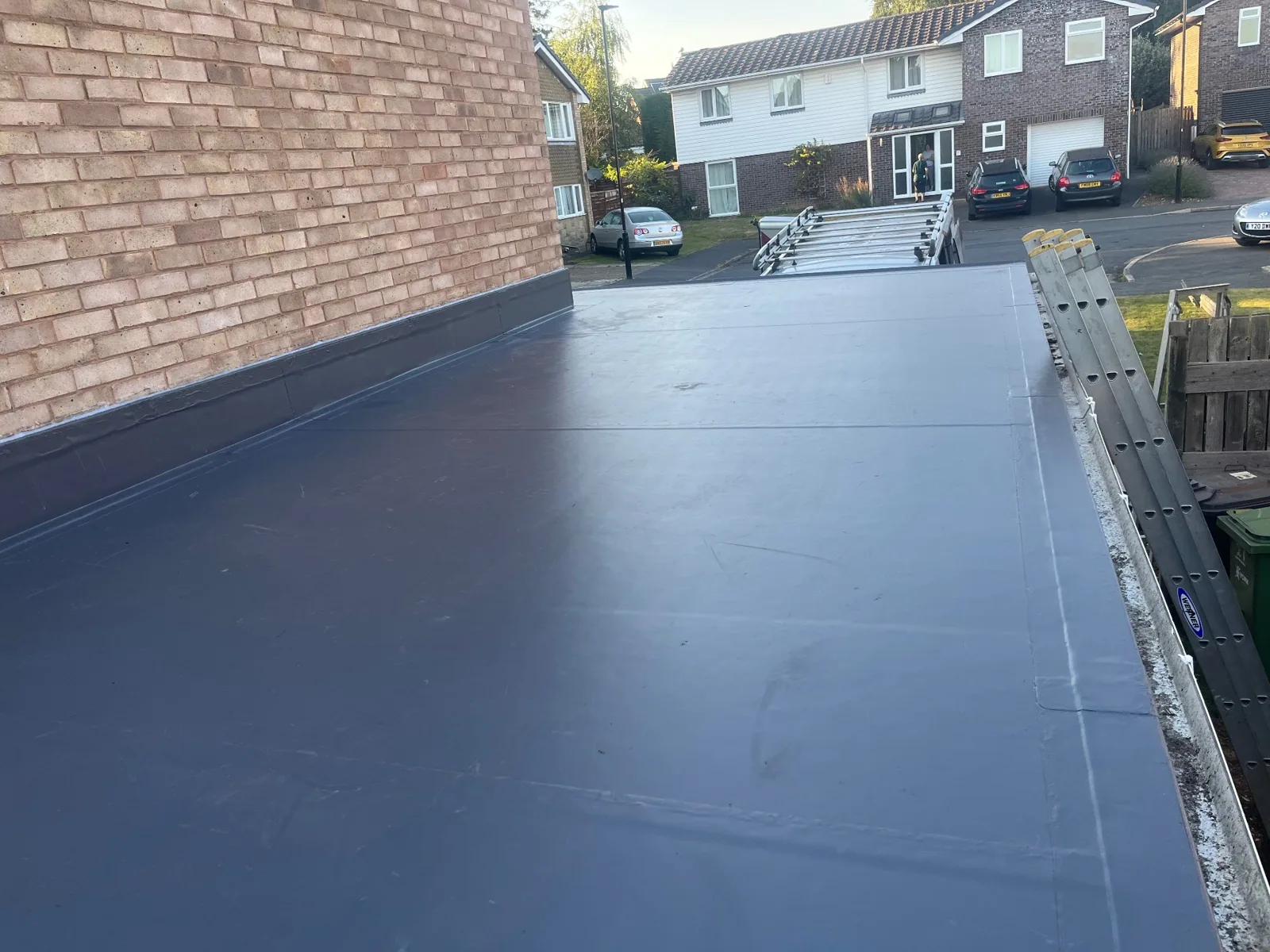
Sika Sarnafil Roofing Systems in Sherman, TX
Sika Sarnafil thermoplastic roofing in Sherman, TX: PVC weld checks, grease and chemical exposure, cold-weather repairs and replacement planning.
A PVC roofing sheet stays flexible because of what is blended into it. Plasticizers keep the polymer supple so it can bend at curbs, drape over parapets and take the movement of a hot afternoon. Over years some of those additives migrate out and the sheet stiffens. A stiff sheet cracks sooner at folds and corners. Sika Sarnafil is a manufacturer known for thermoplastic roofing membranes, PVC in particular, joined by hot-air welds into a continuous surface. In Sherman, TX the sheet is flexed hard, with a record 113 F in summer and a record low of -3 F in winter. We inspect for stiffness, weld quality and the details that carry the most movement.
Probe the Hot-Air Welds
A thermoplastic weld fuses two sheets into one. When it works, the lap becomes as strong as the sheet. When it does not, a channel remains. We probe each lap along its length, feeling for gaps and lifted edges. We check the weld bead for a clean, even line and look for skipped areas, burn marks and contamination.
Welds made over dirt, at low temperature or with the wrong machine setting can look right and still be weak. Heat cycling then works on the weak spot until it peels. We mark every suspect lap on the plan, photograph it and record its length. The map shows whether the problem is isolated or runs along many laps, which separates a spot repair from a wider weld review.
Weld width matters as much as weld quality. A lap needs enough fused width to resist peel, and the width can narrow where the welder drifted or the sheet was misaligned. We measure exposed weld width at several points on each suspect lap, compare it with the width found elsewhere on the roof and note the difference. A narrow weld near a drain or a wall is a common candidate for early failure, and we put those on the near-term list.
Check for Grease and Chemical Exposure
PVC resists many oils and chemicals better than some other sheets. That resistance has limits, and exhaust fans can discharge more than steam. Restaurants and food plants vent grease and fats onto nearby roofs. Industrial exhaust can carry chemicals. These deposits sit on the sheet, soak into laps and can attack sealants and adhesives.
Sherman has food processing among its industrial base, with Tyson and Sunny Delight among the tenants in Progress Park, and restaurant roofs collect kitchen exhaust. We look at the area around each fan and vent, note staining and check the sheet for softening or swelling. Where grease collects, we recommend grease containment at the exhaust and a regular cleaning schedule. The log tracks the condition of each area over time.
Hospitals and clinics add another layer. Sherman has three hospitals, and a roof over a hospital often carries heavy exhaust equipment. We check around each stack and intake, confirm that curbs are sealed and flag any area where condensate or exhaust discharges onto the sheet. Interior protection and access rules come first when we plan work over a care setting.
Repair Carefully in the Cold
Cold stiffens thermoplastics, and cold surfaces slow welding. A repair made at low temperature can look complete and fail in a few weeks. Sherman has recorded a low of -3 F, and the December 2013 sleet put a layer of ice 4 to 5 inches thick across Sherman and Denison. We repair leaks in winter when they must be repaired, but we prefer to make permanent welds in milder, dry weather.
For winter leaks we make a temporary seal and record it. When conditions allow, we return and weld a proper patch. The surface is cleaned, the patch is cut with rounded corners, and the weld is probed after cooling. Rounded corners matter because square corners concentrate stress and lift first. We photograph each repair and add it to the log with the date and the temperature.
Look at Corners, Curbs and Pipes
Details carry the most stress. Pipe boots, curb corners and wall terminations are cut and shaped by hand, and each has several layers of weld. Movement works at these spots every day. A weld failure at a corner is a common leak path.
We inspect each detail for gaps, lifting and cracked sealant. Where a prefabricated boot or corner is available, we use it. Where one is not, we form the detail on site with care. A seam failure repair and a membrane puncture repair both begin with cleaning and cutting a patch large enough to extend well past the defect. We keep a record of every detail repaired, so recurring trouble at one location can be traced.
Equipment curbs deserve a second look in summer. Heat softens sealants and lets flashing slip, and the weight of a unit can settle a curb a fraction of an inch over time. We check the base of each unit, test the flashing height and look at the sealant bead at every corner. Where an owner plans to add or swap units, we note the new curb locations early so the flashing can be built in properly.
Match the Patch to the Sheet
Thermoplastic families do not all weld to each other. A PVC patch bonds to PVC. A TPO patch does not bond reliably to PVC. Using the wrong patch can create a repair that looks sound and peels. We identify the sheet by testing, by reading the papers and by examining a core sample before choosing a patch.
The same discipline applies across makers. A PVC roof from one maker and a prefabricated PVC system from Duro-Last share a polymer family, while sheets from Versico and others may belong to a different one. A mixed roof, where an older PVC section meets a newer TPO addition, needs a clear transition detail. We map those joins and mark them on the plan.
Plan Hail Checks and Replacement
Spring brings hail and wind. North and Central Texas see most of their tornadoes in April and May, and a June 8, 2025 report put half-dollar hail northwest of Denison. We check for bruising and edge lift after events, and we scan for wet insulation.
When a roof reaches the end of its life, the choice is a recover or a tear-off. A replacement is specified to whatever the local building department requires, which we confirm with that office before pricing, and the scope lists each layer as its own line.
A new thermoplastic roof can often be fitted with walk pads along service routes, extra reinforcement at drains and prefabricated corners at curbs. These small additions cost little compared with the roof and cut down on the failures we see most. The written scope lists each addition as its own line, so the owner can decide which ones fit the budget.
Commercial Roofing Questions
Why does PVC get stiff with age?
Plasticizers migrate out over time. The sheet loses flexibility and cracks sooner at folds.
Can PVC be patched with TPO?
Not reliably. Patches should match the sheet family so the weld fuses.
Does grease harm a roof?
It can. We check the area around exhaust fans and recommend containment and cleaning.
Should leaks be repaired in winter?
Yes, with a temporary seal if needed. Permanent welds are best made in mild, dry weather.
How do you tell what is on my roof?
By testing the surface, reading the papers and examining a core sample.
Send the Address and the Roof Papers
Send the building address, any leak history and the roof papers you have. We will walk the roof with you and explain what the readings show.
Related Roofing Work
Progress Park
Commercial roofing in Progress Park, Sherman, TX: scans, seam repair and recovers for food, beverage and metals plants, with baseline surveys for new buildings.
Restaurant Roofing
Restaurant roofing in Sherman, TX: grease-resistant membranes, exhaust fan flashing and repairs scheduled so the kitchen and dining room stay open.
Seam Failure Repair
Seam failure repair in Sherman, TX: probe, weld, tape and re-seal split membrane laps, then scan for the wet insulation that open seams leave behind.
Membrane Puncture Repair
Membrane puncture repair in Sherman, TX: find cuts, tears and impact bruises from foot traffic and debris, check the insulation below and patch to match.