
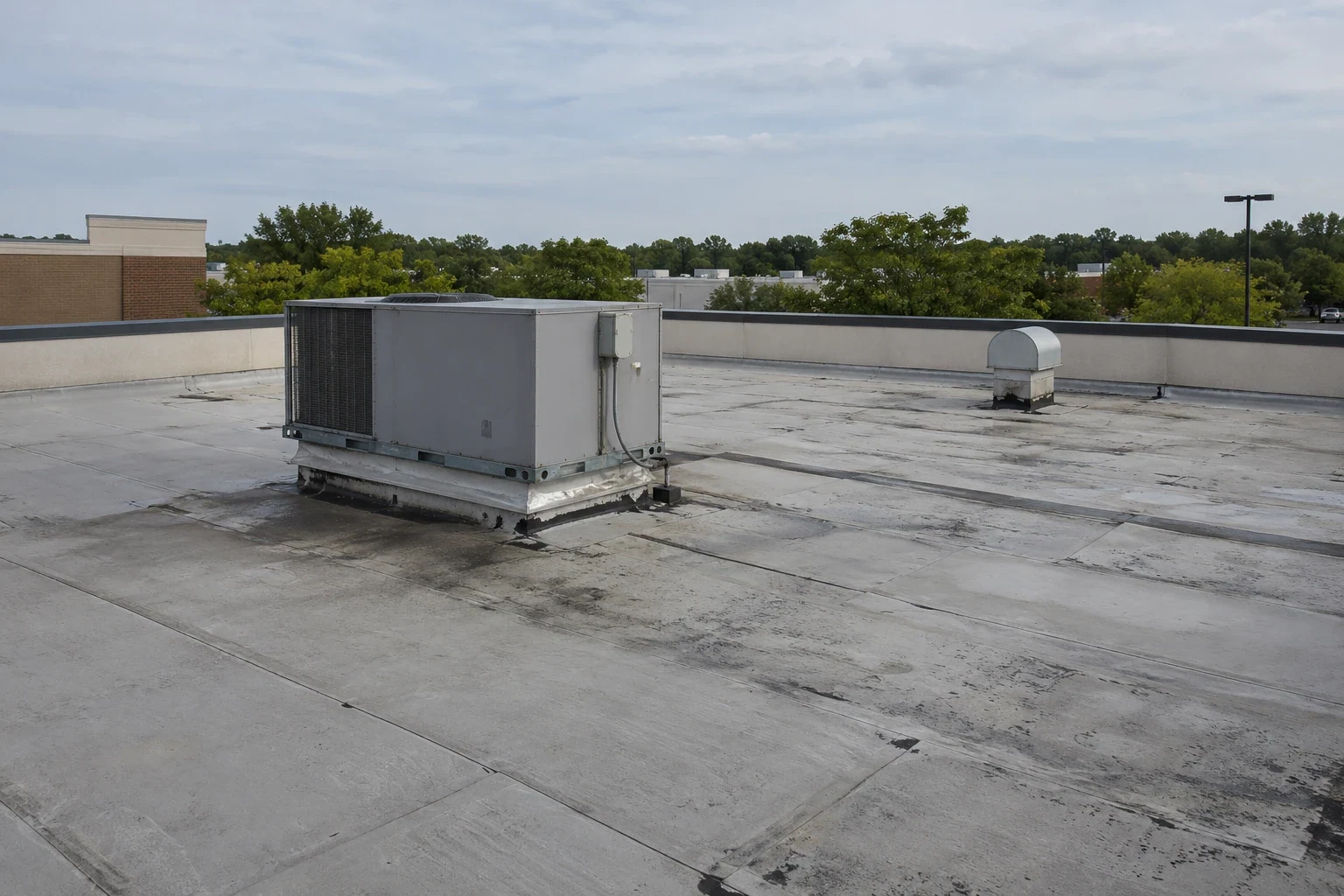
Roofing for Retail and Restaurant Chains in Sherman, TX
Roofing for retail and restaurant chains in Sherman, TX: kitchen grease and exhaust, rooftop units, same-format reporting across stores and fast storm response.
Grease is a solvent. Kitchen exhaust throws a fine film of fat onto the roof around the fan. Sun softens it. Rain carries it across the membrane. Over a few seasons it breaks down certain sheets, swells the seams and stains the surface. A restaurant roof can look sound from the ground and be soft underfoot near the hood. A retail store has a different problem: a field of rooftop units, each with its own curb and its own technician.
A chain has both, repeated across sites. In Sherman, TX the roofs also ride a range from 113 F down to -3 F. We give a chain one format for every store, so a regional manager can compare roofs and set priorities from a single table.
Protect the Membrane Around the Hood
The first ten feet around a kitchen fan take the worst of it. Grease collects in the low spots and under the fan housing. A grease containment tray catches some. Much still lands on the membrane. We check for softening, blistering and swollen seams in that zone, and for gaps at the curb.
Where wear has started, we replace the membrane in that area with a type that resists fats and oils, then add a protective pad or a grease-rated sheet below the discharge. We also check that the hood curb is flashed correctly and that the fan sits level. A tilted fan drips grease at one corner. A routine cleaning schedule for the roof around the fan costs far less than a membrane replacement, and we put it in writing for the store manager.
Fresh-air intakes and exhaust fans sit near each other on many restaurant roofs. Grease laden air should never be drawn back into the building, so the spacing between discharge and intake matters. We note any intake that sits downwind of a fan and report it to the store manager and the mechanical contractor. Rooftop work around a kitchen also calls for a fire watch whenever torches or hot tools are used, and we prefer methods that avoid open flame near the hood.
Control Rooftop Units and the People Who Service Them
A retail roof is a work surface. Technicians visit the same units over and over. Foot traffic wears the sheet along a path to the nearest curb. Tools get dropped. Panels get left open. Refrigerant lines run across the membrane on blocks that shift in the heat. Every service call risks a small puncture.
We lay protective walk pads along the path to each unit and replace crushed supports with raised stands. Curbs get inspected for sealant and flashing. A restaurant roof and a shopping center roof both need that discipline. A short set of rules for HVAC vendors, written into the maintenance file, prevents most of the damage that otherwise shows up as a leak a few months later.
Retail roofs also hold signs, antennas and satellite dishes that tenants add over time. Each mount punches a hole, and each hole needs sealing. When a sign or dish is removed, the mount often stays behind and leaks. We list abandoned mounts and cap them with proper flashing. Removing equipment that no longer serves the store lowers the number of places water can enter.
Report Every Store in the Same Format
A chain with stores across several towns needs consistent data. We use the same grading scale, the same photographs and the same repair list on every roof. A regional manager sees a table with each store, its grade, its open items and its next visit. Budgets follow from that table. The roofs in worst shape get work first, and the ones in good shape get maintenance.
For a larger group, a multi-site roof program sets one schedule and one point of contact across all locations. Vendors do not repeat the same walk with different forms. When a store changes hands or a lease ends, the roof file goes with it. The brand has a record of what was done and when, and a landlord can read it too.
Chains that also run hotels or event spaces can fold those roofs into the same file, as the needs of hospitality groups overlap on kitchens and rooftop plant. Where a landlord manages the building, the property manager receives the same report, so tenant and owner work from one set of facts. Lease language on roof responsibility varies, so the file records what was found and who was notified rather than who pays.
Serve the Stores Along US 75 and US 82
Sherman sits where US 75 and US 82 cross, and stores and restaurants follow that traffic. Denison employers include Walmart, and in Anna, a Collin County city with US 75 on its west side, Walmart and Brookshire's are both among the largest employers. Denison lies about 11 miles north of Sherman, and Anna is about 32 miles from Denison. Those distances matter to a chain that wants one crew visiting several stores in one trip.
We plan routes so a crew can handle stores in the same corridor on the same day. We do not assume what any one store's roof is made of. Each gets its own check, and the report says what was found. Big stores differ from pad sites, and a big-box store with a large field of membrane needs a different plan than a drive-through with a small roof.
Act Fast When Hail or Wind Hits a Store
A store with a leak loses sales. Customers see the buckets, and merchandise gets wet. Stores here sit in a tornado belt that peaks in April and May. June 8, 2025 brought a hail report of half-dollar stones near Denison and an EF1 on Rockport Road southwest of Sherman, and dime stones fell north of Sadler in April 2014.
Our emergency roof repair response runs around the clock, holidays included. We tarp, stop the water and photograph the damage. The next day we plan the permanent repair around the store's hours, usually early morning or late night. Photographs and impact counts go to the chain's insurer in a form the adjuster can use. A chain that tracks storm dates by store can see at a glance which roofs took a hit.
Parking-lot hail damage and roof damage often travel together, and the lot is often handled first. A roof leak that starts a week later, after the first heavy rain, then arrives as a surprise. We recommend a roof walk within a day or two of any hail report in the area, even when no leak has appeared yet.
Commercial Roofing Questions
Can grease damage be reversed on a restaurant roof?
Surface grease can be cleaned. Membrane that has softened or swelled has to be replaced in that area. We use a sheet that resists fats and add protection below the fan.
How do you repair a store roof without losing customers?
We work early or late, keep the entrance clear and tarp interior areas below the work. Noisy steps run when the store is closed or quiet.
What does one report for many stores look like?
A table with each store, its roof grade, open items, photographs and next visit date. Details sit on a single page per store.
Who pays for damage from an HVAC vendor?
That depends on the lease and the vendor contract. We document the cause, the location and the repair, so the facts are on file when the question comes up.
How quickly can you respond to a store leak?
Emergency response runs around the clock, holidays included. A crew stops the water first and plans the repair for the next working day.
Send the Store List and Leak Reports
List the store addresses, the roofs that have leaked and the units that have been replaced. We will walk the roofs with you and explain what the readings show.
Related Roofing Work
Restaurant Roofing
Restaurant roofing in Sherman, TX: grease-resistant membranes, exhaust fan flashing and repairs scheduled so the kitchen and dining room stay open.
Shopping Center Roofing
Shopping center and strip retail roofing in Sherman, TX: shared-roof leak tracing, rooftop unit curbs and phased reroofing that keeps every tenant open.
Multi-Site Roof Programs
Multi-site roof programs for Sherman, TX and North Texas portfolios: one inspection method, one ranking and one schedule across every building you own.
Roofing for Hotel Owners and Hospitality Groups
Roof repair, replacement and monitoring for hotel owners and hospitality groups in Sherman, TX: heat cycling, hail checks, guest-room leaks and phased work.