
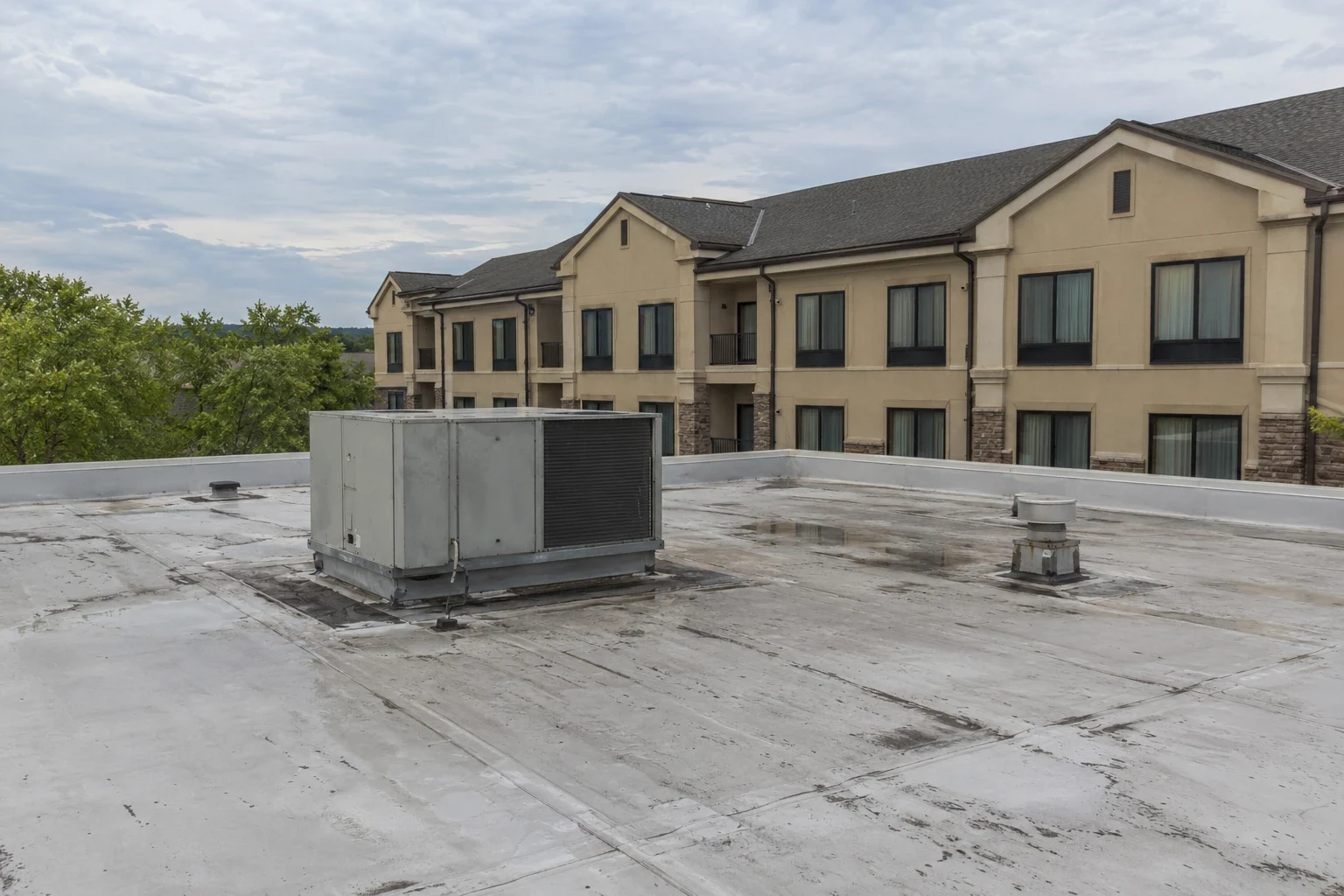
Roofing for Hotel Owners and Hospitality Groups in Sherman, TX
Roof repair, replacement and monitoring for hotel owners and hospitality groups in Sherman, TX: heat cycling, hail checks, guest-room leaks and phased work.
Water finds the room before the owner finds the leak. It enters at a seam or a flashing. It runs along the deck. It drops through a ceiling tile over a bed. A hotel roof has to keep that from happening in every room, every night. The roof is also hard to see. Guests never look at it. Staff rarely climb it. Problems stay hidden until a stain appears.
In Sherman, TX temperatures have climbed to 113 F and fallen to -3 F. That swing works every seam and flashing on a hotel roof. We look at the materials first. Then we look at the rooms below them. Then we tell the owner what the roof is doing and what it needs next.
Understand How Heat Works a Hotel Roof
A dark membrane absorbs the sun. On a hot day the surface runs far hotter than the air. At night it cools fast. The sheet expands and shrinks every day. Seams, flashings and fasteners take the load. Over years the movement opens laps and cracks sealant.
Hotels add their own heat. Kitchens vent grease. Pool rooms push humid air toward the deck. Laundry exhaust adds warmth. Each source stresses the roof near its vent. We check those areas first. A bubble near a pool exhaust points to vapor drive. A stain near a kitchen fan points to grease on the sheet. The cause decides the repair.
Uplift is the other force. Wind pulls at the edge of the roof. A loose edge metal piece lets air under the sheet. The sheet lifts and flaps. The bond fails at the perimeter first. We check edge metal, copings and perimeter fasteners on every walk. A hotel with tall walls and a flat roof is most exposed along the parapet.
Walk Every Roof Level on the Property
A hotel is not one roof. A main block has a flat deck. A porte-cochere has its own slope. A lobby has a taller section. A pool house has a small roof. A meeting wing may have a different membrane. Each part ages at its own pace.
We walk them in order. We map the seams. We log the flashings. We find the drains and test the flow. We probe the soft spots. Where water is suspected, we run a moisture scan and cut a core sample. The result is a roof-by-roof list. The owner sees which sections are sound and which are not. A small patch on one wing may save a full replacement on the rest.
Records matter here. Hotels change hands. Brands change. Roof files disappear. We build one clean file for each building. It lists the roof type, the age of each section, the warranty terms and the drain locations. Each curb gets a photograph. The next manager starts with facts instead of rumor. Owners and asset managers who hold hotels as investments read the same file, as investor-owned property reporting requires.
Plan for Spring Storms and Winter Ice
North Texas tornadoes bunch up in April and May. The 1896 Sherman tornado killed 73 people, and a single day in June 2025 produced both an EF1 southwest of the city and a half-dollar hail report near Denison. Hail leaves bruises that are hard to see. They can crack the membrane layer below the surface.
Winter has its own risks. Ice accumulated 4 to 5 inches thick across Sherman and Denison in December 2013, and snow in January 2025 reached nine to eleven inches in scattered Grayson and Cooke county locations. Ice loads drains and edges. We check drainage before the season. After a storm, we walk the roof and record impact marks. We judge each hail strike by test, not by sight.
Phase the Work Around Guests
A hotel cannot close for a reroof. We split the work by wing. We close off the rooms under the active section. We keep the lobby and the entry clear. Noisy tasks run during agreed hours. The tear-off and the dry-in happen in the same day, so no part of the building sits open overnight.
Deliveries come early. The crane sits away from the entry lane. A site lead stays on the roof and another stays at the front desk. Reroofing an occupied building is a schedule problem as much as a roof problem. The plan lists the dates, the rooms affected and the person who talks to guests.
Safety comes first. Crews tie off at every edge. Hoses and debris chutes stay clear of walkways. A flagger controls the entry lane when material moves. Guests see a fenced area and a sign, not a hazard. The management company gives us the contact list for each shift. Night staff know who to call.
Respond to a Leak at Night
A guest calls the desk at two in the morning. Water is coming through the ceiling. The night manager needs a number to call. We answer around the clock. The first visit has one aim: stop the water.
We trace the entry. We install a temporary cover. We protect the room below and photograph the roof. The next day we return with a permanent plan. Emergency roof repair includes interior protection. The room can go back into service as soon as it is dry and safe.
Records follow the call. We time-stamp every photograph. We log the room, the entry point and the temporary measure. Insurers ask for those facts. So do brand reviewers. The same file supports the claim and the permanent scope.
Place the Property in the Local Market
Sherman sits at the crossroads of US 75 and US 82, with State Highway 91 running to Denison. The city's industrial base includes Texas Instruments, which began production at its SM1 wafer fab in December 2025, and Progress Park, a master-planned industrial park of about 3,300 acres. Three hospitals and Austin College also sit in the city. The roof of a hotel in this setting has to protect rooms through every season.
Owners with several properties benefit from a standard format. A multi-site roof program gives every hotel the same inspection list and the same records. Brand reviews and lender questions then draw on the same file.
Commercial Roofing Questions
How do we handle a leak over an occupied room?
Move the guest. Cover the bed and the floor. Call us with the room number and the time the water began. We locate the entry on the roof and stop it. The room returns to service when the ceiling is dry and checked.
Can the brand require a certain roof system?
Some brands set standards for roofs. Send the document. We compare it to the building and the local climate. If a standard does not fit the site, we say so and offer an option that meets the intent.
How long does a hotel reroof take?
The schedule follows the number of wings and the weather. A phased job takes longer than a single push but keeps rooms in service. We give a calendar after the survey and mark the weather-sensitive steps.
Do pool and kitchen roofs need special care?
Yes. Humidity builds under a pool deck and condenses on cold surfaces. Grease damages some membranes. We check ventilation and vapor control and choose a sheet that suits the exposure.
What should we keep on file for a lender or brand review?
Keep the inspection report, photographs, core results, warranty papers and a repair log. Store them with the property file. They answer most questions without a new site visit.
Send the address and the leak history
Share the property address, the roof records and any past leaks. We will walk the roof, run the readings and explain what they show.
Related Roofing Work
Roofing for Real Estate Investors and REITs
Roofing for real estate investors and REITs in Sherman, TX: acquisition surveys, remaining-life estimates, reserve planning and storm records for each asset.
Hail Damage Roof Repair
Hail damage roof repair in Sherman, TX: find bruises, fractured membranes and dented metal with moisture scans and core samples, then repair and document.
Occupied Building Reroofing
Reroofing Sherman, TX hospitals, schools, plants and offices while they stay open, with sectioned tear-off, dust and noise control and daily closure.
Roofing for Property Management Companies
Roofing for property management companies in Sherman, TX: portfolio roof surveys, tenant-safe repairs, storm documentation and maintenance plans.